Thursday, July 10, 2008

Car Crazy

On the minus side, the excessive use of private cars brings widespread congestion, choking pollution, serious accidents, parking mayhem, the concreting over of the countryside, an addiction to acquiring high powered status symbols and what E.J. Mishan in a telling book he first had published in 1967 showed were "diseconomies of scale". He pointed out that all the costs linked to private car usuage for policing, hospitalisation, road building and upkeep, licencing and other services are shown in economic statistics as if they were entirely positives towards the well-being of our society, when the end result often turns out to be counter-productive.

I am not denying that there are also plus sides to private car ownership, but the above type of factors need to enter our understandings. I for one have managed to spend an active life without ever owning a car nor knowing how to drive. Even for 18 years as an MP with a Constituency the size of Malta to represent, plus journeys back and forth to London and elsewhere, I managed mainly using public transport and taxis. I was, of course, grateful for lifts from my Agent and others. For no-one can detach themselves from the norms of the society around them. My wife (who also can't drive) and myself were grateful yesterday evening, for instance, for lifts to and from a local Labour Party meeting. Whilst the destruction of formerly tightly-knit mining, steel and manufacturing communities has presented people with new travel-to-work needs.

Additionally my own carbon footprint would have to take into account a good number of air miles - although I never had a private jet!

But when all is said and done, we do need to put the current media hype on behalf of the private motorist into some sort of perspective. A reduction in car miles and petrol consumption (along with a move to the use of smaller cars) can't all be a bad thing.

Sunday, July 06, 2008

The East Glasgow Question

Does Geoff Hoon (left) know what he is doing? A new matter arises following the fiasco of his letter to Keith Vaz - never mind his earlier role as Minister of Defence during the invasion of Iraq.


As explained here, why will Glasgow East be without an MP for over 10 weeks after its bye-election? It is now confirmed that the vote will take place on 24 July, following the issuing of the parliamentary writ (moved by Geoff Hoon as the Government Chief Whip) on 1st July and shown here from that day's Hansard -

"NEW WRIT
Ordered,

That the Speaker do issue his Warrant for the Clerk of the Crown to make out a new writ for the electing of a Member to serve in this present Parliament for the Borough Constituency of Glasgow, East in the room of David Marshall, who since his election for the said Borough Constituency has accepted the Office of Steward or Bailiff of Her Majesty’s Manor of Northstead in the County of York .—[Mr. Hoon.]"


As Parliament goes into recess on 22 July which is two days before the Bye-election, the newly elected member for Glasgow East will not then be able to officially be sworn in as MP (and will be restrained as acting as such) until Parliament finally re-assembles on 6th October. Did Geoff Hoon know this when discussing the technicalities of the situation with David Marshall in the run up to the latter's resignation?

The way round this is for Harriet Harmen to make a Business Statement delaying the start of the recess for a week or so. If this would prove to be unpopular amongst MPs, then the alternative is to recall Parliament soon for a short session. Yet acting in such a way for no serious political purpose (outside of the needs of Glasgow East) could upset the Speaker and disrupt the normal summer-time programme of cleaning and re-building directed at stopping the building from dropping to bits.

I was always one of those who argued that Parliament should not have lengthy recesses, as it means that all MPs are placed at a disadvantage in being unable to use Parliamentary Procedures for the pursuit of their constituents interests. The cleaning and re-building argument was always used against this argument.

Perhaps the East Glasgow Question will came to shadow the West Lothian Question and help sort this nonsense out. But I doubt whether Geoff Hoon had this mind when he moved the writ. If David Marshall's resignation and the issuing of the writ had taken place a week earlier, then this would have resolved matters as the Bye-election could have taken place on 17 July, five days before Parliament goes into recess. Given David's reasons for resigning, he can't be blamed for the situation. But a Chief Whip is supposed to know what a Chief Whip is supposed to know.

Thursday, July 03, 2008

Was Milosevic A Democrat?

In December 1992 I was one of the international observers at the Presidential Elections in Serbia, which Slobodan Milosevic (left) won against six other candidates. His main opponent was Milan Panic who received 32.1% of the votes to Milosevic's 53.2%. The turnout was only 64.1%, partly due to the fact that the bulk of the Albanian's in Kosovo abstained. If they had voted against Milosevic this would probably have led to a key run-off between Panic and Milosevic, with the latter having lost his aura of invincibility.

On 26 June, Neil Clark had an article published in the "Morning Star" in which he claimed that the system under Milosevic was a "vibrant multiparty democracy". This is, however, a wild exaggeration of the situation. The 1992 election had many pros and cons and could at the time have been viewed as a possible move towards democracy which was suffering from some major teething troubles. But once it confirmed Milosevic's authority, matters continued to deteriorate.

Yesterday, the "Morning Star" published a letter of mine in response to an article by Neil Clark. The letter appears below, using the newspaper's heading-

Yugoslavia was hardly a model democracy

Even if matters were not as blatantly undemocratic as is currently the case with Mugabe in Zimbabwe, it is still a wild exaggeration for Neil Clark (M Star June 26) to claim that "a vibrant multiparty democracy was in operation" in Yugoslavia under Slobodan Milosevic.

Milosevic's practices included strict controls over state TV which was the dominant media outlet especially outside of urban centres, the use of the ethnic card to galvanise support in the face of a growing economic crisis and placing party officials into key roles in the electoral system to help influence outcomes.

As time went on, the democratic shortcomings in Yugoslavia could not just be dismissed as teething troubles.

It is revealing that Neil should stress that, after 2000, many members of the so-called Socialist Party of Serbia moved over to join the Serbian Radical Party with its neofascist ethnic stance.

This is hardly the response of a set of comrades who have been members of an organisation which Neil believes subscribed to democratic socialist values and practices.

Harry Barnes, Dronfield.

Wednesday, July 02, 2008

Iraq Today And Tomorrow

Here is an interesting and well research item on the way forward in Iraq taken from the other "Harry's Place". It also supplies valuable links to over 20 serious bloggers concerned about Iraq.

Crudely put his thesis is that action has to be directed to protecting and aiding the Iraqi public, whilst kicking terrorist activity up the bum and providing openings for those of its leaders who aren't brain dead to enter the political nation as the only feasible way of continuing to try and pursue their ends. It sounds familiar and could get us to a (perhaps unwritten) Baghdad or Basra equivalent of the Belfast Agreement. See, for instance, my "Iraq's Gerry Adams?" - i.e. Muqtada Al-Sadr (above).

The Struggle For Basic Rights In Iran

After 40 days over 3,000 workers at the Hafttapeh Sugar Cane Company in Iran (on the left) have suspended their strike for 15 days to see what the management will now deliver following promises that they will address the workers' demands. These include the need to pay wages, which are now three months overdue. For details of the dispute see here.

Then there is Mashad which is the second largest city in Iran and is a centre for protests against the Iranian regime's economic, financial and political corruption. Railway workers and students have led recent protests against the lack of basic rights. See this video and Azarmehr's coverage here and here. He provides much more on this key issue.

Tuesday, July 01, 2008

My Life As A Stalinist

MY UNCLE JOE

Charles Elwell died in January. He worked for MI5 prior to his retirement in 1979, but he continued his work against those he saw as being subversives. He came to edit "British Briefing" a clandestine document which ceased publication in 1990. This newsletter was printed by the anti-Communist Industrial Research and Information Service (IRIS). It claimed that copies were circulated to certain "political leaders, MPs, journalists and others", who were requested to treat it as confidential. It is said that "British Briefing" was funded to the tune of £270,000 over a three year period by Rupert Murdoch (see here and trawl down to the item entitled "The Campaign Against Labour").

I was first elected to parliament in 1987 and the above source states that in Charles Elwell's publication "Derbyshire MP Harry Barnes was labelled as 'quite a vigorous Stalinist underminer of British parliamentary democracy'." I operated my Constituency Office from our home and came to believe that over this period my phone was tapped, following a need to have it repaired after I dropped it on the floor. I always felt sorry for those who listened in as the case load must have sounded very boring.

I was in good company alongside other exposed "subversives" who included Patricia Hewitt and Harriet Harman as well as organisations such as Shelter and the World Council of Churches.

My letter written to the "Northern Echo" planted back in October, 1957 entitled "Russia, with its privileged class, isn't Socialist" in reply to the Secretary of the Durham Area Committee of the Communist Party, obviously didn't fool British Briefing. They knew an anti-Stalinist Stalinist when they saw one!

Monday, June 30, 2008

Odd Bye-election Arrangements

There is widespread speculation that upon the resignation of Labour's David Marshall (left) from his seat at Glasgow East for health reasons that the Bye-election will be held there on 24 July.

This would be an odd date on which to hold a Bye-election because Parliament is due to go into recess on 22 July. David's replacement would not then be able to be sworn in to the Commons as a new MP until the Commons' reassembles on 6 October. This would mean that the newly elected person could not be paid until he or she was sworn in, nor claim expenses for this period of 11 weeks or so. This would make it difficult for the newly elected person to pack up their old job, set up a local office and act officially on behalf of the Constituents of Glasgow Shettleston.

To get around these problems there would seem to be a need either to delay the Commons moving into recess, or to later recall the Commons for a brief spell to allow the newly elected member to take the oath. None of this is impossible and the former option could be done via the Leader of the House's Business Statement on Thursday. But it is just a bit odd. Perhaps the latter option of recalling the Commons, will depend upon who wins the seat!

Saturday, June 28, 2008

Labouring On

My membership card tells me the "The Labour Party is a democratic socialist party." So as Labour is not running a candidate in the coming Haltemprice and Howden Bye-election should my comrades not make the most of a bad job and vote for Christopher John Talbot who represents the Socialist Equality Party? This could not, of course, be a line pursued by Bennites for their guru is backing David Davis of the Tory Capitalist Class.

As Labour only obtained 3.07% of the votes in the Bye-election at Henley, then the Trotskyist Talbot might only need a few hundred votes in a low turnout to do better than that and thus claim a major break-through in moving the working class towards permanent revolution!

On the other hand, fellow Labourites at Haltemprice and Howden could always vote for the Greens who (unlike Labour) managed to keep ahead of the BNP in Henley.

The trouble is that none of this is remotely funny. I am part of campaigns at the moment in local elections for Labour, to join in efforts to stem the tide. There is no other option.

Update 11 July : Revolution Postponed - the Socialist Equality Party got 84 votes at Haltemprice and Howden.

Friday, June 27, 2008

Ward's Words

As shown in his latest book "Hugh Bell School 1937 And Other Short Stories and Poems" Bert Ward (above) knows the importance of opening words.

Here are the leads into six of his stories-

"The steel bongie was driving me mad."

"I've been talking to the wall and it's been answering me."

"I first saw it at Argos. The rake, I mean."

"Elsie had got religion. Now that is not a bad thing in itself."

"I've been drinking Lepui"

"I was walking along the promenade at Redcar looking out at sea when I saw the boot."

In each case, the reader just then has to find out what follows.

From Sheffield To Singapore

I enjoy reading when travelling or in, say, a corner of a pub when I turn up early and I am waiting for family or friends. Bert's small book, totals 30 stories and poems. It turned out to be ideal for my habit, which included a bus journey into Sheffield when turning up early at a pub where the Fabians were holding a meeting.

Bert's own explicit politics only emerge fully on the surface in a stanza of one of his poems entitled "The Sailmaker" which is about the HMS Revenge where he undertook his war-time service. Yet it has a sad contemporary ring. It reads -

If you have tears
And those to spare
Shed them for those
Who in despair
Fall into the fascist snare
Of national this
And national that
The evil creed in classless hat
Preaches
"For the common good
Workers must think with their blood",
Then to shed it in great spate
When they have fully learned to hate
Each other.

His stories range widely, from fact to fiction and from humour to pathos. Often mixing together these characteristics. I will only mention one of these for fear of giving his plots away.

The essay which gives the book its title had a special appeal to me. It is about his classmates at a school in Middlesbrough before the 2nd World War. Four were subsequently killed in the conflict,including Bert's special friend John (Jackie) Anderson who is buried in the Kanji War Cemetery.

I have myself laid a wreath at the cemetery, which is in Singapore. This was in 2004 when I was part of a Parliamentary delegation. Having read Bert's book, I just wish that he have been with us.

The story he tells has a lifetime's experiences built into it. His schooldays when only 14 are seen through the prism of his own wartime experiences including the shocks of hearing about his former classmates' deaths and the maturity of experience which comes to someone of a questioning disposition. As Soren Kierkegaard (quoted in the legend at the top this blog) said - "Life can only be understood backwards; but must be lived forwards." Bert's work shows that he has come to understand a great deal which enables him to look back in a telling ways on his own earlier experiences. He also developed the skills to communicate these to us.

For "Hugh Bell School 1937 And Other Short Stories and Poems" by Bert Ward send £5.70 (covering package and postage) to GH Ward, 22 Westwood Ave., Linthorpe, Middlesbrough TS5 5PY.

Thursday, June 26, 2008

Questions To Jeremy

When I was an MP I shared many a rebels' voting lobby and attendance at Socialist Campaign Group meetings with Jeremy Corbyn (left, as always). I now mainly follow his political moves by reading his regular column in the "Morning Star" - indeed for a period in ye olden days I also had the privilege of having a column in the paper which describes itself as the "daily paper of the left". Although I have always seen it as the "daily paper of a left".

On 18 June, Jeremy's article was entitled "Afghanistan: the next Iraq?" and it was highly critical of a statement which the Defence Secretary, Des Browne had made in the Commons two days earlier about the Government's actions in Afghanistan. The flavour of Jeremy's approach is to be seen in his conclusion -

"The Afghan war is anything but a war of peace in the 21st century. It is likely to be the starting point of similar wars.

The government seems unable to break away from the huge mistakes that the Bush presidency made on 2001.

Bush might be going, but his legacy of illegal wars, occupation and death linger on."


Nevertheless, in the body of the article Jeremy did offer a partial criticism of the Taliban in stating that "no-one on the left would support the oppressive nature of the previous Taliban regime in relation to women or education."

In response to Jeremy's article, I immediately e-mailed the following enquiring letter to the editor. It is published in today's issue of the paper and is given the following heading -

What is the correct way forward in Afghanistan?

In his article "Afghanistan: the Next Iraq?" (June 16)*, Jeremy Corbyn points to the oppressive nature of the Taliban when they were in power. How does he feel that the left should now act to try to contain or remove their current influences?

Does he feel that proposing negotiations is a way forward? Does he feel that we should give moral and practical help to alternative progressive forces in Afghanistan and who does he see these as being? Should we help in a genuine rebuilding of the social fabric of the nation and how do we further this?

Above all, if there is scope for pursuing these or alternative avenues, will this be easier or more difficult if British troops are withdrawn or retained? And why?

In short if Des Browne's approach is counterproductive, then what will be productive?

Harry Barnes.


Note: * = This should read June 18. The error is mine.


OVER TO YOU JEREMY

I hope that Jeremy will respond to my questions. Just in case he misses my letter in today's "Morning Star", I am e-mailing him a link to this blog entry.

Monday, June 23, 2008

However Small, We Are All Part Of A Wider Picture

Words And Pictures From The TUC (Plus TUC Update below)
"This is a photo mosaic made up of more than 2,000 photographs, sent in by individual trade unionists from around the world in support of Lovemore Matombo and Wellington Chibebe, the President and General Secretary of the Zimbabwe Congress of Trade Unions (ZCTU).

On 23 June Lovemore Matombo, President of the Zimbabwe Congress of Trade Unions (ZCTU) and Wellington Chibebe, General Secretary of ZCTU are due in court to face charges of 'spreading falsehoods prejudicial to the state'. As part of their bail conditions they are not allowed to address political or public gatherings. These charges and bail conditions are clear breaches of free speech and freedom to associate.

This giant image of Lovemore and Wellington has been created to allow them to 'appear' at a demonstration in London, and around the world on Monday 23 June, even though they are being silenced in their own country, and to protest at the state sponsored violence and intimidation which has intensified since the first round of elections in March.

We are calling for:

1.trade unionists to be free to organise and speak without being arrested and tortured.
2.an end to violence and intimidation
3.real democracy for Zimbabwe.
4.justice and rights for Zimbabwe and Zimbabweans."


I am pleased to be part of the wider picture.

TUC's Update Here

Sunday, June 22, 2008

Update : Why I Am Not A Bennite

In October I posted an article entitled "7 Reasons Why I'm Not A Bennite". An 8th reason has now emerged with Benn's support of David Davis in the contrived Bye-election at Haltemprice and Howden.

How can Tony Benn support someone whose overall views he is fundamentally in disagreement with? And how can he support the candidate of a Political Party which he has opposed throughout his life at election after election and (on fundamental issues) time after time in the lobbies in the Commons? It would be past my understanding if I had not already thought through 7 other reasons why I am not a Bennite.

Tony can hardly be attracted by David's personal qualities, because he has none. David was inept as a candidate for the leadership of the Conservative Party and handed the job to David Cameron. When on both Tory Government and Opposition front benches, he was always a fumbling light-weight. He must have been the worst Government Minister for Europe ever - and could hardly have gained Tony's admiration.

So Tony is knowingly supporting a plonker - but none of this surprises me.

Iraqi Bloggers

For "Photos From Iraq" see the fine blog with that title. Her recent photo (opposite)shows the operation of a black market in the sale of petrol. As I observed in Iraqi Kurdistan this activity is widespead.

For a tour of 100 Iraqi Bloggers see Iraqi Bloggers Central.

Friday, June 20, 2008

The Kurds' Way

A Different View Of Iraq
The Kurdistan Region All-Party Parliamentary Group launched a valuable report about Iraqi Kurdistan this week at a meeting in the Commons. It is worth an examination by all who follow developments in Iraq.

"Labour Friends of Iraq" have provided a summary of the report here with the following bullet points on its 8 recommendations -

"The report, written following a fact-finding visit to the Kurdistan Region in Iraq by the MPs in February, makes eight recommendations for the British parliament, government and people to consider:

1. Support the federal, decentralised system in Iraq.

2. Advocate the implementation of Article 140 of the Iraqi Constitution on the disputed territories.

3. Press Turkey to engage in talks with Erbil, Washington and Baghdad to find a lasting political solution to the PKK issue.

4. Raise awareness of the genocide against the Kurds.

5. Encourage British investment in various sectors of the economy and in English-language education.

6. Support efforts to protect and empower women.

7. Support the development of a free and professional media.

8. Support and encourage links between the Kurdistan Region and UK academic institutions."
.

The report, "The Kurdistan Region: Future Prospects", is available from appgkurdistan(at)gmail.com

Wednesday, June 18, 2008

Your Photo Is Needed

I have just sent my photo (less my glasses to avoid the flash) to the TUC as a means of supporting its campaign for the protection of Zimbabwean Trade Union leaders. Your photo is also urgently needed to help this campaign. Click here to see what it is all about and how you can help. Spread the word via your own blog.

Monday, June 16, 2008

When Will David Davis Actually Resign?

See Updates at the close -with No 8 they are now ended.

Has David Davis yet applied for the Chiltern Hundreds (as a means of resigning from the Commons) and has it been granted to him under the seal of the Chancellor of the Exchequer? If these matters had been covered either on Thursday when he made his dramatic announcement or on Friday before the Commons went into its weekend break, then by now they should have been published in the Commons's "Votes and Proceedings" - but nothing has emerged.

Of course, he could have applied but it is Alistair Darling who is dragging his feet about issuing this stewardship. The Chiltern Hundreds have even been refused in the past, as in 1775 and 1842. But I doubt whether Alistair Darling would do anything so dramatic. But if alternatively the matter was to be dragged out and a motion to issue a writ for a bye-election in Haltemprice and Howden is not carried in the Commons before it goes into recess on 22 July, then no such writ can be issued until the Commons then re-assembles on 6 October. No bye-election could then take place until November at the earliest.

In the item I posted yesterday, I claimed that the bye-election would take place on the 10th or 17th July. This could still happen, but during this Parliamentary week it requires (a) the Chiltern Hundreds to be transferred to David Davis from the current owner of this stewardship (Tony Blair) and (b) the writ for the bye-election to be moved in the Commons (traditionally) by the retiring member's Chief Whip and the motion to do this then carried. The latter could give further scope for a debate on the 42 days issue, but without the participation of David Davis.

In order to resign from the Commons, Boris Johnson took the alternative stewardship of the Manor of Northstead. Once these stewardships are taken up, they perform their task of ending the holder's tenure as an M.P. They can then be taken back by the Exchequer as required or handed back by the recipient. Using only the two stewardships, this is how 17 Ulster Unionists were able to resign in one day on 17 December, 1985 and force a mini General Election in Northern Ireland.

It should be remembered that George Lansbury took the Chiltern Hundreds in 1912 in order to fight a bye-election on an issue of principle. He campaigned for votes for women and was rejected by the male electorate. It took him 10 years to get back into the Commons, but he did nevertheless go on to become the leader of his political party, but only after it had been decimated in the 1931 General Election. Will it be the same for David?

Thanks to Pete for raising this problem with me.

Update 3.35pm, June 16 When Boris Johnson resigned from the Commons on 4th June, this is the item which appeared in the Commons's "Votes and Proceedures" the following morning - "Disqualification of a Member,—The Speaker laid upon the Table a notification, That Mr Chancellor of the Exchequer had this day appointed Alexander Boris de Pfeffel Johnson, Member for Henley, to be Steward or Bailiff of Her Majesty's Manor of Northstead in the County of York." What we now need to know is whether a similar notification has been tabled by the Speaker on behalf of David Davis at 2.3Opm today. If I was still an MP, I would just slip into the table office to find out. Unless I can get one of my former colleagues to do this, I may have to wait to check this out in tommorrow's "Votes and Proceedings".

Update 4.59pm, June 16 A further source for the announcement of an appointment to the Chiltern Hundreds or to the Manor of Northstead is via a Treasury Press Release. This has not yet happened for David Davis, but it occurred for Boris Johnson on the same day the Speaker "tabled" the information - 4th June. It is now over 4 days since Davis announced his intention to resign. Is he having second thoughts?

Update 10.57am, June 17 Here is a claim that David Davis will seek to get called during PM's questions tomorrow and will afterwards apply for the Chiltern Hundreds. The writ for the bye-election would then probably be moved on Thursday, if the Tory whips play ball. The bye-election is then likely to take place on 17 July.

Update 6.05pm, June 17 There is even more confusion. David Davis has now set up a new blog in which he says - Welcome to my campaign to preserve our fundamental freedoms. On 12 June, I resigned from Parliament (my emphasis HB) to take a stand against the sustained assault on British liberty. I resigned after the vote on 42 days, because it marked a watershed. Prolonged detention without charge undermines a fundamental liberty. But it also likely to prove counter-productive – with a range of security experts warning of the security risks presented by this draconian measure. I do not believe we can defend our security by sacrificing our liberty. So does he really believe he has already resigned from the Commons? Or is he deliberately telling a porky? Or is he just confused? From what I know of him, I go for the last option. At the moment, his old blog says that he is still an MP. And indeed once he is no longer an MP, it will be illegal for him to claim that he is one. I'm not sure if it is illegal to say that you are not an MP when you are one!

Update 6.38pm June 17 The error claiming that he has resigned from Parliament has now been spotted on the new David Davis blog. It now reads - "On 12 June, I announced my intention to resign from Parliament" But the wording of this on a side-bar (and in two other places including his profile) has not yet been changed - although it might be by you click into it.

Update 9.00am June 18 Doubt is now thrown on the standing of the new David Davis web-site. It is claimed that "it does look like Davis’ campaign url was registered by an employee of a PR company, headed by someone who thinks ID cards are fucking ace, and subsequently re-registered to Davis’ name and address only today". I am not myself in full opposition to ID cards as I believe that if they were adapted they could be used for socially useful purposes which go way beyond those of security. Nor would I use the f-word. But this is another sign that David Davis is this very confused person. Thanks again to Pete for the link.

Update 9.30am June 18 If David Davis remembers to turn up, stands up and is called by the Speaker to ask a question; then he will ask what is assumed to be his final Commons' question prior to his resignation. This will be to the Prime Minister at some time between noon and 12.30pm. To see if he remembers his lines you should then click in here.

A Final Update 2.10pm June 18 David Davis finally moved to take the Chiltern Hundreds this morning, in time for him to no longer be a member of the Commons by Gordon Brown stood up to answer Prime Minister's Questions. So why did he make us wait 6 days for him to take this promised action? He also then immediately resigned the post when it had served its purpose of removing him from Parliament.

We now await the move in the Commons of the writ for the bye-election. I assume that this will be done soon in order to seek to enable the polling day to fall on 17 July. All that remains to see is that when the writ is moved will some MPs seek to run a filibuster against the proposal and/or call for a division to seek to stop it? If the writ isn't issued soon, then it can't be obtained until after Parliament's Summer Recess and the bye-election will not be possible until November. By then circumstances could arise which could lead to David Davis losing. But I expect that 17 July will be accepted by the powers that be.

Sunday, June 15, 2008

David Davis: Bye-election 10 Or 17 July

Updates Added 19 and 21 June About The Eventual Arrangements For The Bye-Election
If Parliamentary conventions, electoral law and political practicalities are adhered to, then the Haltemprice and Howden Bye-election called by the resignation of David Davis (above) will take place on either 10th or 17th July.


There are a number of factors which favour these dates -

1. They are Thursdays and that is the day of the week on which we normally hold both General Elections and Bye-elections.

2. Parliament goes into recess on Tuesday 22nd July and the Conservatives are likely to wish to hold the Bye-election before then. This is certainly in the interests of David Davis, for if the vote took place during the recess (and as expected he wins) he would then be unable to take his seat until sworn into the Commons afterwards. Not only would he be unable to act as an MP in the meantime, but he wouldn't again be paid his MP's salary until then. The recess lasts until 6th October.

3. To secure a Bye-election on either of the above dates, then the writ to do this needs to be determined by the Commons sometime between tomorrow and the following Monday. If the writ is acquired early next the week, then we are in for a vote on 10 July. If this happens later and by 14 June, then the Bye-election is pushed back to 17 July.

4. Although any MP can move the writ, by convention (in this case) it will be moved by the Conservative Chief Whip. It is also normal for the proposal to be passed on the nod. Although in theory, a division could be forced and the writ refused. That would create an interesting situation. There is a convention that the writ will be moved within 3 months of a vacancy arising. But this isn't a legal requirement.

Note: In the Thatcher era, Dennis Skinner once moved a writ and debated it at length in front of another measure which he succeeded in blocking. He then withdrew his motion for the issue of the writ.

5. The timetable from the time of the writ being issued is as follows -

a. Motion carried to issue the writ.
b. That day or the next day the writ issued. (Day 0).
c. Receipt of writ by the returning officer. (Day 1).
d. Last day for the notice for the by-election. (Day 3).
e. Last day for the return of nomination papers. (Day 5).
f. Polling Day, fixed by the returning officer. (Between Days 15 and 19).

In calculating the above days, Saturdays, Sundays and Bank Holidays are excluded.

6. If my calculation are correct, then 10 or 17 July appear to be the best bets. To check these out, see pages 16 to 19 of "Election Timetables", Research Paper 07/31 issued by the House of Commons Library on 22 March, 2007.

I thank Modernityblog for suggesting that I post an item on this.

Update 5.40pm 19 June The writ for the Haltemprice and Howden Bye-election was finally carried on the nod in the Commons at the start of business today. This is a full week after David Davis initially announced his intention to resign. Nomination papers will need to be submitted by 26 or 27 June depending upon when the writ is officially received by the Returning Officer. This should trigger the start of the candidates' restricted and eventually checkable electoral expenditures. The Bye-election should now take place on 17 July. On the issuing of the writ, this is the relevant extract from today's Common's Hansard -

House of Commons
Thursday 19 June 2008
The House met at half-past Ten o’clock
PRAYERS
[Mr. Speaker in the Chair]
NEW WRIT
Ordered,

That Mr. Speaker do issue his Warrant for the Clerk of the Crown to make out a new writ for the electing of a Member to serve in this present Parliament for the County Constituency of Haltemprice and Howden in the room of the Right Honourable David Michael Davis, who since his election for the said County Constituency has accepted the Office of Steward or Bailiff of Her Majesty’s Three Chiltern Hundreds of Stoke, Desborough and Burnham in the County of Buckingham.—[Mr. McLoughlin.]


Update 10.22am 21 June According to the BBC, the bye-election date is 10 July. This just fits in with the timetable I provided in point 5 above. Sorry for my earlier miscalculation.

Saturday, June 14, 2008

How To Improve Iraq

The lead article in this week's Economist (left) is entitled "Iraq starts to fix itself". It is backed up by a briefing article on what it sees as recent changes in Iraq, which is entitled "Is it turning the corner?". The analysis is, however, a cautious one which ends -

"Iraq's future is still full of pitfalls. The sectarian chasms remain deep, the wounds of strife raw. But for the first time since the insurgency against the Americans took off, the tide, which can quickly ebb, is flowing in the direction of the new order".

In a critical frame of mind, these articles are well worth studying. Hot from discussing the issue of Iraqi Trade Unionism with a group of Norwegian Trade Unionists at Wortley Hall in South Yorkshire, my response to the Economist's articles is as follows.

If "Iraq has started to fix itself", there is an urgent move it could make to extend this process. The Iraqi Government could both recognise and consult with its Trade Union Movement.

Currently Trade unions are banned in the dominant public sector of the economy under a law inherited from Saddam Hussein. In case the law does not fully bite, Trade Union funds have been sequestrated by the State in a decree adopted in 2005; whilst the Iraqi Government has persistently refused to adopt alternative ILO-compliant laws. Even Trade Union elections in the smaller private sector are to be interfered with this summer by restrictions on who can stand as candidates. Also Trade Union leaders trying to work in the Basra Oil Industry have been relocated elsewhere following their organising opposition to oil privatisation.

Free Trade Unions have a vested interest in civil liberties, democratic practices and non-sectarianism. Thankfully the Iraqi Government's controls do not apply to the federal unit of Iraqi Kurdistan, where the percentage of workers in Trade Unions is higher than in Britain and where they have made their own contribution to a section of Iraq which has been fixing itself for some time."


It should be noted that my source is the TUC.

Monday, June 09, 2008

Workers' Education

The Pitmen Painters
Peter Ryley is an Adult Education Tutor at the Centre of Lifelong Learning at Hull University. In discussing Lee Hicke's play "The Pitmen Painters" about a group of Miners who develop their artistic talents via a Workers' Educational Class in the North East, he draws on a report by Madeleine Bunting in the Guardian.

Whilst praising her report, he adds this important consideration. It is worth quoting at length -

"There is one thing missing though. She has failed to spot the threat to the very instrument of the recognition and development of the miners' talent; a national, independent adult education service. This service was delivered by a number of diverse bodies, the WEA, University responsible bodies, local authorities, the residential colleges etc. It was able to exist without restrictions on who could participate, whether they had to study for a qualification or not, and gave tutors and students a degree of autonomy that would be unthinkable today. This is not to say that the system was perfect and that there was no room for reform, but changes over the last twenty years have led to the disappearance of much of its work and a severe restriction on its autonomy. One wonders whether an equivalent group to those miners could be supported today.

Adult education still exists, but the last two years have seen the shedding of no less than one million four hundred thousand funded places. The heavily criticised proposals on restricting funding for students who wish to take qualifications at an equivalent or lower level to one they hold already is having a devastating impact on an already diminished university adult education sector. Though successive governments have shied away from delivering the final coup de grace, death by a thousand cuts is in no way preferable.

Universal adult education was never simply a middle class indulgence, as some stereotyped it. It was, and remains, a source of community cohesion and individual achievement, a lifeline for vulnerable people and a route for social mobility. Something special is dying. It is an unnecessary act of cultural vandalism. The Pitmen Painters is a reminder of the value of what is being wilfully destroyed. I hope it can be saved, otherwise the idealism and energy of a new generation will be required to rebuild it from scratch."


Keeping The Flag Flying

I was also an Adult Education Tutor at Sheffield University from 1966 to 1987 and had the privilege of sharing in the tradition which Peter describes and which has since suffered from a thousand cuts. South Yorkshire and Derbyshire Miners formed the backbone of our classes. I only once ran a session on paintings, when a miner brought his work and discussed it with us. Our classes were in the area of political economy, although we then enjoyed the advantage of being able to roam wherever our intellectual interests took us.

I still try to keep the flag flying. On Friday, for instance, I am off to Wortley Hall to take a class of Norwegian Trade Unionist who are looking into Globalisation. There are no prizes for guessing my topic for discussion - "The Iraqi Trade Union Movement".

When the Labour Party commits itself to saving and building on this tradition, I will then know that we are back on course again.

Postscript From Peter - Sign Up To Save Adult Education

Saturday, June 07, 2008

Fifty Years Is A Short Time In Politics

When Will They Ever Learn?
After a popular Army Coup in 1958, permanent British Royal Air Force bases were quickly forced out of Iraq -including the Movements Unit in Basra where I had undertaken my National Service in 1955 and 1956. Patrick Cockburn of "The Independent" reports on major financial pressure upon the Iraqi Government to now obtain permanent US bases with a continued legal immunity for US troops.

Friday, June 06, 2008

Iraqi Government Attack Basra Oil Workers

The Oil Industry in Basra
In the item I posted yesterday, I reported on the TUC's condemnation of the Iraqi Government for their anti-Trade Union activities. The TUC made five specific claims about the role of the Iraqi Government. The final one was that they are "Relocating leaders of an Iraqi oil union specifically to disrupt the union which has consistently opposed oil privatisation".

The Iraqi Trade union concerned is the "General Union of Oil Employees in Basra". It has itself published a statement which elaborates on the situation. This commences -

"The Iraqi Oil minister, Hussein Al-Shahirstani, had ordered the transfer of 8 Oil Union activists.

They used to work at the Oil refineries in the south. This act represents the minister's anti-union policy, and lack of respect for Unions and Unions' activists in the Oil sector.

Those activists, through their hard work, are well known for fighting corruption and corrupt-ministry gangs in the Oil sector.

They have been transfered to Baghdad Al-Dorah neighborhood (known for worsening security situation, and high level of sectarian killings) .

In the context of Iraqi security situation such a transfer is rightfully regarded as Human rights crime."


See here for the statement in full.

My own fuller coverage of the Trade Union situation in Iraq appears here.

Thursday, June 05, 2008

TUC Condemns the Iraqi Government

At a meeting at the International Labour Organisation (ILO), the British Trade Union Congress (TUC) has made the following devastating five-point criticism of the Iraqi Government's treatment of their nation's Trade Union Movement.

The Iraqi Government are -

1. Using Saddam Hussein's laws to ban public sector trade unionism.

2. Introducing a new law to freeze union bank accounts and allow the government to interfere in union internal affairs.

3. Repeatedly failing to adopt an ILO-compliant labour law for several years to replace the anti-union Decrees.

4. Demanding elections inside Iraqi unions this summer on the government's terms, including disenfranchising public sector workers, prohibiting non-Iraqi citizens from standing for elections, and requiring candidates to secure the support of their employers.

5. Relocating leaders of an Iraqi oil union specifically to disrupt the union which has consistently opposed oil privatisation.


Here is the full report from the TUC.

If anyone spots a report of this in the British Mass Media, please let me know. It is, however, likely to make tomorrow's "Morning Star" and hopefully "Tribune" as they try to stir the conscience of the nation.

It should be noted that none of the five points apply to the Trade Union Movement in Iraqi Kurdistan, where federal powers are used in an entirely different way.

Wednesday, June 04, 2008

For An Obama-Edwards Ticket

Visit and revisit this web-site for the continuing case as to why John Edwards should be appointed as Barack Obama's running mate in the American Presidential Election. It also provides an avenue for assisting in the campaign to have John Edwards adopted as the Democrats Vice-Presidential candidate.

Tuesday, June 03, 2008

GDH Cole And The Root Of The Matter

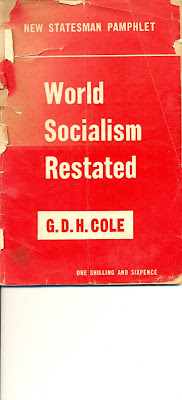
This is a copy of the cover of a well-thumbed pamphlet by GDH Cole which I purchased 52 years ago. It is the subject matter of this review.


I initially posted this item on 24 July, 2006. So the first sentence in the second paragraph is now dated. But as I have just returned from my holidays to find New Labour flat on its back, I thought that it was time (as somebody once said) "to return to basics".


The socialist theorist and activist GDH Cole (1889-1959) had a special relationship with the New Statesman. For 40 years he was a regular contributor of signed and unsigned articles and he died only a few hours after chairing a New Statesman Board Meeting.

Exactly 50 years ago the New Statesman published one of his most telling pamphlets, entitled “World Socialism Restated”. His wife Margaret, who shared their life’s work, correctly pointed out that the pamphlet contains “some of his finest and most sincere writing in the post-war years”.

GDH sets off in style, taking us back a further 50 years to his own conversion to socialism, which followed his reading “News from Nowhere” by William Morris.

He wrote “I became a Socialist because, as soon as the case for a society of equals, set free from the twin evils of riches and poverty, mastership and subjection, was put to me, I knew that to be the only kind of society that could be consistent with human decency and fellowship and that in no other society could I have the right to be content.”

The pamphlet covers three of Cole’s persistent themes, which crop up regularly in his volumes of books and articles.

First, socialists should not themselves subvert socialism by building powerful and uncontrollable bureaucratic structures which destroy the very possibility of social equality and democratic participation for everyone. He directed this point forcefully against both Communists and Social Democrats.

Secondly, any effective moves to go beyond the built-in exploitations of capitalism require the wider labour movement to avoid limited reformist programmes which both dampen the will for change and can easily be subverted by capitalist interests.

Finally, socialists need to operate together on an international canvas to ensure that their project is seen as being incompatible with colonialism, racism and the international power of capitalist investors. The international links being essential if capitalism was ever to be transcended.

There are, of course, areas where his pamphlet is very much a creature of its time.

For instance, he seeks the unity of working class movements; at first within individual nations. So he looks for ways of overcoming the rifts between the (then) Communist and Democratic Socialist Parties in countries such as France and Italy. For despite his consistent criticisms of the bureaucratic tendencies of both, he nevertheless wished the two sides to compromise and co-operate so as to strengthen their efforts to transcend capitalism. He vainly hoped that such acts of comradeship would themselves help to nurture his own egalitarian and democratic preferences.

Today; the fall of Communism, the extension of globalisation, the impact of the technological revolution, post-modern politics and the increasing dominance of ethnic and religious divisions throughout the world have made the quest for democratic tolerance and unity even a tougher task than Cole faced.

But he recognised there is nothing new in socialist and labour movements being obliged to act as countervailing forces in trying to reshape political and economic structures which they have seldom themselves originated. It was part of the history of the British Labour Movement which he had recorded in loving detail.

For us, international financial structures, the United Nations, the European Union (which he opposed), globalisation and electronic communications are all avenues where the fight for democracy and equity should now fruitfully be directed.

Cole’s analysis of third world needs is also seriously dated. He advocates support for self-determination as the single key to the emancipation of colonial territories. But things went wrong after the success of many independence movements.

Yet today national self-determination in leading areas such as Iraq can’t just be seen as a struggle against American and British neo-colonialism. It also requires a struggle against ethnic, religious, political and criminal extremisms; with help for bodies such as Iraqi Trade Unions who are trying to cater for over a million* members in terrible circumstances whilst acting in harmony with Cole’s democratic and social vision.

Even if the plight of the third world now seems even more problematic than in Cole’s time, he would at least have been excited by the possibilities of struggling to make poverty history and campaigning for raising mass revenues for the third world by a tax on currency speculation.

Throughout his life, Cole automatically married together his commitment to adult and university education with his involvement in a world of practical politics which was linked into his writings and theorising.

His pamphlet clearly illustrates this approach. It was published as part of a project to stimulate support for the International Society for Socialist Studies (ISSS) which he presided over.

In this country Kingsley Martin (then editor of the New Statesman), Barbara Castle, Fenner Brockway and a young Stuart Hall had involvements.

Cole hoped that the ISSS would be as influential on the international scene as the Fabian Society (which he had Chaired) had been earlier in furthering ideas for the British Labour Movement - although he clearly wanted the ISSS to operate within the horizons of the Coles rather than those of the “reformist” Webbs.

According to Margaret Cole, the ISSS failed because “the objects of those who joined it were wildly incompatible”. No doubt a similar effort today would hit the same problem.

Yet an international framework in which tolerant, but determined socialists involve themselves in the dialectics of debating and propounding socialist ideas is, to use one of Cole’s favourite phrases still “at the root of the matter”.

Thursday, May 15, 2008

The Turbulent Twins

Tony and Gordon In The Eyes of Capitalism.
Alan Greenspan was the head of the Federal Reserve in America from 1987 to 2006. He was the crown prince of world capitalism. He has written a book entitled "The Age of Turbulence: Adventures in a New World" (Allen Lane 2008).

Below I give an extract from a review of his book by Prem Sikka which appeared in Tribune. His quote from Greenspan's book confirms what democratic socialists knew all along.

"Greenspan was a key player in the expansion of Reaganomics and the rolling back of the state...He praises Thatcherite economic policies and offers his evaluation of former Prime Minister Tony Blair and present Prime Minister Gordon Brown. Referring to a meeting in 1994 he says: "It appeared to me that Brown was the senior person. Blair stayed in the background while Brown did most of the talking about New Labour. Gone were the socialist tenets of postwar Labour leaders...Brown espoused globalisation and free markets and did not seem to be interested in reversing much of what Thatcher had changed in Britain. The fact that he and Blair had arrived at the doorstep of a renowned defender of capitalism (namely, me) solidified my impression"

Wednesday, May 14, 2008

Super Sunday At Sunderland

I saw Sunderland lose 1-0 at home to the Arsenal on Sunday. The last time I saw the equivalent was at the start of the 1957-58 season when Len Shackleton (left)
played his last game for Sunderland in another 1-0 defeat by the Arsenal. I hold a signed copy of the first edition of his autbiography "Clown Prince of Soccer" with its famous chapter entitled "The Average Director's Knowledge Of Football" which he left blank. The cover of the book shown here is from a similarly titled biography of Shackleton by Colin Malam.


All Roads Lead To The Modern Roker Park

With nothing at stake, Sunderland had their largest home crowd of the season for its final game on Sunday against the Arsenal. The turnout of 47,802 was only 553 short of the record for the Stadium of Light. It is a pity the Arsenal hadn't sold all its quota of tickets.

The Sunderland supporters had turned up to celebrate the fact that their team had already established their survival in the Premiership. It was great for them to go to a game where they did not need to bite their fingernails. The only downside was that we lost 1-0, but then they always were "lucky Arsenal".

Annual Pilgrimage

My son, Stephen and I were also making our first and only visit of the season. He travelled up via a direct train from Kings Cross, whilst I was obliged to change at both Doncaster and Newcastle for the shorter journey from Sheffield.

Remarkably, as I made my way along the platform Stephen's train arrived on the next line. I was now very much on home territory as I once worked as a railway clerk at Sunderland station. It was when standing outside the parcels office that I first caught a glimpse of Ann, whom I went on the marry.

First Stop, The Pub

Stephen (who is Steve to everyone but his parents) and I next walked a short distance along Fawcett Street to Yates' for meals and a shared taste in Guinness. Unfortunately, the forecast of sunshine and warm weather hadn't taken account of the mist rolling in from the North Sea. I was a fool for not anticipating this as I lived just down the coast at Easington Colliey for a quarter of a century. Mists were standard there, whilst the sun shone brightly a short distance inland at Easington Village.

Luckily I had a Sunderland scarf and cap in my bag and the protection these provided were more than adequate.

Mackem The Most Of It

After watching some of the Watford-Hull play off on the big screen, we undertook a classical walk. Back down Fawcett Street (I pretended that the town planners had not mucked it up in the 1970s), past where the late and great Len Shackleton ran a modest tobacconist when he packed up football (see above)and then onto the Wear Bridge. Crossing the bridge is still magic. It had to be crossed in the old days to get to Sunderland's former ground at Roker Park. Nowadays it is packed with Mackem's in Red and White striped shirts crossing the the River Wear. It is this which gives Sunderland its name as it is the land which is cut asunder by the river.

It was then off to the Stadium of Light which is just on the other bank, passing the end of the street where Ann once worked for what is now the huge firm of Edward Thompson. Yet she was its first ever full-time secretarial worker.

Into The Light

After a quick pint at the ground, Stephen and I made our way to near the back of the main stand, almost directly overlooking the half-way line. We had a great view. It was,however, somewhat disconcerting when wisps of cloud and seagulls floated past below us. Yet it all added to the atmosphere for "this is Sunderland, this is Sunderland".

At half time we discovered a supporter behind us from Chesterfield whom we had last met at Old Trafford when Sunderland typically lost to Millwall in an FA Cup Semi-Final.

All I will say about the game is that Sunderland played their reserve goalkeeper and dropped Kieran Richardson for bad time-keeping. I suppose that Keane wanted to see if he needed to keep Marton Fulop as cover for keeper Craig Gordon. Along with Jonny Evans the on-loan central defender whom the whole of Sunderland are desperate should be signed from Manchester United, Fulop was a man of the match. A full report for Sunderland fans is given here.

Time To Reflect

When the game was over I dashed as fast as my walking stick would take me for the Metro to start my journey home via Newcastle, where the Arsenal fans would speculate on what a local Derby with the Geordie's must be like. Like nothing on earth!

I left Stephen heading for the Club shop as he had time to spare before returning home, non-stop to Kings Cross. Luckily for me, I had a copy of the fine fanzine "A Love Supreme" to read on the Newcastle to Doncaster leg of my return home. I particularly enjoyed the "Review of the Season", then a well assessed section on who should stay at the club and who should go, plus a piece stressing the need to find a top line and authoritative club captain - a Keane on the park. I hope that the Keane on the touch-line takes these items to heart.

Keen On Keane

I then moved on to study the 80 page Sunderland programme and was soon into calculating. In the first half of the season we gained only 14 points from 19 games. The equivalent in the second half of the season gave us 25 points. The first half of the season spelt early relegation. The second half of the season spelt solid mid-table. A main difference was the arrivals of Phil Bardsley, Andy Reid and on-loan Jonny Evans.

There is another astonishing statistic. We lost all ten games against the top five teams in the League, scoring only 3 goals against them and conceding 25. Only Derby County equalled this miserable record. But it means that against the remaining 14 teams we held our own - winning 11, drawing 6 and losing 11; with 33 goals in our favour and 34 against.

Our problem against the top teams is that we have invariably played against them with a loan striker, hence our only goals in these games have been one in a 7-1 drubbing by Everton and two in a unique second half revival at the Arsenal when we lost 3-2. Perhaps there is a further tactical lesson here for Keane.

But we dare not complain too much in case he takes the huff and leaves us. For he has filled the ground again with an average Premiership crowd of 43,344 (the 4th highest) compared to 33,904 (10th) in our previous Premiership season of 2005-6. Although some of us see facilitator Neil Quinn as the quiet power behind the throne - as they say "Quinness Is Good For You".

Roll on next season's pilgrimage.

Tuesday, May 13, 2008

Meeting Maliki In Baghdad

Dave Anderson MP, Joint President of "Labour Friends of Iraq" (LFIQ) and its Director Gary Kent were part of a small delegation which have just returned from Iraq after meeting with Prime Minister Maliki and others in Baghdad. The case for Trade Union Rights in Iraq was high on their agenda. As Vice-President of LFIQ I will keep readers posted on the feed-back. Here is an initial report.

Monday, May 12, 2008

Bob Pele


Here is a reply to this comment from Bob Piper. On the left is the model for the "Bob Piper T-shirt". The source is that fine fanzine "A Love Supreme"

Saturday, May 10, 2008

E I Addio

I don't know what Alec Ferguson would have made of it, but in the two months between 8th March and the 8th of May, Sheffield FC played a total of 22 League, Play-Off, Cup and Friendly games. The pressure took its toll last Saturday, when they missed out on promotion to the Unibond Premier League. But they bounced back in their final game on Thursday to win the Sheffield and Hallamshire Senior Cup against Worksop Town at Hillsborough.

It was a great festive evening for Sheffield FC fans. On a fine and warm evening, the 583 spectators were quite reasonably confined to the main South Stand. Janet, Dave and I had fine seats at a great vantage point near the back of the stand.

As the game started it looked as if we were in for the same treatment we had seen when our team lost in the play-off final at Nantwich. Worksop dominated initially and at that stage our star players were our goalkeeper James Holmshaw and the woodwork. But after the first quarter of an hour the tide turned completely. Worksop never got back into the game except for a 5 minute spell at the start of the second half. I was soon able to shout at the three empty sides of the ground "its all gone quite over there!"

Striker Rob Ward was again drafted into central defence and was as solid as a rock. Matt Lowton was in his element in the mid-field ensuring that we were normally on the attack. Smudge (Paul Smith) ploughed forward from the left back position, whilst Jon Boulter acting as a central defender moved across to cover for him.

Gavin Smith our right-back and acting captain was more cautious, yet he was the one who struck from the edge of the six yard box in both the 27th and 69th minutes to clinch the match 2-0.

Worksop Town are in the League we had been seeking promotion to. To be in control of a game against them indicated that we would not have disgraced the Unibond Premier League if we had succeeded in moving up from Step 4 to Step 3 of the Non-League Pyramid. Our performances in this and other cup games we have undertaken against Unibond Premiership teams give us high hopes of being able to grasp promotion next season and then to hold our own at that higher level.

This season has been impressive. Promoted from Step 5 we made the fourth spot in the League, had good cup runs, won the above Senior Cup, had a fine set of 150th Anniversary Celebrations including games at Bramall Lane against Inter Milan and Ajak with respective crowds of 18,471 and 5,173 whilst signing up Pele and a host of other high profile football figures as members - not least Bob Piper.

Sheffield Wednesday did a fine job for us at Hillsborough. Not only did I obtain my fine seat at the £3 concessionary rate, but we were all given free programmes as we entered the ground. It didn't, therefore, matter that much that the pre-match and half-time pints were at League Club prices. Besides Janet, Dave and I made our way back to the Dronfield Contact Club afterwards to celebrate. It has the advantage of cheaper prices for drink, continuing good company and it hosts many of our local Labour Party activities. What more could you ask for - apart from promotion.

For other reports of the game see here and here.

Friday, May 09, 2008

Trade Unionists Arrested For May Day

Wellington Chibebe (opposite) and Lovemore Matombo (see this video) are respectively General Secretary and President of the Zimbabwe Congress of Trade Unions. They have been detained in Harare for exercising their rights to make May Day Speeches.


Here is the letter of protest to Zimbabwe's Ambassador from our TUC, dated 9 May.

"Dear Ambassador

Detention of Trade Unionists

On behalf of the TUC General Council, I write to express our deep concern over the detention of the leaders of the Zimbabwe Congress of Trade Unions (ZCTU) on 8 May 2008 in Harare.

Our information is that Mr Wellington Chibebe, General Secretary of ZCTU and Mr Lovemore Matombo, President, were both detained at the Harare Central Police Station in connection with the speeches made by them on May Day. We have also learnt that they have been charged with inciting people to rise against the government and spreading falsehoods about the current political crisis in your country.

The detention of trade unionists for organizing activities relating to the exercise of their legitimate rights constitutes a gross violation of the ILO Declaration of Fundamental Principles and Rights at Work. Moreover, your country, which ratified Convention 98(1998) and Convention 87 (2003), is obliged to observe the workers' rights enshrined in them. This incident will, no doubt, tarnish the image of your country and further aggravate the current problems, making national dialogue and reconciliation even more difficult.

We urge you to pass on our deep concern over the safety of the colleagues to your Government, use your influence with the authorities to secure their immediate release and ensure that all Zimbabweans are allowed to exercise their democratic rights without interference from the State.

Yours sincerely
Brendan Barber
General Secretary"

Thursday, May 08, 2008

Who Will Be Obama's Running Mate?

Here is Eric Lee's strong recommendation (trawl down to 7 May) for John Edwards (left) and how you can support it. He states -

"John Edwards set the agenda for all the candidates in the early stages of the primary battles. He came up with the first and best comprehensive health care plan. He raised the issue of poverty as no leading politician has done for 40 years. His charisma, his abilities and his appeal to those voters Obama must win in November are beyond dispute."

See also here.

Wednesday, May 07, 2008

Whose Side Are You On In Iraq?

Whose side are you on in Iraq? Try Madeeha Hasan Odhaib (opposite). The following is from Time Magazine on the 100 most influential people in the world.

Madeeha Hasan Odhaib
By Queen Rania


"It's not every day that success stories echo out of Iraq into the halls of power, but Madeeha Hasan Odhaib defies the norm. Armed with her sewing machine, unflinching stoicism and determination, Madeeha, 37, is mending the fabric of Iraq.

Four years ago, this mother of two and seamstress turned district council member took three sewing machines, leveraged them into 60 and built a business sewing hospital sheets and flags. She now employs 100 women. That figure may seem insignificant compared with the accomplishments of other achievers on TIME's list. But in a country with more than 60% unemployment and rampant poverty, such efforts provide a lifeline. Each woman Madeeha employs returns home with an invaluable sense of self-respect, money in her purse, food for her children and optimism for a daughter desperately seeking a role model amid mayhem. Madeeha also treads—or, rather, threads—the line between activism and heroism. She has coordinated with the Red Crescent, Red Cross, Hands of Mercy and Iraqi army to distribute food around Baghdad. And despite threats, she says she'll never give up.

Iraq is suffering one of the worst humanitarian crises we have ever seen. While Madeeha rightly makes Time's list, women like her are found throughout Iraq, sewing hope one stitch at a time. Through Madeeha, we celebrate all of Iraq's courageous women, whose resilience and resourcefulness hold the promise of a new dawn."

Queen Rania of Jordan is a champion of women's rights in the Middle East

Hat Tip - Treasure of Baghdad

Tuesday, May 06, 2008

Bewitched By Nantwich

This is the Weaver Stadium, home of Nantwich Town FC.


Sheffield Of Derbyshire

On Saturday I had a fine day at Nantwich near Crewe. Although I was with fellow Labour Party activists Janet and Dave, we did not go to canvas for the Bye-election which has arisen because of the sad death of Gwyneth Dunwoody. We went to a football match instead. Our local team is the "Derbyshire-based, Sheffield FC", who were in a play-off with Nantwich Town to see who would be promoted to the Unibond Premier League.

Non-League Millionaires

Nantwich have an impressive new ground, which they moved to at the start of the season. It cost £4 million. They were assisted by a grant of over a million from the Football Foundation and sold their old ground for a housing development. I assume that Barratt's were the purchasers as they now sponsor Nantwich Town.

The ground is fronted by a huge car park, has a stand which seats some 400 and has all sorts of impressive mod-cons. The crowd of 1,342 was a record for the season. Although their post-war record is 1,536 last season when they were visited by the well-supported FC United of Manchester.

After travelling to Nantwich on a pleasant sunny day through captivating Derbyshire and Cheshire countryside, we had a pleasant pub-lunch and saw a chunk of the Manchester United - West Ham game on a large screen.

A One-Sided Draw

At the Nantwich ground in the blazing sun and with a refreshing breeze, we found a vantage point opposite one of the penalty spots. Unfortunately, much of the game was dominated by the home team. I gave my excuses to the locals. This was our 20th game in 8 weeks and some of our key players were out through injury. So it was no surprise when Nantwich took the lead just after the half-hour. Yet when we moved into first-half added time, Smudge (Paul Smith) produced one of his magical free-kicks to put us on level-terms. A pile of home supporters had by then made it into the club-bar, ensuring that the rest of us would be left outside. So Smudges curler was poetic justice.

Nantwich's continued domination put them back in the lead after 71 Minutes. But thanks to heroic work by both our goalkeeper (Jamie Holmshaw) and the woodwork, our hopes were still alive when 5 minutes added-time was announced after the 90 Minutes. Robert Ward our normal striker, had been drafted into central defence due to our injury crisis. He had played a solid game. But with the announcement that the game was approaching closure, he threw caution to the wind and rushed up the field and headed an equaliser. That put us into extra-time.

Paying The Penalty

Nantwich's spirits at last dipped and Sheffield did more attacking in extra-time than in the rest of the game put together. But an unlikely victory wasn't to be ours. It was 2-2 after extra-time and we were into the penalty shoot out, which occurred from the penalty spot opposite us. Yet the result had an inevitability about it. In cup games this season Nantwich had already won 3 penalty shoot outs. They now added their fourth, winning 4-1 from the spot.

So whilst the home supporters stayed behind to celebrate, we made an early break for the car-park. All the apprehension had been thirsty work so we stopped off for a pub-break. Now we watched most of the second-half of Bolton against my team Sunderland on the big screen, with the Mackem's losing 2-0.

Things Can Only Get Better

But the beauty of football is that it can always be better next time. So I am lined up for a visit to Hillsborough on Thursday when Sheffield FC play Worksop Town in a cup final. Then its on to the Stadium of Light next Sunday to see Sunderland change its fate against a top team. So far this season we have lost all the 9 games we have played against the top 5 teams. The 10th match is against the Arsenal. Smudge, Ward, Holmshaw and the woodwork have shown that anything is possible outside of a penalty shoot-out.

Added Here is a link to a report with photos. If you then click onto the photo of the penalty to bring up its large version and trawl to the right, then from right to left the last three people are Janet, Dave and me - honest.

Monday, May 05, 2008

A Thought On May Day

Given his interest in the Workers' Party of Ireland, this is mainly for Johnny Guitar. It is from the Northern People of 3/2/1989. Sorry it is cut short. In full it said -

"Mr. Harry Barnes, Labour MP for North Derbyshire gave a full and frank analysis of "Thatcherism" and how it could be combated. Mr. Barnes received resounding applause when he said that "megaphone marxism" was not the way to defeat the Tories nor could it build a conscious working class. Dealing with the everday needs of the people was, he said what the Labour Party were about"

Mind this was said well before the days of Blair and Brown. Of course, I am no longer an MP and it used to be North EAST Derbyshire I represented. This was on my first visit ever to the Island of Ireland. I was then fully involved with its politics for the next 16 years before I retired. Iraq now seems to have taken its place in my priorities.

Sunday, May 04, 2008

May Day In Baghdad

I am always amazed by the complexities of life and activity in Baghdad. We can now give a new meaning to the notion of its "Red Zone". Link here to over 50 photographs of the People's Flag in Baghdad on May Day (including the one above).

The Iraqi Communist Party celebrated May Day with a rally in Firdos Square in central Baghdad, followed by a march to the headquarters of the party. The rally and march were attended by leaders of the party, including the Secretary of its Central Committee, Comrade Hameed Majid Mousa. Thousands of trade unionists, members of democratic organisations and other people participated, carrying banners greeting the Iraqi working class on International Workers' Day.

Hat Tip - General Federation of Iraqi Workers

Friday, May 02, 2008

Out For The Count

It has taken almost 5 weeks for the Electoral Commission in Zimbabwe to declare the results of their Presidential Elections. As there is now to be a run off between Tsvangirai granted 47.9% and Mugabe given 43.2%, how long will it take for this next vote to be announced? It will, of course, depend on who wins, or whom the Electoral Commission dare declare has won.