Showing posts with label Iraq. Show all posts

Wednesday, January 15, 2020

Labour and Life Long Learning

   In a speech to the Association of Colleges on 14 November 2017 Jeremy Corbyn said "Just as Nye Bevan created the National Health Service in the aftermath of World War 2, the next Labour Government will create a National Education Service. We will offer cradle to the grave education that is free at the point of use."  This was a huge and massively important commitment which Labour now needs to retain and develop for the future. When achieved it will help to transform and improve our society massively. Providing us with a seriously minded society (yet one that is more happy and fulfilled) and which uses its developing understandings to ensure that our political system will be fully democratized and meet the needs and requirements of masses in our society who are currently in depressed and deprived circumstances.
   The establishment of an appropriate system of Lifelong Learning will, however, be much more complex than setting up the NHS was. For generally a person (or their relatives and friends) will be aware whether they are in need of help from a doctor, ambulance or hospital services. Determining when someone is in need of forms of adult learning facilities (and whom they should approach) will require a more complex range of life-time openings.
   The Labour Party Manifesto at the recent General Election included a section which briefly spelt out Labour's intended direction of travel on the matter of Lifelong Learning. See the items entitled "Further Education and Lifelong Learning" which appear on pages 40 and 41, click here.

   Unfortunately, this was not an issue which was able to obtain much coverage during the General Election period itself. This was partly due to failings by the media, but it also arose from the fact that Labour's own work in shaping its approach was only reaching fruition when the election was on top of us.

 Image result for Labour Party Lifelong Learning Commission
   A "Lifelong Learning Commission" co-chaired by Estelle Morris and Dave Ward only issued its Interim Report in July 2019. It was then only able to come up with its final 85 page report containing more detailed  recommendations as we moved into the dissolution of parliament for electoral purposes in November. Click here.   A summary of its 16 major recommendations appear on pages 58 and 59 of the report.

I will now confine myself to what has been my own specific interests in forms of adult learning, which is just the tip of the iceberg.
 
  My own commitment towards forms of lifelong learning developed after some of my early failures via school education and from later experiences starting from the time when I undertook my National Service as an 18 to 20 year old. My involvement with forms of lifelong learning being mainly restricted to the areas of politics, economics, industrial relations and philosophy. Labour's proposals go well beyond these matters. But I will now restrict myself to my own experiences.
  As an only child, I came from a solid coal mining background. My father and his five brothers all came to work at the same local pit and his only sister married a local miner. Only my Uncle Arthur finally moved away and joined the RAF. My mother's two brothers also started work in the pit, one then moving  into nursing. My mother and one of her three sisters also married coal miners. This meant that I had the advantage of being brought up in a tightly mining environment with close social bonds.
  But my shortcomings at Primary School were centered around extreme shyness and a serious inability at spelling. So I failed the then 11 plus exam and went to a Secondary Modern School and not a Grammar School. Then I had never read a book from cover to cover until at 12 a teacher took our class into the school library and made us borrow and read a book. I read John Buchan's "Mr Standfast" and was hooked. I later made it to Grammar School via an "occasional admissions" exam. But I was no success there when it came to the "O level" exams at 16, failing the key subjects of English Language and Maths. But in a post war period shaped by the Attlee Government there were lifelong job opportunities and I made it as a Railway Clerk. By then I was regularly into purchasing books such as H.G. Well's "Short History of the World" and visiting the local library, where my mother also borrowed serious novels.
   A key step in my own form of lifelong learning started when I undertook my National Service via an RAF Movements Unit at Basra, linking in with Iraqi State Railways. I was shocked by the harsh living and working conditions I saw many Iraqi people experiencing
   Then there was a book shop I visited in Basra which sold Rational Press Association books which challenged what had been my Methodist background. There were other books to buy and I also ordered works by writers such as G.B. Shaw, GDH Cole, James Joyce (recommended by a corporal), a volume of Shakespeare's plays and Tolstoy's "War and Peace".
   The man who ran the shop said that he had been stopped from my ordering Karl Marx's "Das Capital" when he checked the matter out with the local chief of police. But I also obtained the "New Statesman" weekly on rice paper, plus "Reynolds News" and the "Observer" which came by sea and were then two weeks old.
   I was finally demobbed at 20 in the midst of political turmoil around the British invasion of the Suez Canal and the Russian invasion of Hungary. It was a politically stimulating period. My initial avenue for expressing my developing political views were letters to the local press. Then a year after my demob I joined a body stimulated by GDH Cole called the International Society for Socialist Studies and even heard him addressed them. I also joined the Labour Party and after a few months became a local branch secretary and arranged for the meetings to rush through business each second month and then have a speaker and a discussion. A local Fabian Society was then founded at near bye Peterlee and I became their Secretary. I was into the dialectics of political debate.
   I then attended a Fabian Summer School held at Ruskin College in Oxford where I discovered that the College itself was for people like me, who had an interest in subjects such as Politics and Economics but no relevant "A" level qualifications as a pathway into such studies. I later made it into Ruskin College via references (one from Manny Shinwell my MP), writing an essay for them and attending an interview. My fees and living allowance being met by the Durham County Council. After 2 years full-time study, this led me to obtain an Oxford University Diploma in Economics and Political Science which enabled me to get a place at Hull University where I gained a degree in Politics and Philosophy.
    But that was only a leg up to my fuller involvement with Lifelong Learning. For from 1966 to 1987 I was a tutor in the Sheffield University Extramural Department (later called the Division of Continuing Education) taking Day Release Classes for Trade Unionists from areas such as the Coal, Steel and Railway industries plus classes for shop stewards. I mainly taught Politics, Industrial Relations and Student Skills. Numbers of my students also moved on to full time study at Adult Education Colleges, including Ruskin. Others became more fully involved in their Trade Unions and in areas such as Local Government.


        1983 Derbyshire Miners Day-Release Class

   Then my Department established an Access Course mainly providing openings into Sheffield University for adults without formal qualifications. I taught classes on Philosophy and then acted as Course Director. Those who successfully made it to full-time University Studies at Sheffield via our classes ended up generally with above average degree results.
   Then when I became an MP in 1987 three of my fellow Labour colleagues were former Yorkshire Miners whom I had taught on Industrial Day Release Classes and another Labour MP from that background had been a fellow student with me when I was at Ruskin. Dennis Skinner had also attended our Derbyshire Miners classes, then Ruskin. He was a day release student with us the year I arrived in Sheffield, but I was then teaching a different Derbyshire Miners Class.
   Although I studied and taught politics for 21 years before becoming an MP and then took many classes down to parliament on day trips, my parliamentary activity was also a huge learning curve. Not only was the range of parliamentary activity widespread, but constituents came forward with a complex range of problems which needed to be tackled. Luckily I soon learnt that if an issue was new to me, the first place of call to find out about a topic was the research staff in the Commons Library. For Conservative Government Ministers (at the best) would only answer the specific questions I asked them. Whilst a researcher would know that I was new to a topic and would explain what I really needed to know and pursue. The loss of their services are the main thing I have missed since retiring from the Commons in 2005.
  As an MP lifelong leaning was an issue I pursued, but circumstances dictated that this had to be in a  defensive capacity. Thatcherism struck at the work of Adult Education Colleges such as Ruskin and also ended payments of student fees. Next even Tony Blair (with my full opposition) removed University allowances for students for living purposes, thus adding further to their borrowing costs. These matters still need to be tackled.
   When I finally retired from parliament in 2005 I returned to an old habit of setting up monthly discussion meetings. This time as Political Education Officer for my local branch of the Labour Party in Dronfield where I have now lived for 50 years. I only passed on that commitment last year, but I still keenly participate in the group's discussions. In fact this item on Lifelong Learning arises because Bob Heath a former Sheffield University Extramural colleague of mine (whom I initially studied with at Ruskin College and then Hull University) discussed this very issue with us at our last meeting. Click here.   John Halstead who involves himself in both ILP activities and our local discussion group, being a further colleague from my Extramural days. He works closely with the Society for the Study of Labour History.  
   Then three other sources feed my attempts at my own form of continuing adult learning. First, I continue to read works in my areas of interest. Having found hardly any scope for fiction since I first turned up at Ruskin in 1960. Secondly, I scan the Internet for serious forms of information relevant to my interests - whilst seeking to avoid those comment boxes where people just fart at each other about politics. Then also there is the ILP.  Under the influence of Keir Hardie it was founded in 1893 and helped shape the Labour Party. But in experiencing a departure by Labour from its basic values, it set out on its own in 1932. It finally returned to the fold in 1975 changing its name to Independent Labour Publications. I then joined and participated with them in a wide range of Labour movement discourse.  

  Whilst I am for the forms of adult learning which I have stressed, Labour's recent publication correctly goes way beyond these matters, showing the wide number of areas where varying forms of Life Long Learning are very deeply needed. The whole issue should not just be an add on to Labour Policy, but needs to be at its heart.     


Tuesday, November 05, 2019

63 Years Ago Today At RAF Habbaniya in Iraq


Habbaniya
The photo shows what was its HQ.
On 5th November 1956 Britain and France invaded Egypt in what became known as the Suez Crisis. The Iraqi Government then had Nuri al-Said as Prime Minister and were under British influence having signed the Baghdad Pact in 1955. Immediately riots broke out against the Suez invasion in areas such as Baghdad, Basra, Mosul, Najaf, Kafu and Hilla. These could be seen as triggers which eventually led to the Iraqi Revolution of 1958 under Qasim.

At the time of the outbreak of the unrest I was in Iraq. I had undertaken the bulk of my National Service in the Royal Air Force at a Movements Unit in Basra. But as I was due to be demobbed I had been moved to the RAF camp at Habbaniya to await a plane to take me back to Britain. So I did not directly experience the unrest, being stuck in the camp.

But on 5th November a flight in front of mine set of from Habbaniya to Cyprus on the first leg of its journey back to Britain. But as it was approaching a fighter base in Syria permission was withdrawn for it to fly over that country. So it had to double back to Habbaniya.

Whilst having a meal in Habbaniya I listened to the BBC News over the loud speakers telling us that there were no British troops in Iraq ! Plans were then made, however, for RAF flights to and from Iraq to be made via Ankara in Turkey. And I was given a place on the first of these. Although we were intercepted by Turkish fighters who made signs to us that we would be shot down if we did not return to Iraq. Luckily they must have received radio information confirming that we had permission to proceed, as they then flew away.

As reservists who had completed their National Service were at the time being called up to help with the fight in Eqypt, I was worried that I would not be demobbed and be caught up in the conflict. But I only had clerical experience working with Iraqi State Railways and Shipping lines. Pen pushers such as myself (filling out Arabic forms in English) were not what the invasion needed.

Unfortunately, my life was then taken over by my being demobbed and returning home to my previous job as a railway clerk. So I never discovered exactly what turmoil faced my former RAF colleagues at Basra. I had served there for 20 months and had never experienced any problems whatsoever from the local community; yet I moved almost daily around areas such as its railway station, good yards, docks and the Basra town centre. Then Iraqis worked as clerks and labourers on our camp. But this peace and tranquility are likely to have changed a great deal after 5 November. I had avoided any problems by the skin of my teeth.

For what was happening in Iraq at the above time, the following is a useful source – pages 115 to 117 of “Iraq” by Adeed Dawisha, Princeton University Press. I refer to the first paperback version published in 2009.

It was, however, my experiences in Iraq and the Suez Crisis which drew me into subsequent political activity. I have since attempted to make up for my failure to reconnect with RAF Basra personnel at the time of my demob and now hold a proud certificate of honorary membership of the Iraqi Federation of Trade Unions – who surfaced in 2003. 

For more on Iraq follow the link below 

Thursday, December 10, 2015

(Iraq 3) : No Guide For UK Forces In Iraq 1955/6

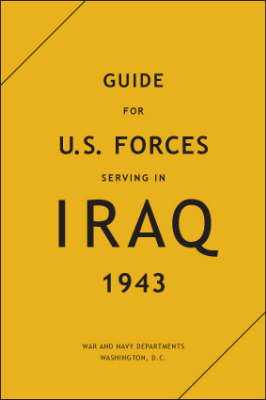
Guide for U.S. Forces Serving in Iraq, 1943 (Hardback)

When American troops moved into Iraq in 1943 to help to pursue their Second World War objectives, they were issued with a booklet which they could slip into their light summer-style tunics. It gave them some details about Iraq, its local customs and how to respond in a friendly and understanding way to the local population. It gave hints on Arabic translations and about the pronunciation of some 400 local words and phrases. Information was supplied about the local currency, weights and measures and about climatic and health problems. Care was taken so that the troops would not cause  offence to Muslims, especially about their religious practices and about the role of females within their culture.

A copy of the booklet was re-published in 2008 with a preface added to explain its purpose and  nature. The 2008 version can be obtained cheaply via this link.

Whilst a close examination of the document might produce criticisms and suggest shortcomings,  I would have found it invaluable to have been presented with an equivalent British document when I arrived in Basra in 1955 at what was my permanent RAF posting for the period of my National Service. But I never received any form of document to explain where I was, nor why, nor how to behave.  Neither were we ever given any verbal explanations about the equivalent matters covered by the United States' War and Navy Department's document. There was, for instance, no form of educational service at our small Movements Unit.

Beyond knowing that the local currency was Dinars and Fils and my being able to follow Arabic numerals and pick up some Arabic swear words from my fellow troops, I never learnt any Arabic. The Iraqis on our camp tended to talk English. This was whether they worked with us in our offices, drove us by boat on the Shat-el-Arab river to the docks in Basra, washed and ironed our clothing, emptied barges and transferred goods to railway containers, drove taxis into Basra town centre or served in shops and night clubs. At least they shared sufficient English for us to get by. When I regularly rang up a Basra railway official to book seats for troops on the train, I would say his name "Abdul Sarhib ?".  He would start to answer me in Arabic, then quickly realise that my accent did not fit and turn to English saying "Hello RTO", which was my RAF designation as a Rail Transport Official. My job included filling out Passenger Rail Forms and also forms for the transhipment of goods. These forms were in Arabic, but I merely knew what went into each box and I filled in these in English. I had little incentive to learn Arabic in order to get by.

Yet there were aspects of life generally on religion and politics which I was keen to examine. I wanted to test out and examine my preconceptions in these areas. But I never picked up on the tensions in Iraqi politics which existed round about me at that time. Life just appeared to me to be harsh (but tranquil) for the people living round about me. It was a misunderstanding that came from mainly being tucked away in an RAF camp which had its own separate form of existence.

I came almost weekly to make use of an English Book Shop in Basra Town Centre, which was run by someone who originated from India. I ordered the "New Statesman" whose air mail edition came out weekly on rice paper. I also ordered "The Observer" and "Reynolds News" which both came by sea and could be up to three weeks old before I read them. I was into reading plays having earlier been a regular theatre attender at the Theatre Royal in Newcastle. So I ordered copies of the complete plays of both Shakespeare and George Bernard Shaw. I was also into reading Shaw on politics. Then Corporal Murphy and I used to debate religion, as I started out as a Methodist and he had been a Catholic who had become an atheist. Although I initially attended the Anglican Church in Basra, I too eventually became on atheist. My developing concerns about religion may have been pushed along by the fact that my bookseller had a good selection of books for sale by the Rationalist Press Association.  The local Anglican Vicar even preached a sermon against these, which only made them even more interesting for me.  Corporal Murphy also got me into ordering and reading books by James Joyce.

But I only picked up bits and pieces about Iraq and its past. And this was mainly ancient history, in works such as "Ur of the Chaldees : A Record of Seven Years Excavation" (Pelican 1954). Although this is a book which I might only have turned to on my return home.

During my time in Iraq, the major political events I was aware about which effected developments were (a) the signing of a Treaty known as the Baghdad Pact in 1955 and (b) the impact of the Suez Invasion as it reverberated in Iraq. But the latter only happened as I was moving to be flown out of Iraq at the end my National Service. So matters only touched my radar at the end of my time in the country - although this was to be in a big way. The Baghdad Pact also then took on more significance for me than it had at the time of its adoption.

Within less than two years of my leaving Iraq, there was a massive and dramatic change of regime. By then, I was aware that there were some things I had missed about developments in Iraq during my period of National Service.

I will try to fill in some of the gaps in my 1955/6 understanding in my next item on Iraq. I just wish I had known more about such things at the time. An equivalent to the booklet issued to the war-time American troops would have helped.

Thursday, November 19, 2015

(Iraq 2) : From Easington Colliery to Basra.


The area of Easington Colliery where I lived before I was sent to Basra in Iraq to undertake my National Service.

I was brought up at Easington Colliery on the east coast of County Durham. Before I was called up to undertake my National Service in the RAF in November 1954, I had never travelled any further south than York. That journey had been made two years earlier, when I had applied to be a railway clerk after leaving school. I then had to travel to the railway head office at York for an interview. It landed me a job which I then undertook covering passenger and parcels office work, mainly at Easington's neighbouring railway station which was at Horden Colliery. But it was a job that was to have bigger implications for my travels than I ever anticipated.

When I undertook my basic training in the RAF at West Kirby, I was interviewed by a Sergeant to help determine what form of work I should seek to undertake in the RAF. As I had been a railway clerk, he suggested that a position in a "Movement's Unit" might be appropriate. He pointed out that there was a large unit of this type at Hull.  I felt that would be ideal for me to be able travel home regularly. So that became my first and accepted option.

But amongst our Squadron at West Kirby where I did my basic training, I was the only person to then be sent straight overseas. For it was felt that I did not require any training for my post.  I could work and learn under a corporal who already was undertaking the tasks I needed to follow. These involved working closely with Iraqi State Railways in Basra.  RAF equipment and goods arrived at the port at Basra to then be sent by rail to Baghdad, from where they were collected by personnel from RAF Habbaniya to then be taken to their camp by road some 55 miles away. There were also regular (but limited numbers) of troop movements of those travelling by rail to and from Baghdad, which had to be catered for.  In English, I filled in arabic passenger forms and goods' notes. But no-one ever taught me any arabic. I just learnt what to put where, in English. The best I did was to understand arabic numerals. All the Iraqis I dealt with spoke English - including those who worked at our Movement's Unit which was situated on the banks of the Shat-el-Arab river. This included many Iraqis who undertook manual functions.


I regularly visited Basra railway station, its docks and its goods yards. Then when our Movement's Unit downsized, I also took up some similar clerical and organisation work with shipping companies, handling "Bills of Lading" relating to shipping merchandise.

Not only did the RAF fail to facilitate (or even encourage) us to learn arabic; no-one ever explained why it was that we were in Iraq. Furthermore, we were just a small movements unit with many of us being only 18 to 20 as we were undertaking our National Service. I shared areas of accommodation with those up to the rank of corporal and we socialised. But those in higher ranks lived a separate existence. Even our cricket team only contained two sergeants (which may, however, have been a fair proportion), the rest being entirely from lower ranks - including myself as the scorer and standby.  No one I ever came across used their holiday breaks to visit historical sites such as the Ziggurat of Ur, which was less than 100 miles away - although officers might well have done this unknown to us. But we only communicated with high ups in relation to our duties. Nor was information made available to tell us that Iraq covered land which had been the cradle of civilisation. Neither was there today's modern technology to click into, which can be used as a form of self-education. It was not for us to ask where we were, nor what we were doing there.

Yet my time in Iraq helped to transform my life. When I left Britain, I initially had a six day stay in the canal zone in Egypt,  I then boarded a flight to Habbaniya; via Jordon where we landed late at night and saw little but a landing strip, desert and the inside of a large reception tent.  At Habbaniya, I stayed for a period to undertake a weapons' course run by the  RAF Regiment. This gave me time to spend a weekend at the YMCA in Baghdad, travelling via Fallujah. Then when I finally travelled by rail from Baghdad to Basra, the train was delayed as we were due to pull out of the south of the Iraqi capital. I was looking out of the window at a scene which seemed to me to be from an ancient world. Everything was made out of mud. Mud houses, mud walls, mud walkways, open sewers cut into the baked mud, with a drinking well close by. Men and women were neatly and cleanly dressed in the Muslim tradition, with children playing beside them. But this was a world I had never glimpsed nor thought about before in a modern context. It came to have a huge impact upon me.

Mud houses in Iraq

Later in the dock area in Basra, I observed heavily exploited labour at work. For instance, men were bent double carrying what were huge (and now old-fashioned) commercial refrigerators on their backs. Manual labour still often being a substitute for the technology of that age.

A double question began to pray upon my mind. How could God and man allow such things to happen? Matters of a philosphical and political bent were emerging for a thinly educated young man. These would help to reshape my values, self-studies and key interests. But life at the Movements Unit with regular weekly trips into Basra town centre, gave me the false impression that Iraq was a place of peace and tranquility. The first seven sections in the previous item on this blog (click here) cover a brief military history of Britain's involvement in the area over the 41 years before I arrived in Iraq. When I now reflect that it is 60 years since I arrived in Basra; the preceding period of 41 years seems to be a relatively limited time span. Many of the Iraqis I met and passed had lived through those years of military conflict and imperial domination. Unknown to me, these were experiences that had not gone away from their minds.

The only hint that some problems existed was when I attempted to order a copy of Marx's "Das Capital" from an English bookshop in Basra. The proprietor who originated from India, later felt the need to check matters out with the local Chief of Police. He was not allowed to order a copy. I only learnt much later that the Iraqi regime had been in a period of conflict with its own home grown Communists - see Hanna Batatu's "The Old Social Classes and the Revolutionary Movements of Iraq" (Princeton University Press, 1978 and here).


Friday, November 06, 2015

(Iraq 1) : Britain's Military Heritage In Iraq - Started 101 Years Ago Today

1. 101 years ago today and just three and a half months after the start of the First World War, Britain invaded Mesopotamia. British troops (who were mainly from India) captured the old fort at Fao (al-Faw) which then formed part of the Ottoman Empire. Fao is located at the south of what is now Iraq. It is where the Shatt-al-Arab river flows into the Persian Gulf. The Shatt-al-Arab itself starts at a point where two other main rivers flow into each other. These are the Tigris and Euphrates. They both commence in what is now Turkey, with the Euphrates then cutting fully across a significant section of Syria.

The photograph below is of British troops in Mesopotamia during the subsequent campaign.

2. Mesopotamia is seen as the cradle of civilization. It was where the Garden of Eden is believed to have been. The story of Noah and the flood fits in with an ancient Sumerian legend about an old man who survived 40 days and nights in an ark. Its main rivers produced rich fertile soil and a supply of water for irrigation. The civilizations that emerged around these rivers being amongst the earliest known non-nomadic agrarian societies. In terms of written history alone, Mesopotamia goes back to 3100 BC. It has a rich cultural heritage. But numbers of its ancient sites are now being destroyed by ISIS.  Way back it was part of the Assyrian and Babylonian empires: with later periods in which (amongst many others) Alexander the Great, the Romans and the Persian Empire had a presence.

3. Britain embarked upon its invasion at Fao soon after the start of the First World War, because the Ottoman Empire (which then dominated much of Mesopotamia) had recently signed a treaty with Germany. There was a particular worry about the danger to Britain's oil supplies in neighbouring Persia, especially in relation to the Anglo Persian Oil Company.

4. A long and bitter struggle then took place. But when British troops captured Baghdad in 1917, the Ottoman Empire collapsed. Britain then moved to unite and control what became the basis of modern Iraq in the vilayets of Mosul, Baghdad and Basra. In 1919, however, it faced insurrections from the indigenous population who were far from keen about the prospect of having a fresh foreign imperial power emerging over them.

5. In 1920, however, Britain obtained a League of Nation Mandate to enable it to continue to play a major role in the development of Iraq. Following further unrest, Britain manoeuvred to create a situation in which a sympathetic regime under King Faisal was accepted in a carefully calibrated plebiscite, with a 96% endorsement.

Here is a link to a fine book which covers the above period. Note the comments about its considerable strengths.


6. Iraq operated under the British Mandate until 1932 when nominally it became independent. But before it gained its formal Independence, the United Kingdom achieved the Anglo-Iraq Treaty of 1930. This included permission to establish air bases for British use at Habbaniya and Shiaba, as British Crown territory. It was a situation that added to discontent amongst wide elements of the Iraqi population.

7. In April 1941 during the Second World War, there was a coup d'etat in Iraq when Rashid Ali ceased power and asked Germany for military assistance in the event of war with the British. Britain then sent troops into Iraq to topple the new regime and remained in effective control of the country until 1947 with a new Anglo-Iraqi Treaty being signed in Portsmouth the following year. This set up a joint defence board , but the Treaty was abandoned following mass protests in Baghdad known as al-Wathba (the leap). Britain, however, retained its bases in Habbaniya and Shiaba under the terms of the 1930 Anglo-Iraq Treaty.

8. In 1955 a pro-Western defence alliance known as the Baghdad Pact was signed between Turkey, Iraq, Iran, Pakistan and the United Kingdom. As part of its terms the British Crown Territories at Habbaniya and Shiaba air bases were handed over to Iraq, although Britain still retained (but down-sized) it forces there and also at its Movements Unit which operated in Basra on the banks of the Shatt-al-Arab river. (Where I was undertaking my National Service at the time) The Baghdad Pact also led to the disbanding of a force called the Iraqi Levies. This force was made up mainly of Assyrians and had British Officers. It had originated as a local Arab armed scouting force during the First World War. On their disbanding, the Levies were given the opportunity to join the Iraqi Army, which then took over their previous facilities. But few Assyrians did this.


9. In one form and another Britain retained a continual presence and influence inside Iraq until the nation experienced a major regime change in 1958. The transformation in Iraqi politics in that year was itself stimulated by major unrest in Iraq over Britain's involvement in the Suez crisis of 1956. In 1959, the remaining RAF personnel and their aircraft were then obliged to withdraw from Iraq.

10. Britain's next direct military involvement in Iraq arose in response to Saddam Hussein's invasion and annexation of neighbouring Kuwait. Under "Desert Storm" in 1991, USA-led forces engaged in an air bombardment of Iraq. The RAF undertaking low-level attacks on Iraqi airbases. The Royal Navy provided scope for helicopters to destroy much of the Iraqi Navy. Whilst British Challenger tanks destroyed 300 Iraqi vehicles in both Kuwait and in pursuing Iraqi troops along the "road to Basra", until the plug was pulled on this military operation as the slaughter of Iraqi Troops was gaining bad publicity.

11. From 1992 up to the United States-led coalition invasion of Iraq in 2003, two "No Fly Zones" were enforced upon Iraq by USA, British and French air forces. The zone in the north of Iraq was established shortly after the Gulf War, extending from the 36th parallel northwards and providing protection for Iraqi Kurds, who had faced genocidal attacks from Saddam Hussein's regime - especially back in 1988. A zone was also established south of the 32nd parallel to defend the Shia population from attacks by Hussein's minority Sunni based regime. In 1996 this southern zone was expanded from the 33rd parallel.


12. The US-led invasion of Iraq took place in 2003, consisting of 21 days of major combat. UK forces took responsibility for supervision in the southern area of Iraq around Basra. They mainly withdrew from Iraq in 2009, whilst leaving behind some troops for training purposes. The final 170 British troops departed in October 2012. US forces finally left in December 2012. Iraqi Body Count estimated that 174,000 Iraqis were killed as a result of the conflict up to 2013. 4,779 Coalition troops were killed, plus a total of 1,674 in the categories of contractors, medics and aid workers. Sectarian conflict has continued to add significantly to the numbers of Iraqi killings.

Here is a most worthwhile history of Iraq which brings matters up to recent times. 

This telling blog entitled "Musings On Iraq" has been running since 10 September, 2008.

This is my own thread on Iraq. It has fallen away in recent years, but (hopefully) it will now be revived.


Wednesday, December 18, 2013

BBC Sources On The Arab World

 
Currently a range of valuable BBC sources can be found which deal with the Arab World. To start with, links to details about twelve Arab Nations can be found here . Furthermore, when accessing details on any of these specific nations a range of other links can also then be found.

Then here is this link to a BBC's item called the "Arab Spring : 10 unpredicted items". Each of these ten items then provide their own links, which themselves then lead on to extra items.

My own bits and pieces on the Middle East can be found via the labels shown below, although these are mainly related to items about Iraq. It was where I undertook my National Service in 1955/56. The experience and the events of that time helped to push me into politics.

The links I provide are as much for my own purposes as anything else. They will supplement my growing library on the Middle East. Its political complexities should be high on our agendas.  Perhaps the BBC will get round some day to giving an equally serious survey of British politics.

21 December - Now there is more, here.


Thursday, November 28, 2013

The Late John and Vi Hughes

John Hughes obituaryvi hughes
John and Vi Hughes.

I attended an ex-students weekend at the Rookery at Ruskin College a few years ago to give a talk on Iraq, which I have had an interest in ever since I served my National Service there in 1955/6. Later I went to Ruskin to study, from 1960 to 1962. The talk I gave was at held in the equivalent of the old lecture room I had once attended to listen to John Hughes and other tutors. Shortly after I started my talk, John and his wife Vi walked into the room and sat at the back. It was a telling moment for me. Here was a man I respected as much as anyone I had come across and whose lectures and tutorials had been inspirational. Yet now he was coming to listen to me. My life from my time at Ruskin has been dominated by political education and political practice, Yet John and Vi turning up to hear me at the Rookery of all places, gave me more satisfaction than anything I have ever experienced in these aspects of my life. Way beyond anything like visits to 10 Downing Street, when I became an MP. After my studies at Ruskin, I eventually had the privilege of becoming a tutor on the same courses at Sheffield University which John had once taught upon between 1952 and 1954, including those he covered at Scunthorpe. Thankfully John did not only teach me applied economics, he used the ideal techniques for adult education. I knew whom I had to seek to follow. As an MP, I was in a group of his ex-students who hosted an evening with him in the Commons. Apart from talking to John and Vi after the meeting on Iraq, it was the only meeting I had with him after leaving Ruskin over 50 years ago. When I had a chat with Vi and John at the Rookery, I pointed out that his comments on one of my essays (after his inevitable encouragements) had said that it lacked an analytic framework. I did not appreciate what this meant and failed to raise the matter with him at the time. But after Ruskin I moved to Hull University and studied philosophy, so the point soon became clear to me. So I told John when we met , that I could now do analytic structures at the drop of a hat. My difficulty has been to find sufficient appropriate empirical information to sustain my analysis. John never had such problems. Vi also taught at Ruskin in my time, but not on the course I pursued. Yet we all invariably linked the two of them together and talked of "Vi and John". It was not just an indication of how close they were, but of the combined impact they had on our closed community. The fact that they died within a fortnight of each other must have been a terrible wrench for their family. Yet without seeking an inappropriate religious symbolism, it means that ever since they first met in 1948 John and Vi were together and virtually departed together. Their togetherness in pursing their joint values is what will be remembered, and will give comfort to those who knew them.

Friday, August 30, 2013

Well Done Graham Allen


Precedent plays a big role in parliamentary procedures. There was a tradition of Prime Ministers making use of Royal Prerogative powers to lead us into military conflicts, without the prior consent of parliament being required. This is the way that Tony Blair intended to act over the invasion of Iraq, until a campaign led by Graham Allen the MP for Nottingham North helped to change his mind. What happened is explained below in Graham's own words, as they appeared in Hansard. What he did meant that prior to the invasion of Iraq, Blair was pushed into seeking the support of the Commons for his intended actions. Which at least gave the opportunity for large numbers of Labour MPs to oppose the move, even though we failed to block the proposal.

When it came to the proposal to bomb Syria, David Cameron felt obliged to seek the support of the Commons for this probable line of action. The logic of having a coalition Government might have required him to do this anyway, but Graham Allen's precedent also helped considerably. The Prime Minister still enjoys the ability to resort to the use of the relevant Royal Prerogative Power in the future. But yesterday's defeat of the Government's proposals has further helped to ensure that future Government's are likely to feel the need for prior parliamentary permission before they lead us into military action. Well done Graham.

From Hansard of 13 June 2013, here is Graham explanation of the line he pursued in 2003 -  


"Mr Graham Allen (Nottingham North) (Lab): I was one of the organisers of the rebellion, and it was with great sadness that I rebelled against my party and my Prime Minister. Will my right hon. Friend concede that the vote was not gifted by the Government, but hard fought for? Many of us worked for many months to obtain the vote. Indeed, there was to be an alternative convening of Parliament in Church House, at which we would have had a critical mass, and only 48 hours before the Government conceded that there would be a vote. We had enough Members to convene a Parliament to discuss the Iraq war, and the former Speaker, Bernard Weatherill, was prepared to chair it. It would have included Members from across the House, including some very brave Conservative Members, Members from the Liberal party and friends from the smaller parties across the political spectrum. But 122 Labour Members voted on the first occasion, and indeed the numbers went up on the second vote, which is unheard of, given the whipping operation against those who did not want us to go to war. It was not a gift of the Government; it was hard fought for ".

Also, see here on the parliamentary arithmetic of yesterday's vote.

Thursday, March 08, 2012

Abdullah Muhsin Outlines The Plight Of the Independent Trade Union Movement in Iraq

Abdullah Mushin has a long term involvement in seeking to establish independent trade unionism in Iraq. He is currently the foreign representative of the Iraqi Teacher's Union and is in daily contact with trade unions in Iraq. This article initially appeared on the web-site of Labour Friends of Iraq. He gives details of the current state of play in the struggle for widespread and independent trade unuonism in Iraq. His cause is in need of continuing support by trade unionists in this country.


Nine years after the end of Saddam’s regime, and more than two months since Iraq gained its full national sovereignty, the country is experiencing a state of political chaos at best and extreme disintegration at worst.

This has unfortunately allowed fascists such as Al Qaida and Saddam’s diehard loyalists to kill and maim many innocent Iraqi civilians in the last few weeks with suicide car bombs and the assassination of a former leader of the Iraqi Teachers' Union.
Democrats hoped that the end of Saddam’s authoritarian regime in April 2003 would be a new dawn for Iraq’s once mighty democratic trade union movement to rebuild itself in a democratic and independent fashion from the ashes of wars and dictatorship.
However, Iraq's new political elites are unconcerned about the plight of Iraqis who are living without proper social services and with great insecurity.
Instead, these elites are fighting each other for bigger shares of political power and control of Iraq’s natural resources.
Saddam’s unions disappeared in 2003 but left a bad cultural legacy in the minds of Iraqi workers who see unions as no more than instruments of violence in the hands of the state.
The Iraqi Federation of Trade Unions (IFTU) was openly and democratically created in May 2003 to replace Saddam’s defunct labour fronts.
It aimed to be a workers voice that champions and defends rights to social justice, jobs, fair pay and working conditions. It aimed to arrest and then eliminate Saddam’s cultural legacy.
However, the occupation authorities, from day one, opposed the IFTU by deliberately keeping Saddam’s anti union laws in place and by putting hurdles in its way.
Successive Iraqi governments have endorsed and maintained this opposition towards nascent democratic unions. They have also repeatedly meddled in their internal affairs to control them and, if that failed, to hinder them vehemently.
The failure of democratic politicians (there are many in parliament and government) to make the necessary changes has helped lead to the near total collapse of law and order and Iraq being engulfed by sectarian strife which segregated Iraqi society along lines of ethnicity, religious and ideological and nationalistic affiliations.
This impacted heavily on workers' attitudes, for they were not immune and they also responded in extreme lines. This national political mess led to the creation of opposing unions along sectarian, religious and ideological and nationalistic lines.
The IFTU, itself a new and fragile structure, recognised immediately the danger but its hands were full with no legal rights to organize and no access to its monies and resources.
The IFTU was battling to build genuine independent and democratic unions, fighting to free its monies and to abolish Saddam’s anti-union diktats in favour of labour laws compliant with ILO standards.
And it struggled to build one united trade union movement that’s capable of halting the threat of sectarianism ever getting grip of Iraq’s nascent trade unions. The IFTU also campaigned to build unions capable of standing up for workers' and women's rights.
From late 2004 it initiated a quiet policy of contacting and speaking to all trade unions centres in Iraq including those in Iraqi Kurdistan. The purpose was simple: for the short term it was trying to find a common ground to work together on issue of common interests. In the long term it was trying to set the foundation for building a united , democratic and independent grassroots trade union structure that has no room for extremist ideas of any shape and form.
This quiet policy initially paid off and a unification meeting was set for September 2005 in Syria at the ICATU headquarters where I was one of four people who represented the IFTU.
The IFTU signed a merger statement with leaders of the General Federation of Trade Unions (GFTU), the old official federation and the General Federation of Iraqi Trade Unions (GFITU) which had split from the GFTU after the invasion of Iraq to form the General Federation of Iraqi Workers (GFIW).
The unity statement agreed that the GFIW should work to organize a national conference within three to six months to democratically elect a new leadership and adopt a new democratic internal constitution.
In 2008 two more Islamist federations joined the GFIW which now united five trade union centres. The IFTU's reasons for merger were genuine but unfortunately others had sinister motives. Some of these unions’ leaders who joined with the IFTU worked covertly with some dominant Islamist elements within the state to control the GFIW right from the beginning.
They wanted to divert the GFIW from its primary task of defending workers' rights and to make it a new instrument in the hands of some dominant parties.
Progressive Iraqi forces failed to make a legal and moral democratic stand in support of the Iraqi unions. Combined with extreme government pressure and interference by hardline forces this meant that the unions were finally over taken by the Iraqi state.
The state acted covertly in co-operation with their stooges in the GFIW leadership. The Ministry of Labour used state resources, including security forces, to secure total control of the GFIW at a meeting of its national general council on 18 January 2012. The GFIW website www.iraqitradeunions.org details these twists and turns.
My hope, as one who has spent much of my life in defending and building independent trade unionism, is that the GFIW can regain democratic ideals and values such as social justice, independence and above all serving workers rather than the interests of hardline political masters.
To be blunt, however, the struggle is now harder than before. Further sacrifices and hardship are needed as well as continuing support from the international labour movement. I have some hope that this can be done if the original spirit of the Arab Spring can be harnessed.

Hat tip : Labour Friends Of Iraq.

Friday, December 23, 2011

The Mass Murders In Baghdad


Statement of the Political Bureau of the Iraqi Communist Party:

More innocent victims and bloodshed are the price
of policies of ruling political blocs and their infighting


Our people have once again paid the price for the crimes of terrorists who exploit the unprincipled power grab of political leaders and their infighting. Baghdad and its inhabitants have been terrorized by a series of cowardly bombings that have targeted several areas of the capital today, killing and wounding hundreds of innocent people, in addition to considerable material damage inflicted on the houses of citizens, their shops and other property. These criminal acts, carried out by the remnants of the former regime and their allies, remnants of Al Qaeda and other religious extremists - the enemies of the people, freedom and democracy - have been timed to coincide with the precarious conditions experienced by our country as a result of the grave crisis which the political and security situation has descended to during the past few days, and the intensifying conflict between the leaders of the Iraqiya bloc and the Rule of Law bloc, which has taken a dangerous new turn.

Iraqi patriotic forces, along with millions of our people and also the Iraqi Communist Party, have for years been warning the leaders of the ruling political blocs to stop playing with fire, disregarding the fate of the homeland and the blood of its citizens, and sacrificing them on the altar of their narrow differences and selfishness and their endless fight over the spoils of power.

The Iraqi Communist Party, while condemning the crime that has taken place today 22nd December, and calling for firm punishment of the criminal perpetrators, holds the leaders of the competing political blocs responsible for the deterioration and bloody breaches of security that have occurred this morning in the streets and areas of Baghdad. It also appeals to everyone to heed the voice of reason and rise to the challenge of the grave events that no longer only threaten the fate of the political process, but also threaten the fate of the Iraqi people and homeland and their future. We call upon the masses of our people and the conscious forces to close their ranks and support the armed and security forces in tracking down the terrorist criminals.

These serious developments stress the importance of responding to the sincere calls, and the urgent need, for an all-inclusive National Conference that encompasses all the forces and parties involved in the political process. The convening of this conference should be expedited in order to put an end to the continuous deterioration experienced by the country, and to ensure that it is led to safety through the national program of action that is binding on all.

The danger threatening the country is escalating and there is no time to waste.

We express our sympathy to the families of the victims and our sincere wishes for the recovery of the wounded and injured.

HAT TIP - Iraqi Letter

Thursday, September 01, 2011

Shack's Back

Here are links to snippets from six football matches involving Sunderland in 1955-6, during the days of the great Len Shackleton. I missed them all, due to the fact that I was undertaking my National Service in Iraq. But now after 55 years I get to see them, including the famous 6th Round FA Cup tie between Newcastle and Sunderland. Everything comes to he who waits. As Len Shackleton said "I'm not biased when it comes to Newcastle, I'm not bothered who beats them!" - especially when it is Sunderland. Here you can hear him being interviewed.

Monday, August 29, 2011

Iraq In Crisis - Again

In the spring of 2011, Iraq witnessed major protests across the country. See this article, which addresses the causes of these demonstrations. It also discusses the obstacles toward forming a stable government and the nature of sectarianism and government corruption. Finally, it gives its consideration to the implications for U.S. policy.

State Interference With Political Parties : Iraqi Style

See here.

Saturday, June 11, 2011

Now Maliki Fails The Iraqi People

On June 7, 2011 Prime Minister Maliki's 100-day deadline for reforming the government of Iraq expired, and his promise to make improvements turned out to have been hollow. In response, on June 10 demonstrations took place in nine cities in northern, central and southern Iraq. Protests occurred in Basra city, Hillah in Babil, Diwaniya in Qadisiyah, Nasiriyah in Dhi Qar, Najaf city, Kirkuk in Tamim, Mosul in Ninewa, and Karbala city.

For details, see this fine report by Musings on Iraq.