Wednesday, July 06, 2011

Modifying A Picket Line


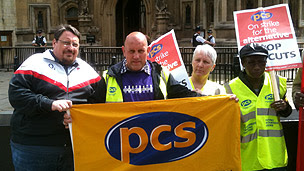
During last Thursday's strike, the Public and Commercial Service (PCS) Trade Union ran what seems to have been a picket line outside at least one of the main entrances to the Commons. One of their justifications for doing this is that they have fellow members of the PCS who work in the parliament building. They may, however, also have been asking others not to cross their picket line, including Members of Parliament. This raises the question of what Labour MPs should have done when confronted by such a picket - especially those who reject Red Ed's criticisms of the strike.

On the day prior to the strike Ed Miliband failed to raise the issue of the dispute at Prime Ministers Questions, although it was the key matter of the day. This gave Cameron the chance to taunt Miliband by asking whether Labour MPs would cross picket lines outside Parliament and other public buildings, and a spokesman for the Labour leader is then reported as saying that Labour MPs "will be coming to work as normal"; although it is not clear as to how many Labour MPs picked up this response.

Labour MPs who spoke in the Commons
that day have been criticised for crossing a picket line. No vote took place that day, so those who spoke have been the easiest people to target. But is this targeting justified? There are a number of problems to consider.

(1) MPs using their passes have nine or ten entrances into Parliament. Four of these are major and well used entrances. It must have happened on the odd occasion, but in the 18 years I was an MP I can not once remember arriving at the Commons for a day's work via the entrance shown on the above photo. So many MPs could have arrived in the Commons on the day of the strike without observing the pickets.

(2) Many of those who have avoided being targeted were either (a) present in the parliament building, but did not speak in the Commons or (b) never turned up to enter the building as it was likely that there was no three-line whip that day. A few might have joined the strikers in their constituencies. But, unfortunately these would be few and far between. Many would just be AOL for reasons that had nothing to do with the strike.

(3) A handful had important matters to pursue in the Commons on behalf of their constituents and/or in the wider public interest. This is the main reason that we have a Parliament and a democratic franchise fought for by movements such as those of the Chartists and the Suffragettes. This point still stands even though the Commons and the use of the franchise often fails to meet up to the standards they should.

This third category include (a) John Cryer who contributed fully and well to a debate which directly effected the interests of his constituents and whom is, I assume, a solid supporter of the strikers, (b) Louise Ellman who had obtained a debate organised to discuss the dismissal of employees at Liverpool Passport Office and (c) Tom Watson who pursued an urgent question on the acquisition of BSkyB - a matter whose considerable public importance can be seen in today's media coverage.

The problem this matter raises is how should we act when two important principles clash with one another. First, there is the principle that you should not cross a picket line. Then there is the principle that you should not place any form of impediment upon an MP entering the Commons - a principle which seems to me to have been of significance ever since we achieved a (more-or-less) universal franchise.

When two principles clash, we need to look for the best way around them. Most MPs who supported the strike could have been away from the Commons giving backing to the action. But being away from the Commons for the full day was not a reasonable option for John Cryer. We need more John Cryer's not fewer. I would, therefore, hope that MPs such as John McDonnell and Jeremy Corbyn who refused to cross the picket line, would now ask PCS (etc) to modify there tactic in future. If the Commons is picketed, the picket line should not be directed at stopping the entry of MPs; but should instead seek to gain support from MPs. A support which can always be delivered (in part) inside the Commons itself.

Here is how one person responded to a similar dilemma, although it is about entering Downing Street which seems to me to have a lessor democratic importance than the Commons should have. On 23rd February 1979 during the Winter of Discontent, the Secretary of State for Energy recorded in his diary "Pickets were standing at the end of Downing Street. One picket looked through my car window and asked if he could speak to me. The driver went on but I stopped him and got out. I assured (the pickets that) I was not going in to do their job or replace their work, and I went in. I sat down at the table outside the Cabinet Room and worked on my papers...." (Tony Benn).

Saturday, June 18, 2011

Dear Andy Burnham

This is a submission for the review of Labour's Education Policy for which Andy Burnham has the lead responsibility. In particular it is a response to a question he asks - "What knowledge and skills do the next generation need to be successful in the modern world?"

We should see "success" as something that will be achieved in a collective way. For if we encourage schoolchildren and young students to pursue selfish interests by using educational facilities mainly to compete for status, wealth, influence and power; then we undermine what education at its best can achieve. Education should have three main objectives. First of all to enable and encourage people to develop intelligent and expanding interests into the scientific, artistic, social and other problems which surround them. Secondly, it should enable people to make well intentioned and well thought out contributions to the way they feel society should function and operate. Thirdly, obtaining the changing skills and understandings which are often required in modern-day employment should be seen as something that is a valuable spin-off from the advancement of the first two objectives.

A sustainable future needs to be built upon the principles of equity, a concern for each others rights and freedoms. democratic participation and mutual respect. These are not values which educational provisions should try to force upon people; but they are values which are best advanced in circumstances of serious investigations and free and open debate.

Whilst children should require a firm grounding in the basic skills of reading, writing and arithmetic and need to be able to pursue their expanding interests in these, the second educational objective mentioned above for equipping people to play a full part in the operations of a democratic society is one which is now seldom recognised. This objective requires moves into the study at school of subjects such as history, geography, current affairs, literature and the arts. These provide a opening through which students can later move on to pursue subjects such as philosophy, sociology, psychology, economics, political studies, other social sciences and the arts.

The stress on the above areas is not intended to place a block upon those who choose to specialise in technical, scientific, industrial, business and related areas . It is just that we all benefit from there being a serious and questioning input into society from areas such as the humanities.

The education of children and young people is not, however, shaped only by their experience within schools, colleges and universities. Their understandings, interests and abilities are also significantly influenced by their experiences at home and in their communities; including the impact they draw from the media. Caring parents who themselves take an intelligent interest in the educational development of their children can be at the cutting edge of such influences.

Education, therefore, needs to be a life long experience; both for today's young people and for older people who can influence and encourage them. We, therefore, need to see significant developments taking place to enable people to move into informal and formal educational avenues. Whilst there is scope for encouraging and assisting the work of bodies such as the Workers' Educational Association, Trade Union Education Schemes, Adult Education Colleges and University of the 3rd Age (and also filling in the gap with a University of the 2nd Age - or a combined University for all these ages ); there is also a need for people to be able to move in and out of formal educational avenues throughout their lives. The avenue of Continuing and Life Long Learning has two major needs. First, it requires appropriate financial arrangements to be made; so that participants have entitlements to leave from their employment for study purposes and are not, thereby, financially handicapped. This requires the development of a system of Paid Educational Leave. Secondly, it requires forms of open access, where people are not deterred from pursuing their developing interests by an initial requirement to jump over a series of examination and qualification hurdles, especially in new areas of study.

There needs to be a recognition that the proper education of the young needs to be linked with serious forms of education for their seniors - especially as today's youngsters will themselves become seniors.

We all need to recognise that education offers us a major avenue for improving society. And whilst a proper commitment to the needed forms of educational provision may appear to be costly in the short run, they will prove to be the most cost effective way to build both a better society and a better world.

The communal and media influences which were mentioned earlier as being avenues which could come to impact in a positive way on the intellectual development of young people and others would (a) be shaped by the recommendations for improving educational facilities which are mentioned above, whilst in the meantime these avenues could themselves contribute to improved educational standards by (b) the establishment of close links between the Department of Education and bodies with communal and media responsibilities, for the development of programmes of action which fit in with the overall education approach suggested in this submission. This can be done without imposing governmental patterns in these areas, but by encouraging practices which begin to satisfy and encourage people's shared and growing educational aspirations.

Saturday, June 11, 2011

Now Maliki Fails The Iraqi People

On June 7, 2011 Prime Minister Maliki's 100-day deadline for reforming the government of Iraq expired, and his promise to make improvements turned out to have been hollow. In response, on June 10 demonstrations took place in nine cities in northern, central and southern Iraq. Protests occurred in Basra city, Hillah in Babil, Diwaniya in Qadisiyah, Nasiriyah in Dhi Qar, Najaf city, Kirkuk in Tamim, Mosul in Ninewa, and Karbala city.

For details, see this fine report by Musings on Iraq.

Thursday, June 09, 2011

Clegg and Cameron in 1895


Click onto the cartoon to enlarge it. Then turn to Dronfield Blather for the cartoons relevance to the Labour Party, which did not even exist when the cartoon first appeared in the Independent Labour Party (ILP) newspaper "Labour Leader" in 1895.

Egypt's Trade Unions Under Attack

See here.

Hat Tip : Labour Start.

Saturday, June 04, 2011

Many New MPs Feel Overburdened

A Hansard Society survey finds that great numbers of the new intake of MPs find the demands of their new jobs to be too great a burden. This is a sign that parliament is clearly attracting many recruits for the wrong reasons and that selection procedures for candidates in winnable seats are deeply flawed.

Of course, there have never been any past halycon days. And once someone makes it to parliament, the influences and controls of the whips and the front benches can be corrupting. But new MPs should at least start out as seeing themselves as (a) playing important roles in the democratic process, (b) being in a position where they can help people who are in less fortunate circumstances and (c) as having acquired a privileged platform to press for their political ideals - should they have any.

It would help if those selecting candidates for winnable seats were on the look out for candidates who have a track record of serving others rather than serving themselves.

Thursday, June 02, 2011

A Week In Which To Save The Labour Party

A review of the Labour Party policy making process was launched at last year's Annual Conference of the Labour Party and a subsequent report will be presented for endorsement at this year's Annual Conference.

The deadline for submissions to the review is 10th June - in only eight days.

Submissions can be made either: - Via the Labour Party website at: members.labour.org.uk/pip - Or in writing to:
Review of Partnership into Power
Policy and Research Department
The Labour Party
39 Victoria Street
London
SW1H 0HA

I intend to submit the following -

"Complex and convoluted systems undermine the operations of supposed democratic procedures. Democratic arrangements need to be straightforward and understood. The current "Partnership Into Power" system and the functions of the National Policy Forum are not understood by the bulk of Labour Party members who participate in Labour Party Branch and Constituency activities, serve on local councils and/or engage in local electoral activity. The current system is dismissed as being one of "smoke and mirrors". It should be abandoned.

In its place we require a clear structure for policy making, in which democratically run units of the Labour Party have a direct link into the activities of the National Executive Committee and into the decision-making procedures of the Annual Conference of the Labour Party".

If you would like to add your name to the above statement along with your Labour Party Branch and Constituency details, then please confirm this via the attached comment box within the next few days. An alternative is to send your own submission directly to the Labour Party.

Monday, May 30, 2011

60 years after the Easington Pit Disaster

The above photograph was taken at Easington Colliery yesterday at a Ceremony of Remembrance held at the graves of miners who were killed in a local pit disaster 60 years ago. I was at the ceremony and at an earlier and packed Memorial Service held in the Parish Church, where the names of all those killed was read out. 81 were killed due to an explosion in the Duckbill District of the Five Quarter Seam and this was followed by the deaths of two of the rescue workers.

Another 895 men were working in other parts of the pit at the time and the official report into the disaster pointed out that if stone dusting had not taken place earlier then "the explosion might have acquired such violence that it would have spread beyond its actual confines and have caused one of the greatest disasters in mining history". Yet as it was, the explosion rushed through nine miles of roadway.

We all have our own way into the past. I was a 14 year old school boy and my father was in the pit when the explosion struck at 4.35am on 29 May 1951. He survived because he was working in a different seam to the one in which the explosion took place. He later helped with what he described as being "salvage work". The official report by the Chief Inspector of Mines states that tribute "must be paid to the large number of colliery workers who removed bodies, strengthened stoppings and cleared paths. Their work, though not so dangerous as that of the trained rescue teams, was arduous, unpleasant and not without strain, and I am glad to have the opportunity of recording sincere appreciation of their services". It was an overall experience which reinforced my father's loyalties. So yesterday I wore his old Durham NUM tie.

My father moved to Easington with his parents and five siblings when he was a three year old in 1912 just after coal was first drawn from its pit. He worked at the colliery between the ages of 14 and 65 and died in 1996 just three years after the pit was closed. Few people could have been so closely bound to its life as a mining colliery. The experience of its pit disaster happening roughly half-way through his life.

The photo of the young girl above comes from the this source.

Added 24 June : Also see here, here, here, here and here.

More Trade Union Repression In Iraq

See here.

Tuesday, May 24, 2011

A Clause 4 Moment?

The major problem with the Labour Party Consultative Document "Refounding Labour" is that it manages to put forward over a 100 questions on how the Labour Party should operate and function without ever raising the key question which should shape our approach to these bits and pieces : namely, what is the Labour Party supposed to be about? What is its purpose?

Yet there is a well known section of the Constitution of the Labour Party which deals with the paramount issue of what its very aims and values are - its famous Clause IV.

I can appreciate why the Labour Leadership would wish to avoid a re-run of the past disputes over reforming Clause IV, which were initially unsuccessfully instigated by Hugh Gaitskell and then successfully by Tony Blair. For if they had even mentioned the words "Clause 4" in their Consultative Document, then that would have been enough to stimulate an argument as to whether we should return to the original wording that was adopted in 1918 namely - "To secure for the workers by hand or by brain the full fruits of their industry and the most equitable distribution thereof that may be possible upon the basis of the common ownership of the means of production, distribution and exchange, and the best obtainable system of popular administration and control of each industry or service." The publicity around the Labour Party itself re-opening this debate could have been used to damage Labour's standing. But perhaps our responses to the Consultative Document could be used to get the matter of aims and values back onto the agenda, yet we might be able to avoid any major damage from the media. Especially if we use the words of the original Clause IV as inspirational, rather than treating them as if they were the Holy Grail.

The current Clause IV appears below. What do you think of it as it stands?

Clause IV.
Aims and values

1. The Labour Party is a democratic socialist party. It believes that by the strength of our common endeavour we achieve more than we achieve alone, so as to create for each of us the means to realise our true potential and for all of us a community in which power, wealth and opportunity are in the hands of the many not the few; where the rights we enjoy reflect the duties we owe and where we live together freely, in a spirit of solidarity, tolerance and respect.

2. To these ends we work for:

A. A DYNAMIC ECONOMY, serving the public interest, in which the enterprise of the market and the rigour of competition are joined with the forces of partnership and co-operation to produce the wealth the nation needs and the opportunity for all to work and prosper with a thriving private sector and high-quality public services where those undertakings essential to the common good are either owned by the public or accountable to them
B. A JUST SOCIETY, which judges its strength by the condition of the weak as much as the strong, provides security against fear, and justice at work; which nurtures families, promotes equality of opportunity, and delivers people from the tyranny of poverty, prejudice and the abuse of power.
C. AN OPEN DEMOCRACY, in which government is held to account by the people, decisions are taken as far as practicable by the communities they affect and where fundamental human rights are guaranteed.
D. A HEALTHY ENVIRONMENT, which we protect, enhance and hold in trust for future generations.

3. Labour is committed to the defence and security of the British people and to co-operating in European institutions, the United Nations, the Commonwealth and other international bodies to secure peace, freedom, democracy, economic security and environmental protection for all.

4. Labour shall work in pursuit oft these aims with trade unions and co-operative societies and also with voluntary organisations, consumer groups and other representative bodies.

5. On the basis of these principles, Labour seeks the trust of the people to govern.


As a democratic socialist, I can live with much of the above. Sub-clause 1 appears on the front of Labour Party Membership Cards and is what many members may believe is the full Clause. But there are four more sub-clauses given above. The first section presses for each person to be given the chance to reach their own potential, rather than seeing people as benefiting by sharing and helping each other. But the overall phraseology is ambiguous enough to be given a general form of democratic socialist interpretation. And the meaning given to the sub-clause depends to some extent what then follows.

It is sub-clause 2a which is the major drawback for me. It encapsulates the New Labour approach which came to fail us both morally and electorally by 2010. Here the concept of the "Dynamic Economy" attempts to marry together the opposing forces of a mainly unrestrained free enterprise approach with that of the public well-being. Below I offer an alternative form of words in favour of advancing the alternative concept of a "Sustainable Economy".
In sub-clause 2b, I am also concerned about the commitment to promoting "equality of opportunity", a concept which creates the image of us being lined up on the starting line to race against each other, rather than our working together to form an egalitarian, participatory and sharing society. The notion of "social equality" seems to me to point us in a better direction.

My two proposed amendments are given below. Limiting the changes in the overall wording, whilst trying to get to the heart of the matter, seems to me to be a practical yet principled approach.

Proposed amendments.


A. Replace sub-clause 2a on “A Dynamic Economy” with the following -

“A SUSTAINABLE ECONOMY, serving the public interest by operating through the principles of co-operation and participatory democracy, in which wealth and economic power are fairly shared.”

B. Amend sub-clause 2b on “A Just Society” as follows -
"Replace the words"equality of opportunity" with the words "social equality".


Wednesday, May 11, 2011

Refounding Labour : a summary of Labour's consultative document

Keir Hardie is one of the primary founders of the Independent Labour Party (ILP) and then of the Labour Party, of which the ILP was itself a part. Labour is now seeking to refound itself.

It is, therefore, appropriate that I should have recently returned from a week-end school run by the ILP (now Independent Labour Publications) where we discussed the "refounding" document which I summarise here.


Friday, May 06, 2011

Massive Swing from Lib Dems to Labour in Chesterfield

Labour gained 23 seats from the Lib Dems in the Chesterfield Borough Council Elections, turning a 11-37 deficit into a 34-14 victory. The photo shows Councillor John Burrows the new leader of the council celebrating with his grandchildren Oliver and Jacob. On May Day he also made significant contributions to this meeting on Adult Education. Well done John and the Chesterfield Labour Party.

Saturday, April 16, 2011

Important May Day Meeting In Chesterfield


What Now For Adult Education? Lessons from the Derbyshire Miners.
A Discussion Meeting.

Speakers
Toby Perkins, Labour MP for Chesterfield and Shadow Education Minister
John Burrows, Leader of the Labour Group on Chesterfield Borough Council.
Bob Heath, former Director of Studies for the Derbyshire Miners' Day Release Courses.

Time

1.30 pm (after the May Day March and Rally)

Date
2nd May, 2011

Venue
Council Chamber of the North East Derbyshire District Council, Saltergate, Chesterfield (Entrance and car parking facilities via the back of the building)

ALL WELCOME

Wednesday, March 30, 2011

The Effect On Iraq


Christopher Hitchen has produced an article entitled "The Iraq Effect : if Saddam Hussein was still in power, this year's Arab uprisings would never have happened". He does not appreciate that if Iraq had not been invaded in 2003, then Arab uprisings could well have taken place even earlier than they have, starting out in Iraq itself and not Tunisia.

Before the invasion, Saddam Hussein faced massive internal problems in Iraq, the nature of which which the Blair/Bush camp never properly recognised. Hussein was only clinging onto power and resorting to his terrible methods to do this. The economy was in a state of collapse, whilst Hussein grabbed what he could via his excessive use of crude state power. However, what was mainly clandestine opposition came from significant elements of three main sources – the Shia, the Kurds and those who believed in democracy. Of course, the later included Shia, Sunni, Kurdish and secular elements. This tradition's greatest expression was the mass rally in Baghdad on May Day 1959 attended by almost 10% of the Iraqi population pushing for democratic institutions. That such values still exist was shown in the immediate movement to set up the Iraqi Federation of Trade Unions once the 2003 invasion took place. A movement supported by Iraqi Labour Movement activists, numbers of whom returned from exile. Those forming the IFTU were opposed to the invasion, but saw that they needed to act in line with their commitments to attempt to rescue Iraq and build a future. They weren't alone for there are wide forces who have since pressed for civil rights and the basic standards of life.

If without an invasion, Hussein had somehow managed to hold onto power until now, then what impact would recent events in the Middle East and North Africa have had in Iraq? Serious efforts by the groups I mention above would have arisen to seek to remove him from power and the international debate would have now been about what we would need to do to aid active opponents to Hussein’s regime. In fact if the invasion of Iraq in 2003 had never taken place, the first uprisings against extreme dictatorship could well have arisen in Iraq well before it was ever triggered in Tunisia. To deny this clear possibility is to fail to understand the people of Iraq.


Sunday, March 20, 2011

Political Education and the Labour Party

A Conference with the above title was held in Rotherham on Saturday. I suspect that a number of democratic socialists (but thankfully not all) were put off attending when they saw that it was organised by the local Rotherham MP Denis MacShane and that Gerald Kaufman and David Owen were key participants. For at first glance it looked like an anti-left stitch-up. And indeed this might have been part of its intention.

The title of the Conference refers to the General Elections which followed Ramsay MacDonald setting up a National Government, the Attlee Government running out of steam and Michael Foot becoming leader of the Labour Party. These elections led to Labour being in a minority position in parliament for three periods which each spanned between 13 and 14 years.

The implications behind the title being that to avoid such periods in the wilderness, Labour should have stuck behind Ramsay MacDonald, obtained a more dynamic leader than Attlee if Bevanism was to have been nipped in the bud, and just never ever have acquired Michael Foot as leader as he was a loser. The conclusion which is thought to follow from such an approach is that a right wing New Labour agenda is needed in current circumstances.

But as we had a seven hour day with only short breaks and contributions from a series of independently minded academics, Polly Toynbee and others, plus audience participation; other lessons emerged. In fact in the concluding comments of the day from Andrew Gamble a Professor of Politics at Cambridge, he pointed out that the most telling collapse of Labour support emerged in the 1970s and not in the three periods stressed in the title. He could have added that in the ten General Elections from 1974 the Labour vote has only twice topped the 40% mark, yet this level was comfortably surpassed in all the nine post-war elections which proceeded that date. Perhaps if all that talk in the Labour Movement in the early 70s about developing a Social Contact had actually led to the development of a social bond that would have moved us in the direction of sharing, decency and social equality, then our support would not have fallen below the 30% mark in 1983 and 2010.

We were in danger of being provided with a selective one sided diet of the left's failings, covering Jimmy Maxton, Nye Bevan, Michael Foot, past Communist Trade Union leaders, the Ban the Bomb movement, Tony Benn and Militant. But this would hardly amount to a serious analysis. An early contributor David Howell pointed out that Labour support in 1945 was particularly strong amongst first time voters, which covered all those who had not qualified to vote in the previous General Election which was then way back in 1935. This was a cohort of voters who went on to help sustain the Labour vote in numbers of other early post-war elections. The question this leads to is just where can we find such a cohort today who have a clear interest in sharing and equality? What about today's young voters who are concerned about Student Fees, the loss of the Educational Maintenance Allowance, a lack of jobs, a world facing massive shortages of essentials, the dangers of climate change and the horrors of third world poverty? If we bring the young on board on such issues we do more than gain a political advantage, we help to revitalise our own beliefs.

Any conference which provides scope for the dialectics of debate, soon moves out of the realm of political propaganda into that of much needed world of political education; something which invariably takes over when carefully expressed disputes and disagreements arise. Even the anti Michael Foot line which was pressed by Kaufman and Owen, provides scope for countervailing considerations. Just why in 1983 did Michael Foot's leadership produce the worst percentage turn out for Labour of any General Election since 1922? Was it all due to his unilateralism, his duffle coat and his left-wing credentials? What about the knock on consequences of Thatcher running a highly populist and successful military campaign over the Falklands, and then there was the massive rupture within the Labour Party which led to the formation of the SDP? David Owen was at the centre of the breakaway and bares a major share of that responsibility for that 1983 election result.

Around 15 speakers made contributions, numbers of whom had sufficient interest in the topic to join the rest of us in the audience over the seven hours. I have always believed that speakers should also be listeners. Even when Hestor Barron confined her remarks to the experience in Durham Mining Constituencies in the 1930s, my concentration did not drop. But then she was discussing the area of my roots and I have read her book on the Durham Coalfield at the time of the 1926 Strike.

The day revealed an important issue for Labour if it is ever to maintain its future and reach its potential. It needs political education, political education, political education. So it is all power to Denis MacShane's elbow. He may have helped to produce something that has more significance than anything he probably ever had in mind.

Friday, March 18, 2011

Libya in 2011 is not Iraq in 2003

Iraqi Workers' Protest


Whilst I detested Saddam Hussein's Regime, I fully opposed the invasion of Iraq believing that it would produce the type of death, destruction and mayhem which followed. Furthermore, I would still have actively opposed an invasion even if a United Nations' Resolution had been adopted to legitimize it. The argument that Iraq could be invaded because Saddam Hussein held weapons of mass destruction was nonsensical. Either he held no such weapons and the case (as it turned out) was false, or he held such weapons and attacking him would have been like prodding a mad dog with a stick. He would have used such weapons and the result would have been even worse than it was.

This did not mean that I felt that he should just have been left to his own devices. There was the strongest obligation upon the international labour movement to support clandestine forces in Iraq (and their supporters in exile) who were struggling for democracy and for trade union and other rights. Although in today's Iraq such pressures now have more open (but still imperfect) avenues of expression, we still need to provide our full backing for them. Not least because Saddam Hussein's anti-trade union laws still remain in existence.

If the invasion had not taken place and if Saddam Hussein and his sons had somehow held onto state power since then, then just imagine what the impact of the current situation in the Arab World would have been upon Iraq. There have already been demonstration in Iraq as a consequence of the protests across North Africa and the Middle East. These current actions in Iraq would have been deeper and more desperate if they had been directed against a contemporary Saddam Hussein.

What would we have done to come to the aid of democratic forces in Iraq in such circumstances? Would the type of United Nations' Resolution which has just been adopted over Libya (which excludes occupation) have been acceptable to people who thought as I did in 2003? I know that we can't control a conflict situation, nor fully restrain western military might from going over the top, nor stop western governments from having hidden agendas. But the option over Libya is to either sit back and give Gaddafi a free hand, or to back the United Nations and the Arab League. Doing the latter does not have to mean that we can't press against excesses by western powers. But democrats throughout the world have no influence over Gaddafi.

Libya in 2011 is not a repeat of Iraq in 2003. Nor might Iraq in 2011 have faced the same position as the one that was disasterously forced upon it in 2003. Circumstances do alter cases.

Tuesday, March 15, 2011

What Now For Adult Education? Lessons from Derbyshire's Miners.

Some of the members of a group of Derbyshire Miners in 1960 who have just completed a three year Day Release Course. They are presenting miners' lamps to their tutors who are the men wearing glasses. On the left is Noel Williams of the Workers Education Association who taught economics and on the right is the politics tutor Royden Harrison from Sheffield University Extramural Department who was a leading Labour Historian and whose final book was to be "The Life and Times of Sidney and Beatrice Webb : 1858 to 1905 the Formative Years". From left to right, the students are Les Ralley who became a leading figure on both his local District and Parish Councils, a 27 year old Eric Varley who four years later was to embark upon his parliamentary career and became a Cabinet Minister, W. Whitaker, E. Lawrence presenting the lamps, E. Bradbury and N. Wade. The nature and significance of such courses is indicated below. A meeting is to be held on May Day in Chesterfield to discuss how far the tradition they were part of can be revitalised in modern circumstances. Details of the meeting appear at the close.


Under Bert Wynn who was Secretary of the Derbyshire Miners, a programme of Day Release Classes was established in 1952. These continued in operation for the next four decades, but finally ended as a consequence of the closure of the local pits. Miners attending studied subjects such as industrial relations, economics and politics.

A new class of 20 miners was established each year. They came to span a three year period and involved a total attendance of 120 days. The tutors on the courses came from the Sheffield University Extramural Department. The Derbyshire Miners having an agreement with the National Coal Board (NCB) to release their members from work to attend the classes.


Those attending required no prior educational qualifications; nor were any exams, tests nor marks ever provided. However, because the supply of places on the courses was always outstripped by the demand, selection conferences were held in the Miners Offices on Saltergate by the tutors where the applicants met together in discussion groups and participated in a note-taking exercise. A Saturday morning class also came to be run for those who it was felt would benefit from a preparatory development of their student skills; many of these miners moved onto the full Day Release Courses and made highly effective use of the abilities they had developed.


The miners on the courses also engaged in private study and produced a steady stream of written work. After their time on the courses, the participants went on to make a variety of uses of their studies. Some becoming more deeply involved in the work of the National Union of Mineworkers, other progressed through the NCB, numbers became involved in the work of the wider labour movement including those who became local councillors, whilst the late Eric Varley and Denis Skinner became local MPs, others moved into full-time studies at Adult Education Colleges and then often went on to obtain degrees at University before taking up posts such as social workers, educationalists and full-time trade union officials. Others remained in their established roles in their communities, taking their newly developed interests with them and also influencing communal developments.


I was lucky to be a tutor on the courses for 21 years from 1966, before becoming a local MP for a further 18 years. I have always claimed that the standard and seriousness of the investigations in the classes was more substantial than was the general run of my experiences in parliament. This is because serious adult education is about making well thought out judgements on complex issues, whilst parliamentary politics is too often about point scoring.


The pattern which was established in Derbyshire was pursued elsewhere. The Extramural Department were involved with similar courses in areas such as the South Yorkshire Coalfield, the Steel Industry, the railways, engineering and with Shop Stewards Courses which drew people together from differing firms.


It was not, however, just because of the decline of large industries mainly concentrated in the public sector, that such courses were ended. Another pattern of adult education (which had always had its own separate existence) took over but was manipulated under Margaret Thatcher. Unfortunately, it became a growing trend that was then pushed under New Labour. What remained of day-release work was often placed under the influence of employers, whose interests were to see their workers being trained to undertake tasks strictly relevant to their employment duties. More emphasis was placed upon adults attending courses in their own time, which would be carefully accredited to meet specific and limited purposes. Certification became the order of the day. The way for adults to progress via education came to be seen as requiring studies to be broken up into specific and limited modules and tested at each stage, so they could act as stepping stones (or some would say stumbling blocks) to higher qualifications. The scope for investigating key issues about life and society were restricted and were seen as secondary. The old form of equality and socialising between tutors and students, in which each learnt from the other, was seen as being unnecessary. Increasingly course fees were expected to cover the bulk of the provision of adult education.


It is not that there should be no room for some forms of today's dominant trend in adult education, but it should never have happened at the expense of the invaluable approach which the Derbyshire Miners had participated in and developed.


Nothing in life is, however, ever too late. Some of us have always attempted to replicate something of what used to be called the liberal education tradition by running and attending a variety of discussion groups. But it is now time to campaign for what was taken away from us. We are not alone in this.


Why not join us at the meeting advertised below? Former participants in the Derbyshire Miners' Day Release Classes will be present. But we know that we can't somehow just try to re-cycle the past. It is a matter for all of us to seek new ways in which what was once achieved in a period from the 1950s can be refashioned to meet the challenging conditions of the 21st Century. We owe many debts to Coal Mining in Derbyshire; serious adult education is one of them.


What Now For Adult Education? Lessons from the Derbyshire Miners.

A Discussion Meeting.


Speakers

Toby Perkins, Labour MP for Chesterfield and Shadow Education Minister

John Burrows, Leader of the Labour Group on Chesterfield Borough Council.

Bob Heath, former Director of Studies for the Derbyshire Miners' Day Release Courses.


Time

1.30 pm (after the May Day March and Rally)


Date

2nd May, 2011


Venue

Council Chamber of the North East Derbyshire District Council, Saltergate, Chesterfield


ALL WELCOME

Wednesday, March 09, 2011

Musings On Iraq

Joel Wing of California has been researching and writing about Iraq since 2002. He runs a fine blog entitled "Musings on Iraq". Today he surpassed even himself. See the five items he posted today at 7.14 am 7.15 am California time.

Friday, February 11, 2011

Prisoners and Voting - Yesterday in Parliament

There were two grounds on which MPs could have voted yesterday against the motion in Commons on “Voting by Prisoners”. The first of these was to uphold the right of the European Court of Human Rights (ECHR) to determine what the position should be. The second was out of a belief that prisoners should have the vote. It was, of course, possible to have voted against the motion whilst holding to both of these positions.

Unfortunately, in the absence of many Labour MPs in the Chamber the debate was dominated by Conservative MPs who were opposed to the general role of the Court and also were strong critics of the EU (although the ECHR isn’t an EU institution.) The few people who opposed the motion mainly defended the ECHR, so the coverage of the issue of whether prisoners should have the vote was only thinly dealt with.

With the addition of the tellers for the “No” vote, only 24 MPs voted against the motion. 10 were Lib Dems, 3 Welsh Nationalists (PC), 1 Green, 1 Conservative (Peter Bottomley) and only 8 were Labour – only 3 of whom who spoke in the debate (Kate Green, Yasmin Qureahi and Jeremy Corbyn).

I find the general failure of Labour MPs to give serious consideration to franchise rights to be highly disturbing but not surprising. The list of Labour MPs who supported opposition to the ECHR and prisoners voting rights is particularly worrying.

Monday, February 07, 2011

Tunisia, Egypt And Iraq

Protests in Iraq inspired by events in Tunisia and Egypt - see "Musings on Iraq". The photo shows the situation in Basra.

Wednesday, January 26, 2011

Still A Colliery And Not A Town

The Daily Telegraph's Web Site are running a story to say that John Darwin (on the left) who is known as the "Canoe Man" has been released from prison after three years under the condition that he does not talk to the media. They also indicate that he is living at Easington Colliery in County Durham.

I was born at Easington Colliery and was brought up there in what were probably its best days, although it also suffered its worst experience at the same time due to a massive pit disaster in 1951 when 79 local miners and three rescue workers were killed.

Yet it was an era of full employment, a highly productive local pit, a newly established and functioning health service, a wider welfare state and a nationalised coal industry. All of which provided hope for the future. Easington Colliery itself was a closely knit community.There were jobs in all parts for young people such as myself without qualifications. Coal was first drawn there in 1910 and its communal spirit had been forged out of the experiences of two world wars, the major mining strikes of 1912, 1921 and 1926 and the years of the inter-war economic depression. Especially from the mid-40s to the mid-50s its life seemed to me to have a tight social bond and to offer security for the future. No doubt much of what I felt was due to the feelings and hopes of youth. But there were also sound reasons for optimism about the future.

The start of the Daily Telegraph article now paints a starkly different picture for today. It reads -

"Easington Colliery is an obsolete town with an obsolete name. The coalmine that gave it its purpose is long shut but the place remains, lines of drab terraces marching down to the grey North Sea.

Desolation is its chief asset. When the makers of Billy Elliot wanted the perfect 'It’s Grim Up North’ setting, they settled on Easington. The town figures prominently in tables of deprivation, and lays claim to the most obese population in the country. Pound shops rub shoulders with pubs protected by steel window shutters, the standard furniture of broken Britain. No paradise, then. Certainly not the paradise envisaged by John Darwin when he was dreaming of wealth and sunshine"

The judgement of the writer is partly journalistic but it also makes use of uncomfortable truths. Strickly speaking it is wrong to call Easington Colliery an obsolete town with an obsolete name. It was and still is a colliery and not a town. It did not exist before its pit was sunk, although it lost its main purpose when the pit was closed in 1993. But it grew up as a colliery in the days when the pit, the miners' lodge, the local labour party, the workingmen's clubs, the miners' welfare, the co-op, local cinemas, chapels, allotments, the miners' own welfare park with its local football team, a long row of shops on the northern side of Seaside Lane , and almost a thousand colliery houses plus council housing and other rented accommodation and aged miners' homes all flourished. Its population peaked at 10,000 in the 1930s. Much has changed and much has gone, but it rightly refuses to be robbed of the word "Colliery" in its name. Also much of what remains makes use of and is embedded within its past.

And even though the Daily Telegraph's writer is correct to say that the Easington Colliery is no paradise, he is obviously unaware that the area in which I lived (containing mainly council houses) was known as Paradise - as a young boy my mates and I formed a football team which we grandly called Easington Colliery Paradise Rovers and beat Richie's Rockets 20-10. Perhaps it is that paradise that John Darwin now lives in.


Tuesday, January 25, 2011

To Hack Or Not To Hack?

Today's Morning Star contains (a) an editorial on its centre page attacking hacking by News Corporations which it runs alongside (b) a major article by John Pilger which supports the use WikiLeaks is making in using information acquired in similar ways. I suppose the difference between the two uses of similar techniques is felt to arise from what are perceived to be the different purposes behind them. Yet the proximity of the two items does raise the question of just when we are justified in hacking and when we are to be condemned for doing it.

Thursday, January 20, 2011

Democracy And The Vote

The democratic principle should require that within an appropriate electoral area each person should have one vote. Any deviation from this principle requires a precise and equally principled justification. I can only see two main acceptable restrictions on such franchise rights. One that a person is considered to be too young to vote. As we should err on the side of caution in withholding franchise rights, I would like to see people enfranchised from the date of their 16th birthday. A second restriction on franchise rights needs to apply to those who have a serious mental condition such that they can not exercise a choice and there is a danger that persons they are dependent upon will exercise their voting rights in their place.

If we add to this list of restrictions, we need to be able to establish a solid and principled case. To say that prisoners who have been convicted of particularly nasty crimes should be excluded, is not a good argument in itself as it merely appeals to popular feelings of disgust for them. But to exclude people from the franchise because we judge them to be evil is a worrying approach. It could lead to different people wishing to exclude a variety of categories of the electorate by using arguments which are racist, xenophobic, sexist, anti-capitalist or what you will.

Furthermore it is not just prisoners who are currently excluded from the franchise. In the United Kingdom the ban includes those who are settled here from overseas nations other than Ireland or Commonwealth Nations. Then there is the lack of attention we pay to the efficiency of the electoral registration system. Millions who qualify are missing from registers. These involve a high percentage of the homeless, the rootless, ethnic minorities, the poor and the young. An extra reason for votes at 16 is that those who are due to attain the vote at that age could initially be placed on electoral registers at school when they are"attainers" at the age of 15. If we achieve 100% electoral registration for 16 year olds, it will be easier for the registration system to keep people on registers as they grow older.

Are there no people who should be excluded from electoral registers outside of the two main categories I mentioned in my opening paragraph? There are only two more that I can think of. First, under the principle I am arguing from there is no need for people to register in more than one place at the same time and then choose which of their franchise rights they use on any particular occasion. And if people register in more than one place, there is no automatic check to ensure that they have only used their franchise the once at any one time. Secondly, there is no case for British Citizens settled overseas having the vote in this country. Under the democratic principles I am arguing from, they should be given the vote in the country in which they are resident. We should support any of their efforts to achieve these rights in their country of settlement.

If my arguments are to be challenged, then I hope that critics will either seek to show how their arguments fit in with democratic principles. It is, of course, possible to argue against the democratic principles which I have used on fascist, stalinist, elitist, populist and other non-democratic grounds. We should judge the opposition to "votes for prisoners" to see which of these perspectives they fit into.

Of course, democracy requires much more than democratic voting rights. But it is seriously hampered without them.

Tuesday, January 18, 2011

We Should Not Pick And Choose As To Who Is Entitled To The Vote

Radical Jack

So much for the democratic and civil liberties credential of Jack Straw and David Davis in their efforts to withhold voting rights for prisoners. I am not against them obtaining a debate on the issue in the Commons, but I hope that enough MPs will be present to challenge the line they are taking.

Everyone who is capable of exercising a choice, is resident within the United Kingdom and has reached an agreed age (which I would put at 16) should have the vote in our parliamentary elections. They should all then be subject to laws determined under parliamentary procedures - even though acts of peaceful civil disobedience can be a justifiable avenue of protest against unjust measures where the protesters are willing to face the legal consequences of their actions.

Now and again we come across prisoners who are released because they are innocent. Then we are aware that masses of people who have committed crimes have never been captured. If we adopt the principle of kicking people off registers because we think they are nasty, heaven knows who will left with the vote.

We need to get people onto electoral registers and not kick them off. At least three and million who are entitled to the vote are currently missing from registers. Young people, ethnic minorities, the poor, the homeless and the rootless form the bulk of these. We need a pro-active system to ensure their rights are given to them.

Then there there are people who are firmly resident in this country other than Commonwealth and Irish Citizens who are find themselves disenfranchised, yet they are firmly subject to the law of the land and are not tax exiles.

What we are entitled to is a Full Franchise - we should not pick and choose as to who is entitled to the vote. It is for the people to choose who should represent them.

Friday, January 14, 2011

This Blog Is Still Alive

This Blog is still alive and I anticipate that it will soon be kicking.

Thursday, December 09, 2010

A Liberal Interpretation

On page 39 of the 'Liberal Democratic Manifesto 2010' it states " We will scrap unfair fees for all students taking their first degree, including those studying part-time, saving them over £10,000 each. We have a financially responsible plan to phase fees out over six years, so that the charge is affordable even in these difficult economic times, and without cutting university income. We will immediately scrap fees for final year students"

Saturday, December 04, 2010

Needed - A Vote Of No Confidence

Nick Clegg has booted the Doctrine of the Mandate into touch by making the strongest possible commitment at the General Election to vote against increases in student fees (see photo), then advocating the exact opposite as Deputy Prime Minister.

Vince Cable (below) as Business Secretary is the responsible Government Minister on the issue. Whichever way he votes on the matter in the Commons his changing speculations as to what he will do has driven a coach and horses through the notions of Ministerial Responsibility and Cabinet Collective Responsibility. He has changed his mind as often as he has shifted his views on what type of economic policy we should pursue.


There is now a great opportunity for Labour to undermine the position of the Lib-Dems on Student Fees by calling for a Vote Of No Confidence on the issue.

Thursday, December 02, 2010

Snow Good

These are views from my home in Dronfield in North Derbyshire. First there is the view I look out upon when sat at my computer. Next is the garden, with a table at the back. Finally there is the view from the front step. Click onto the photos to enlarge them.

We have had 22 inches (56 cm) of snow and it is still snowing - and the gas heating has cut out. I have now cleared the front for the gas man. (Update 3 December : Didn't need the gas man, my wife Ann fixed it.)

Thursday, November 25, 2010

Trying To Put Howard To Flight

Howard Flight is in trouble again. He just won't follow the autocue.

I once attempted to nail him for raising a question to the then Prime Minister (Tony Blair) relating to an item in his own Declaration of Interests which referred to what was then his deputy chairmanship of Guinness Flight Hambro Asset Management Ltd. I claimed that his question was unparliamentary in that it amounted to advocacy on behalf of that body.

I raised the matter via a written complaint to the Parliamentary Commissioner for Standards preceded by a couple of points of order to the Speaker, Betty Boothroyd. But when Howard Flight responded the Commissioner accepted his submission. The Commissioner's response was then accepted by the Commons' Standards and Privileges Committee. This is the link to their report.

In 2005, Flight was secretly recorded stating that if the Conservatives won the coming election they would make more spending cuts than those they had promised to the electorate. It led to a spat with the Tory Leader Michael Howard and the blocking of Flight's re-selection as a candidate. But perhaps it is exactly what Flight then said that appealed to David Cameron who recently recommended him for a Peerage. But then he should have known that Flight can't keep his lip buttoned.

Well I did try to sort this out in 1997.

Sunday, November 21, 2010

A Constitutional Fix

54 newly appointed peers, 50 fewer democratically elected MPs.

Hat Tip : Bob Piper.

Saturday, November 20, 2010

Linking To The Formal Parliamentary Work Of Your MP.


At the end of the "links" section at the right hand column of this blog, I have added four new links to the parliamentary activities of my local MP and parliamentary successor, Natascha Engel.

The first link provides access to the relevant sections of Hansard which provide (a) the oral and written parliamentary questions she asks and (b) her contributions in debates. The second link gives the Early Day Motions which she has both submitted and signed. The third link is to her section at the BBC's "Democracy Live" which includes access to various videos of her parliamentary contributions. The fourth link provides access to the reports of the Back Bench Business Committee which she Chairs.

(Note at 6.40 pm : Although these four links are working at the moment, two of them broke earlier. But others will have better technical skills than mine when adapting what I propose below, mainly via here)

Others in the UK could use these links to then search out the work of their own MPs and then to set up their own links. Areas I have not so far sorted out include links to relevant Hansards for Standing Committees and submissions and support for proposed amendments to Bills. Nor have I links for an MP's own Private Bills.

It should be noted that even in parliament, the above areas only form part of an active MP's work. For most of their parliamentary activities no Hansard writers or Common's Clerks are involved. These additional avenues include formal and informal meetings with Government Ministers and their opposition shadows, their own Party meetings including a wide range of back-bench committees, all-party and other groups on a range of topics, letters/emails to Ministers etc (normally on behalf of constituents) and a whole host of informal links to seek to advance their concerns. Such extra avenues are only possible, of course, because an MP has the normally unspoken threat in the background of raising their concerns via formal parliamentary procedures unless the informal avenues produce results. The hurdle they always need to overcome is the power of the Executive over back-bench MPs. This is why the work of the Backbench Business Committee which Natascha chairs is so important.

It should also be noted that the use of the above formal and informal parliamentary avenues only form part of an active MPs' work. Constituency work, campaigning and fact-finding are as significant and need to be added to the equation.

In my experience it is the MP who is active in parliament who is also active in their constituency.

Wednesday, November 17, 2010

Passion and Precision

There is an art in an opposition MP using the nooks and crannies of parliamentary procedure to seek to alter practices by the Coalition Government and its officials which are socially harmful.

My local Labour MP Natascha Engel (see photo) led a Westminster Hall debate on 27 October which had exactly this intent. She spoke with passion, understanding and precision.

Her topic was the future of work capacity assessments. These were brought in on April 2010 by the previous government to assess the work capability of people who are long-term claimants of incapacity benefit. However she raised concerns that their increasing use was solely to "bring down the welfare bill" and urged the government to see "people not the benefit". A video of the full half hour debate can be found here.

On this matter Natascha has worked closely with the Derbyshire Unemployed Workers' Centres, who are chaired and supported by Graham Baxter who was the subject of this earlier item I posted.

Saturday, November 13, 2010

A Labour Success Story - Don't Now Upset The Applecart

Graham Baxter (front figure) carrying a Unite banner on the Chesterfield May Day March 2009. He has been an active trade unionist since his first day at work 54 years ago. (Click onto the picture to enlarge it).

There are times when it is appropriate to put forward words of appreciation for those whose actions we too often take for granted.

In what have been difficult times for Local Government, the North East Derbyshire District Council (NEDDC) has made remarkable progress in recent years under the controlling Labour Team led by Graham Baxter.

In 2008 the NEDDC made local government history by becoming the first council to leap straight from being designated as "weak" to "excellent" in an official national scheme established to judge council performances, known as the Comprehensive Performance Assessment.

The Audit Commission also found that the Council had made good progress in reducing crime and anti-social behaviour, in supporting economic development via successful infrastructure projects which reversed the decline in local jobs and industry, in meeting housing needs including those of the homeless, in working with neighbouring councils and with its local population, in contributing to progress in health, cleanliness, sustainable waste management and much more.

The Council has also received an impressive list of awards and commendations for its services from bodies such as the National Municipal Journal, the Local Government Association, the Cabinet Office, and the Chartered Institute of Public Relations. Currently it is also nominated for further recognitions of its services. In fact, it is possible to produce a list of at least 34 awards, nominations and commendations which the Council has received since July 2007.

Graham Baxter has also recently been awarded the MBE in recognitions of decades of public service, culminating in his work as leader of the Council since 2004.

But it is not just officialdom which recognises the Council's achievements; three quarters of those responding to a survey felt that the Council has worked to make the area cleaner, greener and a better place. 80% feel that North East Derbyshire is a good place to live.

The support which the Council gives to the Derbyshire Unemployed Workers' Centres is also exceptional. Graham Baxter is an active Chair of this key organisation. It provides welfare rights advice and makes representations on all aspects of Welfare Benefits to anyone that requires it. Each year it deals with around 10,000 enquiries and represents some 200 people at tribunals, recovering over £1.5 million for the local economy and thereby preserving jobs. NEDDC's continuing support and involvement with this body is crucial in current circumstances.

The Coalition Government is now proposing to cut the budget of the Department of Communities and Local Government by 36.6% over the next 4 years, whilst capping Council Tax levels as an extra means of cutting local authority access to resources.

In the years ahead, the North East Derbyshire District Council will need to exercise the same forms of creative response which it has recently shown under Graham's leadership. It will also need to link with the wider Labour Movement to push back the Coalition's threat of massive cuts.

It is imperative that Graham and his team have local backing from the electorate to be returned to office in next year's District Council Elections.

In the meantime, it is a big thank you.

Thursday, November 11, 2010

A Welcome Admission

Here Alan Johnson admits that Labour got its economic priorities wrong under Blair and Brown. It now seems to be accepted that those in the Labour Movement who attempted to save our manufacturing base and to restrain the growth of financial institutions were correct all along, even though they were dismissed at the time as merely being the "usual suspects".

What is now important is how we learn from the mistakes of New Labour and how we change the strategy for the future. But an apology should always be accepted as it offers fresh openings.

Sunday, November 07, 2010

Votes For Prisoners - And Many Others

The vote should be available to anyone over 16 who is settled in the United Kingdom, with the exception only of those who have such a serious mental disability that they are unable in any way to understand the process they would be involved in. This is because we are all human beings who are subject to the decisions made by those who are elected.

People should not be excluded from the vote on the grounds that they are in prison or are nationals of a foreign country (in this category at the moment only Commonwealth and Irish citizen can qualify).

Serious action should also be taken to ensure that the missing millions who are entitled to vote (but who are missing from registers) are discovered and added to the registers. Those missing from registers are a significant proportion of the poor, the young, the rootless, the homeless and ethnic minorities.

A major case for giving the vote to 16 year olds is that they could initially be registered via their schools when 15 as "attainers" and it would then be easier to trace them later to ensure they then maintained their voting rights.

I can not understand anyone who otherwise sees themselves as a democrat and a believer in human rights coming up with reasons to exclude any category of people. The vote is not something that one should earn. It is for politicians to seek to earn our votes.

As things stand with criminals, we have the odd position that we keep discovering prisoners who are innocent whilst we know that most criminals are never captured. If there was a justification for excluding prisoners from the vote, (which there isn't) we would need a superior justice system to the one we have - yet it is currently being subject to Government cuts.