 Try here.
Friday, July 29, 2011

Saturday, July 23, 2011
On Solidarity With Norway
See this telling response from Owen Jones, the author of the exceptional "Chavs : The Demonization of the Working Class".
Friday, July 22, 2011
Three Score Years and Fifteen
I have been running this blog for five years. It was established for me by my son, Stephen. After he set up an initial test item, he added a fresh item on 22 July 2006 and first showed it to me during my birthday party that day. It was my 70th birthday; hence the title of the blog which gets more dated as each year passes. From that date, this is also blog item number 600.
As I am 75 today, I now have plenty to do other than blogging.
As I am 75 today, I now have plenty to do other than blogging.
Wednesday, July 13, 2011
Friday, July 08, 2011
A Reply To "The Partisan".

The blog "The Partisan" (their symbol appears above) have placed an item in my comment box in the thread below this one. My reply quotes what they say in five sections, whilst responding to each in turn. Unfortunately, this makes the whole reply too long to go in my comment box. I have, therefore, used this thread for the reply.
(1) "For us, although MPs may well have not literally crossed a picket line, in terms of the spirit of the issue they did."
I accept that numbers of MPs who entered the Commons on 30 June by avenues other than St.Stephen's entrance may have known about the picket and some would be taking diversionary action. But I also see it as being highly likely that others used alternative entries because this was their usual practice and some of these may not have known that a picket was in operation elsewhere. Even if those who entered in ignorance later discovered that a picket existed, by then some of them could have already participated in parliamentary procedures.
(2) "We do also understand both that the list is incomplete, at the moment neither of us has the time or inclination to trawl through hours of BBC Parliament to identify other miscreants, and that some Labour MPs not in Parliament on Thursday may not have had the most noble socialist motives for this."
I hope that you will not abuse this information, but via the following link you will be able to discover (a) who spoke in the Commons that day, (b) who spoke in Westminster Hall and (c) who was present at Commons Committee Meetings. You don't have to trawl through the speeches on the floor of the Commons, as a list can be found as to who spoke - you can then click onto names to check to see if they said anything of importance. It is also possible to check on what was said in Westminster Hall and in Commons Committees, the later providing lists of those in attendance. See - http://www.parliament.uk/ I think that you should search out the contributions of those you have been criticising. Many of your strictures will hold, but you need to judge as to whether they hold for everyone you mention.
(3) "On the more substantive point, whilst we accept that there is a difference between the importance of Cryer's contribution and, for example, Barry "should we rename veal spring beef" Sheerman, there's still a pretty substantial problem here. Whilst it is obviously important that MPs pursue matters in Parliament, it strikes us that an unconditional principle has been violated (if it's unconditional, there should be no question of balancing it with a competing principle)."
Having joined numbers of picket lines in a supportive capacity in the past, I am aware of the importance of the principle involved. The principle is not, however, a categorical imperative. I am sure that the philosopher you later direct my attention to (if Kant had been alive today) would have recognised that it is a principle that is conditional and depends upon the circumstances in which pickets operate. For instance, although the example I now use is not applicable to any current British circumstances, it is theoretically possible for a Trade Union to put in place a picket based on furthering racist, sexist or other interests which are unacceptable to a socialist. This means that an acceptable picket line (as functions in the overwhelming number of cases which we can envisage) is still based on a conditional and not an unconditional principle. I am not, of course, claiming that the picket at St. Stephen's was involved in any such excess. I merely wish to establish the logical standing of the principle we are discussing.
(4) "It's also worth noting that the principle that MPs should work hard for their constituents is widely accepted (at least by the public); principles of unconditional solidarity are being made to appear anachronistic (the GMB, for example, suggested crossing picket lines was an issue of individual conscience, it isn't), this makes fidelity to this principle particularly vital at the moment."
I agree that attempts to uphold picketing rights are especially important in current circumstances. But as this means that bolstering this right is now even more important than it was at some time in the past, this further shows that the weight we give to picketing rights can be given a different stress in different circumstances and is , therefore, a conditional (yet highly important) principle.
(5) "The question on PCS tactics is an interesting one. What we'd suggest is that the Kantian distinction between the public use of reason (one can criticise taxes as much as one wants) and the private use of reason (one still has to pay them) applies here. One can criticise a union's tactics as much as one wants and try to influence them but once they are democratically agreed on one's bound as a socialist not to disrupt them."
Democracy is of great importance, but I do not think that it is the only basis on which the support for picketing should rest. For this would mean that in say, the absence, of a ballot for strike action then picketing would not then be justified. Yet no national ballot took place during the Miners' Strike of 1984-5, but there were still strong reasons for supporting the wide programme of picketing that operated. For the defeat of the Miners by the Thatcher Government would have (and did) lead to a serious collapse in the power and influence of both Trade Unions and the Working Class in general. Nevertheless I agree that it is important that Trade Unions should themselves be democratic organisations. But as democracy is important as part of the life blood of Trade Unionism, so it is important in society in general (although its needs extending). Democracy is important, for instance, in shaping both the activities and openings for MPs - avenues which again need to be extended. Hence (1) the rights of pickets and (2) the rights of MPs to be able to act on behalf of the interests of the electorate are two extremely important principles. When these two principles rubbed up against each other on 30 June, then they needed to be carefully weighed up against each other according to the circumstances of the time. Well intentioned democrats and socialists might come to different conclusions as to which principle was paramount that day and in which circumstances. Furthermore if say,Tom Watson and John Cryer can be excused for coming down on the side of making use of their parliamentary openings that day, it does not follow that everyone else should be excused. It is by a person's intentions that they should be judged. Moral judgements can be complex and often need careful thought, they can't all be devolved to principles we never given any further thought to.
Wednesday, July 06, 2011
Modifying A Picket Line
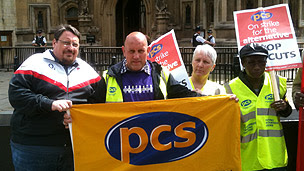
During last Thursday's strike, the Public and Commercial Service (PCS) Trade Union ran what seems to have been a picket line outside at least one of the main entrances to the Commons. One of their justifications for doing this is that they have fellow members of the PCS who work in the parliament building. They may, however, also have been asking others not to cross their picket line, including Members of Parliament. This raises the question of what Labour MPs should have done when confronted by such a picket - especially those who reject Red Ed's criticisms of the strike.
On the day prior to the strike Ed Miliband failed to raise the issue of the dispute at Prime Ministers Questions, although it was the key matter of the day. This gave Cameron the chance to taunt Miliband by asking whether Labour MPs would cross picket lines outside Parliament and other public buildings, and a spokesman for the Labour leader is then reported as saying that Labour MPs "will be coming to work as normal"; although it is not clear as to how many Labour MPs picked up this response.
Labour MPs who spoke in the Commons that day have been criticised for crossing a picket line. No vote took place that day, so those who spoke have been the easiest people to target. But is this targeting justified? There are a number of problems to consider.
(1) MPs using their passes have nine or ten entrances into Parliament. Four of these are major and well used entrances. It must have happened on the odd occasion, but in the 18 years I was an MP I can not once remember arriving at the Commons for a day's work via the entrance shown on the above photo. So many MPs could have arrived in the Commons on the day of the strike without observing the pickets.
(2) Many of those who have avoided being targeted were either (a) present in the parliament building, but did not speak in the Commons or (b) never turned up to enter the building as it was likely that there was no three-line whip that day. A few might have joined the strikers in their constituencies. But, unfortunately these would be few and far between. Many would just be AOL for reasons that had nothing to do with the strike.
(3) A handful had important matters to pursue in the Commons on behalf of their constituents and/or in the wider public interest. This is the main reason that we have a Parliament and a democratic franchise fought for by movements such as those of the Chartists and the Suffragettes. This point still stands even though the Commons and the use of the franchise often fails to meet up to the standards they should.
This third category include (a) John Cryer who contributed fully and well to a debate which directly effected the interests of his constituents and whom is, I assume, a solid supporter of the strikers, (b) Louise Ellman who had obtained a debate organised to discuss the dismissal of employees at Liverpool Passport Office and (c) Tom Watson who pursued an urgent question on the acquisition of BSkyB - a matter whose considerable public importance can be seen in today's media coverage.
The problem this matter raises is how should we act when two important principles clash with one another. First, there is the principle that you should not cross a picket line. Then there is the principle that you should not place any form of impediment upon an MP entering the Commons - a principle which seems to me to have been of significance ever since we achieved a (more-or-less) universal franchise.
When two principles clash, we need to look for the best way around them. Most MPs who supported the strike could have been away from the Commons giving backing to the action. But being away from the Commons for the full day was not a reasonable option for John Cryer. We need more John Cryer's not fewer. I would, therefore, hope that MPs such as John McDonnell and Jeremy Corbyn who refused to cross the picket line, would now ask PCS (etc) to modify there tactic in future. If the Commons is picketed, the picket line should not be directed at stopping the entry of MPs; but should instead seek to gain support from MPs. A support which can always be delivered (in part) inside the Commons itself.
Here is how one person responded to a similar dilemma, although it is about entering Downing Street which seems to me to have a lessor democratic importance than the Commons should have. On 23rd February 1979 during the Winter of Discontent, the Secretary of State for Energy recorded in his diary "Pickets were standing at the end of Downing Street. One picket looked through my car window and asked if he could speak to me. The driver went on but I stopped him and got out. I assured (the pickets that) I was not going in to do their job or replace their work, and I went in. I sat down at the table outside the Cabinet Room and worked on my papers...." (Tony Benn).
Tuesday, June 28, 2011
Saturday, June 18, 2011
Dear Andy Burnham
This is a submission for the review of Labour's Education Policy for which Andy Burnham has the lead responsibility. In particular it is a response to a question he asks - "What knowledge and skills do the next generation need to be successful in the modern world?"
We should see "success" as something that will be achieved in a collective way. For if we encourage schoolchildren and young students to pursue selfish interests by using educational facilities mainly to compete for status, wealth, influence and power; then we undermine what education at its best can achieve. Education should have three main objectives. First of all to enable and encourage people to develop intelligent and expanding interests into the scientific, artistic, social and other problems which surround them. Secondly, it should enable people to make well intentioned and well thought out contributions to the way they feel society should function and operate. Thirdly, obtaining the changing skills and understandings which are often required in modern-day employment should be seen as something that is a valuable spin-off from the advancement of the first two objectives.
A sustainable future needs to be built upon the principles of equity, a concern for each others rights and freedoms. democratic participation and mutual respect. These are not values which educational provisions should try to force upon people; but they are values which are best advanced in circumstances of serious investigations and free and open debate.
Whilst children should require a firm grounding in the basic skills of reading, writing and arithmetic and need to be able to pursue their expanding interests in these, the second educational objective mentioned above for equipping people to play a full part in the operations of a democratic society is one which is now seldom recognised. This objective requires moves into the study at school of subjects such as history, geography, current affairs, literature and the arts. These provide a opening through which students can later move on to pursue subjects such as philosophy, sociology, psychology, economics, political studies, other social sciences and the arts.
The stress on the above areas is not intended to place a block upon those who choose to specialise in technical, scientific, industrial, business and related areas . It is just that we all benefit from there being a serious and questioning input into society from areas such as the humanities.
The education of children and young people is not, however, shaped only by their experience within schools, colleges and universities. Their understandings, interests and abilities are also significantly influenced by their experiences at home and in their communities; including the impact they draw from the media. Caring parents who themselves take an intelligent interest in the educational development of their children can be at the cutting edge of such influences.
Education, therefore, needs to be a life long experience; both for today's young people and for older people who can influence and encourage them. We, therefore, need to see significant developments taking place to enable people to move into informal and formal educational avenues. Whilst there is scope for encouraging and assisting the work of bodies such as the Workers' Educational Association, Trade Union Education Schemes, Adult Education Colleges and University of the 3rd Age (and also filling in the gap with a University of the 2nd Age - or a combined University for all these ages ); there is also a need for people to be able to move in and out of formal educational avenues throughout their lives. The avenue of Continuing and Life Long Learning has two major needs. First, it requires appropriate financial arrangements to be made; so that participants have entitlements to leave from their employment for study purposes and are not, thereby, financially handicapped. This requires the development of a system of Paid Educational Leave. Secondly, it requires forms of open access, where people are not deterred from pursuing their developing interests by an initial requirement to jump over a series of examination and qualification hurdles, especially in new areas of study.
There needs to be a recognition that the proper education of the young needs to be linked with serious forms of education for their seniors - especially as today's youngsters will themselves become seniors.
We all need to recognise that education offers us a major avenue for improving society. And whilst a proper commitment to the needed forms of educational provision may appear to be costly in the short run, they will prove to be the most cost effective way to build both a better society and a better world.
The communal and media influences which were mentioned earlier as being avenues which could come to impact in a positive way on the intellectual development of young people and others would (a) be shaped by the recommendations for improving educational facilities which are mentioned above, whilst in the meantime these avenues could themselves contribute to improved educational standards by (b) the establishment of close links between the Department of Education and bodies with communal and media responsibilities, for the development of programmes of action which fit in with the overall education approach suggested in this submission. This can be done without imposing governmental patterns in these areas, but by encouraging practices which begin to satisfy and encourage people's shared and growing educational aspirations.
We should see "success" as something that will be achieved in a collective way. For if we encourage schoolchildren and young students to pursue selfish interests by using educational facilities mainly to compete for status, wealth, influence and power; then we undermine what education at its best can achieve. Education should have three main objectives. First of all to enable and encourage people to develop intelligent and expanding interests into the scientific, artistic, social and other problems which surround them. Secondly, it should enable people to make well intentioned and well thought out contributions to the way they feel society should function and operate. Thirdly, obtaining the changing skills and understandings which are often required in modern-day employment should be seen as something that is a valuable spin-off from the advancement of the first two objectives.
A sustainable future needs to be built upon the principles of equity, a concern for each others rights and freedoms. democratic participation and mutual respect. These are not values which educational provisions should try to force upon people; but they are values which are best advanced in circumstances of serious investigations and free and open debate.
Whilst children should require a firm grounding in the basic skills of reading, writing and arithmetic and need to be able to pursue their expanding interests in these, the second educational objective mentioned above for equipping people to play a full part in the operations of a democratic society is one which is now seldom recognised. This objective requires moves into the study at school of subjects such as history, geography, current affairs, literature and the arts. These provide a opening through which students can later move on to pursue subjects such as philosophy, sociology, psychology, economics, political studies, other social sciences and the arts.
The stress on the above areas is not intended to place a block upon those who choose to specialise in technical, scientific, industrial, business and related areas . It is just that we all benefit from there being a serious and questioning input into society from areas such as the humanities.
The education of children and young people is not, however, shaped only by their experience within schools, colleges and universities. Their understandings, interests and abilities are also significantly influenced by their experiences at home and in their communities; including the impact they draw from the media. Caring parents who themselves take an intelligent interest in the educational development of their children can be at the cutting edge of such influences.
Education, therefore, needs to be a life long experience; both for today's young people and for older people who can influence and encourage them. We, therefore, need to see significant developments taking place to enable people to move into informal and formal educational avenues. Whilst there is scope for encouraging and assisting the work of bodies such as the Workers' Educational Association, Trade Union Education Schemes, Adult Education Colleges and University of the 3rd Age (and also filling in the gap with a University of the 2nd Age - or a combined University for all these ages ); there is also a need for people to be able to move in and out of formal educational avenues throughout their lives. The avenue of Continuing and Life Long Learning has two major needs. First, it requires appropriate financial arrangements to be made; so that participants have entitlements to leave from their employment for study purposes and are not, thereby, financially handicapped. This requires the development of a system of Paid Educational Leave. Secondly, it requires forms of open access, where people are not deterred from pursuing their developing interests by an initial requirement to jump over a series of examination and qualification hurdles, especially in new areas of study.
There needs to be a recognition that the proper education of the young needs to be linked with serious forms of education for their seniors - especially as today's youngsters will themselves become seniors.
We all need to recognise that education offers us a major avenue for improving society. And whilst a proper commitment to the needed forms of educational provision may appear to be costly in the short run, they will prove to be the most cost effective way to build both a better society and a better world.
The communal and media influences which were mentioned earlier as being avenues which could come to impact in a positive way on the intellectual development of young people and others would (a) be shaped by the recommendations for improving educational facilities which are mentioned above, whilst in the meantime these avenues could themselves contribute to improved educational standards by (b) the establishment of close links between the Department of Education and bodies with communal and media responsibilities, for the development of programmes of action which fit in with the overall education approach suggested in this submission. This can be done without imposing governmental patterns in these areas, but by encouraging practices which begin to satisfy and encourage people's shared and growing educational aspirations.
Thursday, June 16, 2011

Saturday, June 11, 2011
Now Maliki Fails The Iraqi People
 On June 7, 2011 Prime Minister Maliki's 100-day deadline for reforming the government of Iraq expired, and his promise to make improvements turned out to have been hollow. In response, on June 10 demonstrations took place in nine cities in northern, central and southern Iraq. Protests occurred in Basra city, Hillah in Babil, Diwaniya in Qadisiyah, Nasiriyah in Dhi Qar, Najaf city, Kirkuk in Tamim, Mosul in Ninewa, and Karbala city.
For details, see this fine report by Musings on Iraq.
Thursday, June 09, 2011
Clegg and Cameron in 1895

Click onto the cartoon to enlarge it. Then turn to Dronfield Blather for the cartoons relevance to the Labour Party, which did not even exist when the cartoon first appeared in the Independent Labour Party (ILP) newspaper "Labour Leader" in 1895.
Saturday, June 04, 2011
Many New MPs Feel Overburdened
 A Hansard Society survey finds that great numbers of the new intake of MPs find the demands of their new jobs to be too great a burden. This is a sign that parliament is clearly attracting many recruits for the wrong reasons and that selection procedures for candidates in winnable seats are deeply flawed.
Of course, there have never been any past halycon days. And once someone makes it to parliament, the influences and controls of the whips and the front benches can be corrupting. But new MPs should at least start out as seeing themselves as (a) playing important roles in the democratic process, (b) being in a position where they can help people who are in less fortunate circumstances and (c) as having acquired a privileged platform to press for their political ideals - should they have any.
It would help if those selecting candidates for winnable seats were on the look out for candidates who have a track record of serving others rather than serving themselves.
Friday, June 03, 2011

Thursday, June 02, 2011
A Week In Which To Save The Labour Party
 A review of the Labour Party policy making process was launched at last year's Annual Conference of the Labour Party and a subsequent report will be presented for endorsement at this year's Annual Conference.
The deadline for submissions to the review is 10th June - in only eight days.
Submissions can be made either: - Via the Labour Party website at: members.labour.org.uk/pip - Or in writing to:
Review of Partnership into Power
Policy and Research Department
The Labour Party
39 Victoria Street
London
SW1H 0HA
I intend to submit the following -
"Complex and convoluted systems undermine the operations of supposed democratic procedures. Democratic arrangements need to be straightforward and understood. The current "Partnership Into Power" system and the functions of the National Policy Forum are not understood by the bulk of Labour Party members who participate in Labour Party Branch and Constituency activities, serve on local councils and/or engage in local electoral activity. The current system is dismissed as being one of "smoke and mirrors". It should be abandoned.
In its place we require a clear structure for policy making, in which democratically run units of the Labour Party have a direct link into the activities of the National Executive Committee and into the decision-making procedures of the Annual Conference of the Labour Party".
If you would like to add your name to the above statement along with your Labour Party Branch and Constituency details, then please confirm this via the attached comment box within the next few days. An alternative is to send your own submission directly to the Labour Party.
Wednesday, June 01, 2011

Monday, May 30, 2011
60 years after the Easington Pit Disaster
 The above photograph was taken at Easington Colliery yesterday at a Ceremony of Remembrance held at the graves of miners who were killed in a local pit disaster 60 years ago. I was at the ceremony and at an earlier and packed Memorial Service held in the Parish Church, where the names of all those killed was read out. 81 were killed due to an explosion in the Duckbill District of the Five Quarter Seam and this was followed by the deaths of two of the rescue workers.
Another 895 men were working in other parts of the pit at the time and the official report into the disaster pointed out that if stone dusting had not taken place earlier then "the explosion might have acquired such violence that it would have spread beyond its actual confines and have caused one of the greatest disasters in mining history". Yet as it was, the explosion rushed through nine miles of roadway.
We all have our own way into the past. I was a 14 year old school boy and my father was in the pit when the explosion struck at 4.35am on 29 May 1951. He survived because he was working in a different seam to the one in which the explosion took place. He later helped with what he described as being "salvage work". The official report by the Chief Inspector of Mines states that tribute "must be paid to the large number of colliery workers who removed bodies, strengthened stoppings and cleared paths. Their work, though not so dangerous as that of the trained rescue teams, was arduous, unpleasant and not without strain, and I am glad to have the opportunity of recording sincere appreciation of their services". It was an overall experience which reinforced my father's loyalties. So yesterday I wore his old Durham NUM tie.
My father moved to Easington with his parents and five siblings when he was a three year old in 1912 just after coal was first drawn from its pit. He worked at the colliery between the ages of 14 and 65 and died in 1996 just three years after the pit was closed. Few people could have been so closely bound to its life as a mining colliery. The experience of its pit disaster happening roughly half-way through his life.
The photo of the young girl above comes from the this source.
Added 24 June : Also see here, here, here, here and here.
Tuesday, May 24, 2011
A Clause 4 Moment?
The major problem with the Labour Party Consultative Document "Refounding Labour" is that it manages to put forward over a 100 questions on how the Labour Party should operate and function without ever raising the key question which should shape our approach to these bits and pieces : namely, what is the Labour Party supposed to be about? What is its purpose?
Yet there is a well known section of the Constitution of the Labour Party which deals with the paramount issue of what its very aims and values are - its famous Clause IV.
I can appreciate why the Labour Leadership would wish to avoid a re-run of the past disputes over reforming Clause IV, which were initially unsuccessfully instigated by Hugh Gaitskell and then successfully by Tony Blair. For if they had even mentioned the words "Clause 4" in their Consultative Document, then that would have been enough to stimulate an argument as to whether we should return to the original wording that was adopted in 1918 namely - "To secure for the workers by hand or by brain the full fruits of their industry and the most equitable distribution thereof that may be possible upon the basis of the common ownership of the means of production, distribution and exchange, and the best obtainable system of popular administration and control of each industry or service." The publicity around the Labour Party itself re-opening this debate could have been used to damage Labour's standing. But perhaps our responses to the Consultative Document could be used to get the matter of aims and values back onto the agenda, yet we might be able to avoid any major damage from the media. Especially if we use the words of the original Clause IV as inspirational, rather than treating them as if they were the Holy Grail.
The current Clause IV appears below. What do you think of it as it stands?
Clause IV.
Aims and values
1. The Labour Party is a democratic socialist party. It believes that by the strength of our common endeavour we achieve more than we achieve alone, so as to create for each of us the means to realise our true potential and for all of us a community in which power, wealth and opportunity are in the hands of the many not the few; where the rights we enjoy reflect the duties we owe and where we live together freely, in a spirit of solidarity, tolerance and respect.
2. To these ends we work for:
A. A DYNAMIC ECONOMY, serving the public interest, in which the enterprise of the market and the rigour of competition are joined with the forces of partnership and co-operation to produce the wealth the nation needs and the opportunity for all to work and prosper with a thriving private sector and high-quality public services where those undertakings essential to the common good are either owned by the public or accountable to them
B. A JUST SOCIETY, which judges its strength by the condition of the weak as much as the strong, provides security against fear, and justice at work; which nurtures families, promotes equality of opportunity, and delivers people from the tyranny of poverty, prejudice and the abuse of power.
C. AN OPEN DEMOCRACY, in which government is held to account by the people, decisions are taken as far as practicable by the communities they affect and where fundamental human rights are guaranteed.
D. A HEALTHY ENVIRONMENT, which we protect, enhance and hold in trust for future generations.
3. Labour is committed to the defence and security of the British people and to co-operating in European institutions, the United Nations, the Commonwealth and other international bodies to secure peace, freedom, democracy, economic security and environmental protection for all.
4. Labour shall work in pursuit oft these aims with trade unions and co-operative societies and also with voluntary organisations, consumer groups and other representative bodies.
5. On the basis of these principles, Labour seeks the trust of the people to govern.
As a democratic socialist, I can live with much of the above. Sub-clause 1 appears on the front of Labour Party Membership Cards and is what many members may believe is the full Clause. But there are four more sub-clauses given above. The first section presses for each person to be given the chance to reach their own potential, rather than seeing people as benefiting by sharing and helping each other. But the overall phraseology is ambiguous enough to be given a general form of democratic socialist interpretation. And the meaning given to the sub-clause depends to some extent what then follows.
It is sub-clause 2a which is the major drawback for me. It encapsulates the New Labour approach which came to fail us both morally and electorally by 2010. Here the concept of the "Dynamic Economy" attempts to marry together the opposing forces of a mainly unrestrained free enterprise approach with that of the public well-being. Below I offer an alternative form of words in favour of advancing the alternative concept of a "Sustainable Economy".
In sub-clause 2b, I am also concerned about the commitment to promoting "equality of opportunity", a concept which creates the image of us being lined up on the starting line to race against each other, rather than our working together to form an egalitarian, participatory and sharing society. The notion of "social equality" seems to me to point us in a better direction.
My two proposed amendments are given below. Limiting the changes in the overall wording, whilst trying to get to the heart of the matter, seems to me to be a practical yet principled approach.
Proposed amendments.
A. Replace sub-clause 2a on “A Dynamic Economy” with the following -
“A SUSTAINABLE ECONOMY, serving the public interest by operating through the principles of co-operation and participatory democracy, in which wealth and economic power are fairly shared.”
B. Amend sub-clause 2b on “A Just Society” as follows -
"Replace the words"equality of opportunity" with the words "social equality".
Yet there is a well known section of the Constitution of the Labour Party which deals with the paramount issue of what its very aims and values are - its famous Clause IV.
I can appreciate why the Labour Leadership would wish to avoid a re-run of the past disputes over reforming Clause IV, which were initially unsuccessfully instigated by Hugh Gaitskell and then successfully by Tony Blair. For if they had even mentioned the words "Clause 4" in their Consultative Document, then that would have been enough to stimulate an argument as to whether we should return to the original wording that was adopted in 1918 namely - "To secure for the workers by hand or by brain the full fruits of their industry and the most equitable distribution thereof that may be possible upon the basis of the common ownership of the means of production, distribution and exchange, and the best obtainable system of popular administration and control of each industry or service." The publicity around the Labour Party itself re-opening this debate could have been used to damage Labour's standing. But perhaps our responses to the Consultative Document could be used to get the matter of aims and values back onto the agenda, yet we might be able to avoid any major damage from the media. Especially if we use the words of the original Clause IV as inspirational, rather than treating them as if they were the Holy Grail.
The current Clause IV appears below. What do you think of it as it stands?
Clause IV.
Aims and values
1. The Labour Party is a democratic socialist party. It believes that by the strength of our common endeavour we achieve more than we achieve alone, so as to create for each of us the means to realise our true potential and for all of us a community in which power, wealth and opportunity are in the hands of the many not the few; where the rights we enjoy reflect the duties we owe and where we live together freely, in a spirit of solidarity, tolerance and respect.
2. To these ends we work for:
A. A DYNAMIC ECONOMY, serving the public interest, in which the enterprise of the market and the rigour of competition are joined with the forces of partnership and co-operation to produce the wealth the nation needs and the opportunity for all to work and prosper with a thriving private sector and high-quality public services where those undertakings essential to the common good are either owned by the public or accountable to them
B. A JUST SOCIETY, which judges its strength by the condition of the weak as much as the strong, provides security against fear, and justice at work; which nurtures families, promotes equality of opportunity, and delivers people from the tyranny of poverty, prejudice and the abuse of power.
C. AN OPEN DEMOCRACY, in which government is held to account by the people, decisions are taken as far as practicable by the communities they affect and where fundamental human rights are guaranteed.
D. A HEALTHY ENVIRONMENT, which we protect, enhance and hold in trust for future generations.
3. Labour is committed to the defence and security of the British people and to co-operating in European institutions, the United Nations, the Commonwealth and other international bodies to secure peace, freedom, democracy, economic security and environmental protection for all.
4. Labour shall work in pursuit oft these aims with trade unions and co-operative societies and also with voluntary organisations, consumer groups and other representative bodies.
5. On the basis of these principles, Labour seeks the trust of the people to govern.
As a democratic socialist, I can live with much of the above. Sub-clause 1 appears on the front of Labour Party Membership Cards and is what many members may believe is the full Clause. But there are four more sub-clauses given above. The first section presses for each person to be given the chance to reach their own potential, rather than seeing people as benefiting by sharing and helping each other. But the overall phraseology is ambiguous enough to be given a general form of democratic socialist interpretation. And the meaning given to the sub-clause depends to some extent what then follows.
It is sub-clause 2a which is the major drawback for me. It encapsulates the New Labour approach which came to fail us both morally and electorally by 2010. Here the concept of the "Dynamic Economy" attempts to marry together the opposing forces of a mainly unrestrained free enterprise approach with that of the public well-being. Below I offer an alternative form of words in favour of advancing the alternative concept of a "Sustainable Economy".
In sub-clause 2b, I am also concerned about the commitment to promoting "equality of opportunity", a concept which creates the image of us being lined up on the starting line to race against each other, rather than our working together to form an egalitarian, participatory and sharing society. The notion of "social equality" seems to me to point us in a better direction.
My two proposed amendments are given below. Limiting the changes in the overall wording, whilst trying to get to the heart of the matter, seems to me to be a practical yet principled approach.
Proposed amendments.
A. Replace sub-clause 2a on “A Dynamic Economy” with the following -
“A SUSTAINABLE ECONOMY, serving the public interest by operating through the principles of co-operation and participatory democracy, in which wealth and economic power are fairly shared.”
B. Amend sub-clause 2b on “A Just Society” as follows -
"Replace the words"equality of opportunity" with the words "social equality".
Tuesday, May 17, 2011
Subscribe to:
Posts (Atom)