Showing posts sorted by date for query "michael foot". Sort by relevance Show all posts

Wednesday, August 04, 2021

LABOUR - WHAT DIRECTION ?

 1945 LABOUR GOVERNMENT = great, but short of women.Tides of History on Twitter: "#OTD 1945. Clement Attlee is driven to  Buckingham Palace to present the King with his list of Cabinet Ministers  for the new Labour Government. It includes Bevin, Ignoring those who acted as temporary leaders of the Labour Party for short transitional periods, there have been 12 full-time leaders of the Labour Party in my lifetime.
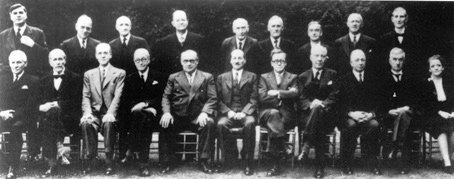
Below I place the first eleven of these in what I judge to be their order of merit. As Starmer has only held this post for a short while I have excluded him from my list. I am very disappointed with him to date but will wait to see if he developes any redeeming features - although I doubt it.

1. Top of my list of Labour Leaders is Clem Attlee. He became the leader of the Labour Party the year before I was born. He  served as Labour leader from 1935 until 1955. He was war-time Deputy Prime Minister to Winston Churchill in the Coalition Government from 1940 to 1945, then Prime Minister of the Labour Governments from 1945 to 1951. His achievements included the development of the Welfare State including the establishment of the National Health Service, the move from the British Empire to the Commonwealth, the development of a mixed economy with a significant role for public ownership,  relative full employment and further Council housing developments.

2. Next in order of merit is Michael Foot, who was opposition leader from 1980 to 1983. He was a clear and sensible democratic socialist. It is seldom appreciated that he was ahead of the Tory Prime Minister Margaret Thatcher in the opinion polls just prior to the outbeak of the Falklands War in 1982. That conflict helped to change British politics opening the door to Thatcherism.

3. Then there was Harold Wilson who was leader from 1963 to 1979, with periods as Prime Minister from 1964 to 1970 and then 1974 to 1976. He had served in Attlee's post-war Labour Government including a period from 1947 as President of the Board of Trade. He pursued a number of progressive avenues especially over the 1964-70 period, including the establishment of the Open University and the outlawing of capital punishment. But he faced growing unemployment, devaluation in 1967 and Trade Union disputes. Then as Prime Minister from 1974 to 1976, Labour was dependent on support from the Liberal Party in difficult economic circumstances. So Wilson never fully delivered what had been hoped for.

4. In fourth position, John Smith had served in Government posts under Wilson and Callaghan and in Opposition positions under Foot and Kinnock. He finally became leader of the Labour Opposition from 1992-4 until his untimely death. I was then an MP and had known him since my entering parliament in 1987. Although I was on the left wing of the Party, I found him to be approachable. And felt that when he was a leader he did not just close the door on left-wingers such as myself. It was a big change from my experiences under the leaderships of Kinnock and Blair. 

5.  Ed Milband became an MP just after I resigned from parliament in 2005. Five years later I eventually supported him in his successful bid to become leader of the Labour Party. A position he held until 2010. My grounds for having supported Ed are reflected in his fine recent publication "Go Big : how to fix our world". Especially the first chapter on Climate Change. See - https://www.youtube.com/watch?v=LTpYaFgRiAE

6. I supported Andy Burnham for the leadership of the Labour Party in 2005 instead of my 6th choice - Jeremy Corbyn. My reasoning being that the Parliamentary Party was not yet ready to be moved to the strong left stance Jeremy had always adopted and that a transitional stage was needed to move in such a direction, or we might be spilt assunder. Now left labourites seem to be in almost as bad a position as ever.

7. Jim Callaghan was Labour's Leader from 1976 to 1980. From 1976 to 1979 being Prime Minister. He was a big disappointment after Harold Wilson. He came from a working class background, but ended up in the 'Winter of Discontent" in direct opposition to the bulk of the trade union movement.

8.  Neil Kinnock led the Labour Party from 1983 to 1992, but only ever in opposition. Given his earlier involvement with Tribune and in other leftist activities, I became massively disappointed with his opposition leadership - especially when I became an MP myself in 1987. No effort came from his office at any time to draw me into anything.

9.  Gordon Brown took over a great deal of Tony Blair's inheritance when he was leader from 2007 to 2010. And Blair finishes at the bottom of my list. Gordon did, however, finally move in the direction of a matter I had campaigned on for some time on the Tobin Tax. See here - http://threescoreyearsandten.blogspot.com/2009/11/tobin-or-not-tobin.html

10. Hugh Gaitskell followed Attlee as leader of the Labour Party from 1955 to 1963. He led it dramatically away from the Clem Attlee position. I used to join Aldermastin Marches alongside the New Left and we sang "Gaitskell is our leader. He should be removed". I also went to a get-together on one of the marches which was attended by number 2 on this list - Michael Foot. Some 64 years ago.

11. Bottom of my list is Tony Blair who moved the Labour Party entirely away from its traditions. I accept that he finalised esssential arrangements for the Northern Ireland peace process. A matter I had devoted a great deal of time to. And that he finally came up with a weak version of a Civil Rights for Disabled People Bill which was something I had pushed more fully. But his 'third way' now hangs fully around the necks of the Parliamentary Labour Party.  However, Starmer has just given his backing to Blair's record ! See - https://www.bbc.co.uk/news/uk-politics-58113968

The higher the Labour Party moves up my list (adding key issues such as climate change, tacking covid and world wide social deprevation] the better. It has been a 76 year journey since I witnessed the 1945 General Election.



Monday, August 22, 2016

60 Years of Labour Leadership Contests.

I give below the results of Labour Leadership elections which I have been aware of in my lifetime. I hope that I have not missed any. From 1955 to 1980 only Labour parliamentarians were entitled to vote. The system has varied since then . There have been 13 elections in all. 31 Candidates (some standing more than once) make up a total of 39 contestants.

A strange characteristic for me of the present contest is that at its announcement I found that I knew less about Owen Smith than I had of any of the candidates on this list. On the other hand, I know more about Jeremy Corbyn than about any of the others, as I met him regularly during my 18 year period as an MP as we were both members of the Socialist Campaign Group. But I still have not made up my mind on how (or whether) to vote this time. For I would like to know how the contestants propose to bring about peace and reconciliation within the Labour Party should they be elected. Has anyone heard them say anything on this matter?

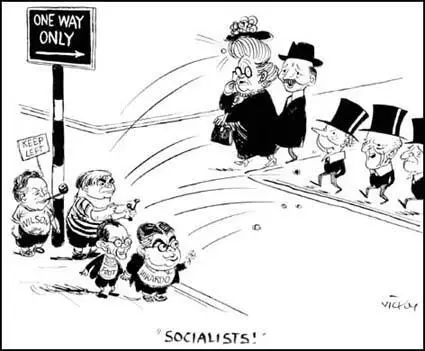
 Vicky, cartoon showing Harold Wilson, Aneurin Bevan, Michael Foot, Ian Mikardo attacking Herbert Morrison, Clement Attlee and Hugh Gaitskell (July, 1951)


1955 Gaitskell 157 Bevan 70 Morrison 40.

1960 Gaitskell 166 Wilson 81

1961 Gaitskell 171 Greenwood 59

1963 Wilson 115 Brown 88 Callaghan 41
                        144           103

1978 Callaghan 84 Foot 90 Jenkins 56 Benn 37 Healy 30 Crosland 17
                            141       133                                            38
                            178       137

1980 Foot 83 Healy 112 Silkin 38 Shore 32
                 139            129

1983 Kinnock 71.2% Hattersley 19.29%

1988 Kinnock 88.6% Benn 11.4%

1992 Smith 91.0% Gould 9.0%

1994 Blair 57.0% Prescott 24.13% Beckett 18.87%

2007 Brown unopposed

2010 E Miliband 34.33% D Miliband 37.78%
                               50.65%                     49.35% 
Also -  (Balls 11.8% Burnham 8.7% Abbott 7.4%)

2015 Corbyn 59.5% Burnham 19.0% Cooper 17.0% Kendall 4.5%


Wednesday, August 31, 2011

Michael Foot : from "Suicide Note" to Salvation?


Gerald Kaufman's claim that Labour's 1983 General Election Manifesto was "the longest suicide note in history" has helped to fuel the impression that Labour's subsequent disastrous election result rested primarily on the shoulders of its policy proposals. To this, is normally added the argument that Michael Foot looked like Worzel Gummidge, which in a television era helped to destroy Labour's popular image.

The above crude analysis conveniently ignores two major alternative explanations for Labour's drubbing.

(1) In 1981, the Labour Party suffered a massive split with the defection of the "Gang of Four" and the formation of the Social Democratic Party (SDP) under the leadership of Roy Jenkins. As it takes two to tango, the blame for Labour's split can not be laid exclusively (or even mainly) on the shoulders of its leftward move. Jenkins and company made the break, refusing to accept the legitimacy of Labour Party Conference decisions. In the 1983 General Election the combined Labour and SPD vote was almost exactly the same as that which an undivided Labour Party had achieved in October 1974 when it won an election under Harold Wilson's leadership. A united Labour Party in 1983 could have achieved something similar.

(2) Prior to the split and then the 1982 Argentine invasion of the Falklands, plus Margaret Thatcher's popularist response, Michael Foot had been ahead of her in the public opinion polls. So much so at one time, that Thatcher was seen as being the most unpopular Prime Minister in British history. But the Falkland Factor (added to the split) was played out to her considerable political advantage.

It is also a paradox that Michael Foot was seen to have had a bad television image, for back in the 1950s he had been a popular and regular television performer in discussion programmes. But by the 1980s, television had become an avenue for those with a simplistic style, rather than those with great oratorical skills, passion, intellect and feeling.

See this article by Jon Williams which stresses the contemporary relevance of the much maligned 1983 manifesto. It is likely to turn out to be far more important for the modern Labour Party than anything that is likely to emerge from its current policy reviews.


Sunday, March 20, 2011

Political Education and the Labour Party

A Conference with the above title was held in Rotherham on Saturday. I suspect that a number of democratic socialists (but thankfully not all) were put off attending when they saw that it was organised by the local Rotherham MP Denis MacShane and that Gerald Kaufman and David Owen were key participants. For at first glance it looked like an anti-left stitch-up. And indeed this might have been part of its intention.

The title of the Conference refers to the General Elections which followed Ramsay MacDonald setting up a National Government, the Attlee Government running out of steam and Michael Foot becoming leader of the Labour Party. These elections led to Labour being in a minority position in parliament for three periods which each spanned between 13 and 14 years.

The implications behind the title being that to avoid such periods in the wilderness, Labour should have stuck behind Ramsay MacDonald, obtained a more dynamic leader than Attlee if Bevanism was to have been nipped in the bud, and just never ever have acquired Michael Foot as leader as he was a loser. The conclusion which is thought to follow from such an approach is that a right wing New Labour agenda is needed in current circumstances.

But as we had a seven hour day with only short breaks and contributions from a series of independently minded academics, Polly Toynbee and others, plus audience participation; other lessons emerged. In fact in the concluding comments of the day from Andrew Gamble a Professor of Politics at Cambridge, he pointed out that the most telling collapse of Labour support emerged in the 1970s and not in the three periods stressed in the title. He could have added that in the ten General Elections from 1974 the Labour vote has only twice topped the 40% mark, yet this level was comfortably surpassed in all the nine post-war elections which proceeded that date. Perhaps if all that talk in the Labour Movement in the early 70s about developing a Social Contact had actually led to the development of a social bond that would have moved us in the direction of sharing, decency and social equality, then our support would not have fallen below the 30% mark in 1983 and 2010.

We were in danger of being provided with a selective one sided diet of the left's failings, covering Jimmy Maxton, Nye Bevan, Michael Foot, past Communist Trade Union leaders, the Ban the Bomb movement, Tony Benn and Militant. But this would hardly amount to a serious analysis. An early contributor David Howell pointed out that Labour support in 1945 was particularly strong amongst first time voters, which covered all those who had not qualified to vote in the previous General Election which was then way back in 1935. This was a cohort of voters who went on to help sustain the Labour vote in numbers of other early post-war elections. The question this leads to is just where can we find such a cohort today who have a clear interest in sharing and equality? What about today's young voters who are concerned about Student Fees, the loss of the Educational Maintenance Allowance, a lack of jobs, a world facing massive shortages of essentials, the dangers of climate change and the horrors of third world poverty? If we bring the young on board on such issues we do more than gain a political advantage, we help to revitalise our own beliefs.

Any conference which provides scope for the dialectics of debate, soon moves out of the realm of political propaganda into that of much needed world of political education; something which invariably takes over when carefully expressed disputes and disagreements arise. Even the anti Michael Foot line which was pressed by Kaufman and Owen, provides scope for countervailing considerations. Just why in 1983 did Michael Foot's leadership produce the worst percentage turn out for Labour of any General Election since 1922? Was it all due to his unilateralism, his duffle coat and his left-wing credentials? What about the knock on consequences of Thatcher running a highly populist and successful military campaign over the Falklands, and then there was the massive rupture within the Labour Party which led to the formation of the SDP? David Owen was at the centre of the breakaway and bares a major share of that responsibility for that 1983 election result.

Around 15 speakers made contributions, numbers of whom had sufficient interest in the topic to join the rest of us in the audience over the seven hours. I have always believed that speakers should also be listeners. Even when Hestor Barron confined her remarks to the experience in Durham Mining Constituencies in the 1930s, my concentration did not drop. But then she was discussing the area of my roots and I have read her book on the Durham Coalfield at the time of the 1926 Strike.

The day revealed an important issue for Labour if it is ever to maintain its future and reach its potential. It needs political education, political education, political education. So it is all power to Denis MacShane's elbow. He may have helped to produce something that has more significance than anything he probably ever had in mind.

Wednesday, March 03, 2010

Michael Foot


I first came across Michael Foot on a Ban-the-Bomb March from Aldermaston to Trafalgar Square in Easter 1960. (The photo was taken at the Labour Party Conference later that year). I marched with a contingent that were associated with New Left Review and somehow on the way I finished up seated on the floor in a crowded room in the flat of Emrys Hughes MP, where Michael was the centre of attention. I had been a regular reader of Tribune for some time, so I was very much a follower of his political position.

From the mid 1970s I was a regular at Labour Party Conferences and often heard Michael speaking either at Party Conference or at Fringe Meetings. Then in 1986 when I was a Prospective Labour Candidate I met him at the funeral of Frank Cousins, which took place at the Crematorium at Brimington near Chesterfield. Earlier I had hoped to visit Frank who lived in my local North East Derbyshire Constituency during his retirement, but his illness had prevented this.

I then served in the 1987 to 1992 Parliament, which was Michael's final period as an MP. He was one of the few senior members of the Commons who spent time listening to others, rather than just popping in and out of the Chamber to speak. But when he did speak there was no one that was more impressive. This is shown in the winding up speech he had made just before Callaghan lost the vote of confidence on 28 March 1979, which then led to Thatcher's first electoral victory. Michael's speech lasts for half an hour, but it is well worth listening to as a way of remembering him.

Thursday, July 31, 2008

The Late Eric Varley

The group in this photo includes Eric Varley who died on Wednesday. He is second from the left and was 27 at the time it was taken. I believe that it appeared in the "Derbyshire Times".

Over a three-year period from 1957 he studied Industrial Relations, Economics and Politics on a Day-Release Course run by the Sheffield University Extramural Department. The photo was taken in Chesterfield and shows a group of Miners who attended the course, presenting miners' lamps to their two final year tutors.

The man holding his lamp up high is the late Royden Harrison. Although I was always very much his academic junior, I took his place in the Extramural Department in 1966 when he moved on.

By the time I emerged on this scene and from 1964, Eric was already the Member of Parliament for Chesterfield. Eventually I was to become MP for a neighbouring seat which almost encircled Chesterfield, but this did not coincide with Eric's time as MP. He and I were also full-time adult students at Ruskin College, but again at different times.

Given such shared experiences, we might have been expected to have met and communicated far more than we did. This distancing arose to some extent because we saw each other as belonging to different wings of the Labour Party and because our paths kept missing each other. I feel that this was my loss.

I did listen annually to his speech at the Chesterfield May Day, heard him address a Rally in Chesterfield for the "no" campaign in Chesterfield during the referendum on the Common Market and made the arrangements with him for his talk to our then local Fabian Society in Dronfield, which is situated between Sheffield and Chesterfield.

The period when we were both at Westminster at the same time was between his appointment to the Lords in 1990 and my retirement as an MP in 2005. But we did not move in the same circles and he was not a regular attender.

We did, however, travel together by train to London if we met by accident and always talked non-stop, he also came to sit next to me at a handful of events - including a Conference of the Regional Labour Party.

He was always keen to find out what I was picking up about politicking in the Chesterfield Labour Party and I was happy to tell him. His own past links seeming to have discontinued.

When he resigned as MP for Chesterfield, he triggered the 1984 By-election which led to Tony Benn's return to Parliament. He had every reason to dismiss the thought that his resignation would have such a consequence. At the time. the Labour Party in Chesterfield had no tradition of lurching to the left. That he had handed the seat over to the very Bennism he had fought within the Labour Party, must have come to him as a shock.

He had held significant front bench posts and had been Treasurer of the Labour Party, so it has always been a mystery in this area as to why Eric resigned from Parliament at that time although numbers of his critics would dismiss his move with the simple claim that he had "sold out".

I feel that we should consider two alternative factors which are not unrelated.

He had been an MP for 20 years. Enough can be enough. I was ready for retirement after my 18 years. On the other hand I was 68 years old. Eric was only in his early 50s, not much older than when I first became an M.P.

Then the political tradition that he was part of was starting to lose its leading role in the Labour Party. There were a couple of options which he would never associate himself with.

First, there was the breakaway by the "Gang of Four" to found the Social Democratic Party which seemed particularly dangerous. It was led by former Labour politicians who seemed to him to be hopelessly romantic pro-Europeans and were also cutting themselves off from what he had grown up with - connections to the Trade Union Movement. He was an NUM Branch Secretary at 23 and became the Chair of the Trade Union Group of Labour M.P.s.

Secondly, there was the Bennite Campaign which seemed to him to be impossiblist. He had himself started out as a left-winger and in his early days was the favoured son of Bert Wynn, ex-Communist and Secretary of the Derbyshire Miners. But by Eric entered the Commons at 31 his political commitments were still maturing. It should not be assumed, however, that he retained little from his Derbyshire NUM past. He saw his new found gradualism* as fitting in with their interests and values. If he was now more right-wing, he was still firmly a labourite. It is something which differs from the later New Labour coup.

My argument might seem to be confounded by the fact that Eric resigned when Kinnock had just become leader. But where did that put Labour in Eric's eyes? Kinnock (whom he seems to have distrusted) still had to battle to overcome Militant and the Bennite left, but it must have seemed that this would be at the price of a great deal of long-winded utopian socialist rhetoric. Eric had run Dennis Healey's unsuccessful campaign against Michael Foot. The consequences of that defeat seeming to Eric to be the electoral humiliation of 1983. It must have looked to Eric as if the next electoral victory (even with Bennism tamed) could still be a couple of decades away. And would it then (whether it was right-wing or left-wing) be recognisable as a labour platform?

I regret not having spoken to him more, perhaps there was something to understand about the feeling he had in his guts.

* = Note added 2 August. Eric would know all about the theories of the Webbs. His day-release tutor Royden Harrison was a leading expert on their (and other) socialist theories.

Thursday, May 10, 2007

13 Wasted Years

In The Beginning

Few of those who voted for Tony Blair in the Labour Leadership contest of 1994 knew or cared about his New Labour project. It was sufficient for the centre and right-wing of the Party that he was presentable and would not rock the boat as far as the electorate was concerned. After all, Labour had been in the wilderness since 1979.

Moderate labourites preferred Tony to John Prescott and Margaret Beckett who at that time both had an appeal for the left and centre-left of the Party.

The New Labour project was, however, to go way beyond moderate labourism. It was to nurture and develop the greater freedoms of the market introduced by Margaret Thatcher, whilst looking for schemes to redirect some of the newly created wealth towards socially desirable ends such as new schools, shorter hospital waiting lists and more job opportunities. Although it was occurring in a new historical context, New Labourism reflected the very norms of Lib-Labism which Keir Hardie and others had fought against when helping to establish the Labour Party itself.

Out Of The Blocks

Tony's first move to break Labour's mould came with his proposal to change Clause 4 of the Labour Party's Constitution, with its commitment to public ownership. Instead, Labour was now to be an advocate of a "dynamic economy" - an Aesopism for Capitalism.

He was now ready to make his appeal for Middle-England (meaning Middle Class) votes. Given the mess the Conservatives had got themselves into, Labour were almost bound to win the 1997 election. Tony's New Labourism was, however, structured to usher in a landslide.

He was now in control of the shop. The norms of full discussions and limited compromises in Cabinet meetings ended. The new wave of Labour MPs tended to be ultra-loyal, hoping that this would ensure their future re-election. The Constitution of the Labour Party was further changed so that the rank and file would find it almost impossible to work out how policies could be changed.

Many left and labourite activists began to re-examine their commitment to Labour. New Labour recruits were attracted in their place, whilst numbers of moderate labourites jumped onto Tony's successful bandwagon.

New Labour Survives A Blip

It isn't easy, however, to drum labourism (and even residual socialism) out of the Labour Party altogether. And immediately after the 2001 election, Tony was placed on the back foot. Although his approach had helped to deliver a second landslide electoral victory, the numbers turning out to vote collapsed. It was now a landslide victory by default. The Conservatives were still in a mess, whilst the past appeal of New Labour to Middle England was on the wane.

At the first meeting of the Parliamentary Labour Party(PLP) after the election, Tony expected gratitude for holding onto the gains of 1997, but what he found was criticism from many of his past loyalists. A shift of direction was now being looked for towards better Party and PLP democracy, in order to alter some of the norms of New Labourism.

An uncomfortable Labour Party Conference was on the horizon, with the Trade Unions both reflecting and influencing the new mood of assertiveness amongst back-bench Labour MPs.

But Tony was then saved by what became his eventual downfall - the consequences of the 11 September attack on the Twin Towers. The Labour Party Conference was truncated and uncomfortable issues sidelined. Tony was now tucked in with the Bush Administration in America, leading to the fateful decision to join in the invasion of Iraq. He increasingly played the role of the National Statesman and was ready to use the votes of Conservative MPs to override the dissident views of increasing numbers of his own back-benchers.

His luck held when few of his Cabinet took the line of Robin Cook and resigned. It was mainly left to the back-benchers to rebel on their own, which they did in increasing numbers in the 2001-5 Parliament compared to that of 1997-2001.

What About Tony's Positive Achievements?

It is, of course, possible to draw up a list of substantial Labour achievements for the past 10 years. But there is a peculiarity about most of these.

Apart from items such as the introduction of the principles of the minimum wage and the praise I lavished on Tony yesterday on Northern Ireland, most of his Government's achievements have to be qualified.*

So that whilst disposable income has substantially improved, so have inequalities. Whilst University education has expanded, so has student debt. Whilst employment opportunities have risen, so has the closure of manufacturing industries. Whilst pensioners can often travel more widely with free bus passes, so workers are more often obliged to travel to work for lower paid and temporary employment. Whilst there has been a devolution of power to Scotland, Wales and now Northern Ireland, local authority functions has been taken away and centralised.

Almost every plus has its associated minuses. Then there are the pure negatives such as the culture of spin. The destruction of the old public service ethos. The downgrading of the role of Parliament (despite allowing a vote on the invasion of Iraq). And the failure to prevent "cash for honours".

The invasion of Iraq was the leading error, even though we can't just now stand back and refuse to offer help in overcoming its consequences.

Whither New Labour?

Will Tony's legacy be to leave us with a New Labour Philosophy? There is no reason to believe that there will be a change of tack from the centre under Gordon Brown, as he has been the economic arm of delivering the New Labour agenda. His clash with Tony has only been over pelf and place.

I have regularly spelt out why I think that Peter Hain should stand for Leader and not Deputy. He can't win, but he is capable of launching a feasible democratic socialist programme for change. But he now only has about 24 hours left in which to make this move. When this doesn't happen, I will have to come out in favour of John McDonnell who will (if he gets the nominations) be the only socialist in the game - surely it won't be Michael Meacher. I will then back Peter for Deputy in the hope that after a likely 2009/10 General Election defeat under Gordon, he will move in to seek to pick up the pieces. Yet he would be in a better position to do this if he stood for Leader now (and lost). We need a champion for now and not tomorrow or Labour Membership and support will go even further down the drain.

An Added Note, 11 May.

* = At this point I should have given a recognition to the important initiatives he took in seeking to tackle poverty in Africa, writing off certain third world debts, in tackling climate change and in moving forward on disability legislation. He could always, of course, have gone further on these and I was particularly frustrated by his unwillingness to advocate an international tax on currency speculation - known as the Tobin Tax. But at least on these matters, he headed in a very different direction to both Bush and the previous Conservative Government.

Monday, March 12, 2007

The Two Worlds of Roy Hattersley

Putting The Boot Into Foot

In using a book review to condemn Michael Foot's leadership of the Labour Party from 1980 to 1983, Roy Hattersley has opened himself up to criticisms here and here.

A partial understanding of what Roy was himself up to at this time can be shown in his activities at the Labour Party Conference in 1981.

Compromise Or Confrontation

At that time, Roy was Joint Chair of the Solidarity Group of MPs which was considered to be on the right-wing of the Labour Party. Prior to what (in those days) were key elections for the NEC of the Labour Party, he addressed a Solidarity fringe meeting. He opened up two options.

On the one hand, he looked for coming NEC election results which would help to heal the wounds in the Labour Party by seeing an advance by right-wing candidates in the (then) Constituency Section which would facilitate the development of a mixed and broader Church. But then he ended up on a more brutal note about the Bennite Left and quoted the slogan "Do not fire first, but if it is war they want let it begin here".

When the election results were announced, Dennis Healy was safely re-elected as Deputy Leader and five lefties bit the dust in the Constituency Section. The potential broad Church was now tilting well to the right.

The "New Socialist" Debate

Roy's immediate response was to seek a move which would either come to terms with the Bennite Left or would undermine them.

He made his initial move for a position of compromise-through-strength at a fringe debate run by what was then the Labour Party's theoretical journal entitled (believe it or not) "New Socialist".

The journal organised a ding-dong right-left debate with Roy and Roger Godsip of Apex on the one hand and leading Bennites, Audrey Wise and Ken Coates on the other.

Roy started with a number of points designed to interest the left or (if that failed) to appeal over their heads to the audience. These included advocacy of high levels of public investment in manufacturing with equity thereby passing into public hands, a socialist incomes policy that would not be a form of wage restraint, what he called genuine forms of industrial democracy and a system of planning agreements. All raving acts of socialism by today's standards.

But instead of Audrey being wise and Ken cottoning on, they looked around for sticks to beat Roy with, such as the failures of the past Wilson-Callaghan Governments and divisions over the European Union. What they should have done was to have got Roy to reveal his full hand and then to nail its socialist potential to the table.

Frustration

I attempted to get called when the meeting was finally thrown open to the floor, to argue that the left should talk turkey with Roy. I wasn't lucky and the ding-dong continued from both the floor and the platform.

Roy had had enough and he left the meeting before the close. When it was all over I dashed up to the late Audrey Wise and sounded off at her at length for the missed opportunity. She could not get a word in edge ways, which must have been a fairly unique experience for her.

Roy was, in fact, willing to continue with his broad Church efforts for a period after the Conference. I had written up my Conference fringe experiences for the ILP's "Labour Leader" under the title "The Two Worlds of Roy Hattersley". He responded with a detailed letter which dealt with his proposals for Labour's Economic Strategy.

But with the 1983 electoral disaster (and the scuttle from socialism) on its way, the Church which Roy went on to help build did not engage with what was left of the left.

The Westminster Terrain

By I became an M.P. in 1987, Roy was Deputy Leader. At an early meeting of the Parliamentary Labour Party, he revealed that he had settled into a position where he was no longer seeking an accommodation with the left. Chris Mullen had just been elected. He was a former editor of Tribune and had worked closely with Tony Benn. When Chris made a contribution from the floor it was something of a mirror image of Roy's approach at the 1981 New Socialist meeting. Although he was in no position of strength, Chris sort a broad Church approach. In dismissing Chris's comments Roy said (in what passed for humour) "well I have to tell you, we are not taking prisoners."

Roy was now in the wrong one of his two worlds. So when the Tribune Group supported him for re-election as Deputy Leader, I left them.

But once Tony Blair arrived on the scene, Roy moved into his other world. This is because Roy is a labourite wherever he resides. It is a pity that back in 1981 the Left did not know that eventually something alien was waiting for them in the wings -New Labour.

Neil Kinnock and Roy were seen as the dream-team. The paradox is that a real dream team earlier might have been Michael Foot and Roy Hattersley, or even vice-versa. But only if Roy had been in his broad Church mode, whilst next to such a fine comrade.

Friday, September 01, 2006

Three in One

If I was asked to pick (a) a favourite radio programme, (b) a favourite author and (c) a favourite weekly journal, I would plump for Little Atoms, George Orwell and Tribune.

Imagine my delight, therefore, when I found all three of these recently rolled into one. On the Little Atoms radio programme, Paul Anderson a former editor of Tribune was interviewed about a book he has edited, entitled Orwell in Tribune. It will consist of a collection of Orwell’s writings from Tribune and is due to be published shortly by Politicos.

Paul Anderson still writes for Tribune. He will be known to some as the joint author (with Nyta Mann) of "Safety First: The Making of New Labour" (Granta Books, 1997). In responding to questions about Orwell and Tribune he was articulate, relevant and highly informative.

If you wish to listen to the programme, click here. Let me first give some more information about the favourites I opted for above.

Little Atoms

Little Atoms is a fortnightly radio programme which can be heard upon Resonance 104.4 FM on Fridays from 16.30 to 17.30. It is a live discussion show with an agenda which is Rationalist, Pro-Science, Atheist, Humanist and for the Progressive Left. So it appeals to all my prejudices; except it has the good sense to see these as being commitments to common sense.

In the programme, Neil Denny and Padraig Reidy (who is deputising for Richard Sanderson) interview guests from the worlds of science, politics, philosophy, journalism and the arts on subjects as diverse as conspiracy theories, cosmology, human rights and the state of the left.

What could be more appealing to a former left (but not nutty) Labour M.P. with a background in studying and teaching politics and philosophy - whose readings nowadays include a greater emphasis on the philosophy of science.

George Orwell

I have been reading the works of George Orwell (and works about him) for nearly 50 years. It wasn’t one of his novels which first grabbed me, but the book in which he describes and assesses his experiences whilst fighting on the Republican side in the Spanish Civil War: "Homage to Catalonia."

The Spanish Civil War broke out five days before I was born and it came to have a special fascination for me, probably because I was brought up during the 2nd World War against Fascism.

The Chapters in his book alternate between his experiences as a militiaman (leading to him being wounded) and the political and then military infighting on the Republican side; which was amongst the Communist UGT, the Anarchists and the independent Marxist force - the POUM. Orwell had joined the latter through links with the Independent Labour Party (ILP) in Britain.

It was perhaps inevitable that I would come to involve myself with the work of the ILP’s successor organisation - Independent Labour Publications.

The best work about Orwell still seems to me to be Bernard Crick’s biography; "George Orwell: A Life" (Penguin 1980). Crick brings together a fine blend of empathy and intellectual rigour in explaining and analysing Orwell’s life and writings.

I only wish that his academic assessment of Orwell’s work had appeared at the conclusion of the book and not as an introduction. For it really flows from the biographical output and could be off-putting to some as a starter.

In a collection of Orwell’s essays, entitled "Orwell and Politics" (editor Peter Davison, Penguin 2001), Timothy Garton Ash states "it was after Spain that he really became Orwell" (rather than retaining his original traits which can be associated with his proper name, Eric Blair). "Every line of his writings now have a political purpose. Imperialism and Fascism would remain major targets of his generous anger".

Although we now face Imperialism and Fascism in modern dress, this even handed and morally significant anger is something we need to nourish to avoid us becoming friends to either side.

Tribune

Tribune (known initially as “The Tribune”) was first published in January 1937 and it still survives. Its heyday was its earlier years up to (and covering) its period of Bevanism. In fact Aneurin Bevan was himself a wartime editor and Michael Foot (his friend and great biographer) had two spells as editor prior to 1959.

Something of the special nature of Bevanism and how it offered a different universe to that now given by New Labour’s Third Way is seen in the following quotation from Bevan’s "In Place of Fear" (1952, MacGibbon & Kee.)

"Democratic Socialism is not a middle way between capitalism and Communism. If it were merely that, it would be doomed to failure from the start. It can not live by borrowed vitality. Its driving power must derive from its own principles and the energy released by them. It is based on the conviction that free men can use free institutions to solve the social and economic problems of the day, if they are given a chance to do so".

The driving power Bevan wished to unleash is seen nowhere better than in Orwell’s writings for Tribune. He wrote some two dozen articles for Tribune from 1940 to 1943 and then became a regular contributor until 1947. For a key period, he was their literary editor and had a personal column entitled "As I Please" to which he made 80 separate contributions.

On Tribune’s 10th Anniversary he wrote that Tribune was "the only existing weekly paper that makes a genuine effort to be both progressive and humane - that is to combine a radical socialist policy with a respect for freedom of speech and a civilised attitude towards literature and the arts". As Bernard Crick claimed in his autobiography of Orwell, "there was less a Tribune line than a Tribune style of argument, which suited Orwell perfectly".

I look forward to reading Paul Anderson’s selection of Orwell’s writings taken from Tribune. Especially as Anderson was first attracted to work for Tribune as its literary editor so that he could follow in the footsteps of Orwell whose work he was 'hooked' upon.

Anderson found a similar satisfaction in that work to that felt by Orwell.

I first ever heard about Tribune when listening to the BBC Overseas Service broadcasting "What the Papers Say" when undertaking my National Service in 1955 and 1956. I wasn’t able to purchase copies until I returned home to be demobbed. These was the heady days of the Suez and Hungarian crises, followed quickly by the marches to "Ban the Bomb".

Today’s Tribune only occasionally reaches the heights of those days. But I subscribe to it still out of past loyalties and in the hope that the Labour Left can flourish again whilst avoiding the twin entrapments of Chomskyism and a fresh Brownite version of New Labourism. As Bevan saw, Democratic Socialists have their own vitality.

Perhaps reflections on Orwell’s Tribune could fruitfully help us to rediscover this.