Wednesday, December 10, 2014

Labour : Great Minds or Fools?


Changing Britain Together

It is good to see that the Labour Party has now caught up with the approach I have been pushing in the 16 items which appear below this one.  They have published their own popular and usable version of bullet points and arguments taken from the policy document "National Policy Forum Report 2014", which was adopted at its recent Conference. It will shape their General Election Manifesto and needs to be accessed and used by Labour's rank and file. Hopefully it will find its way into the hands of Constituency Labour Parties, their branches and affiliated bodies; with encouragements for them to push its messages to the electorate.  It can be found here. You will then need to click into the PDF Download shown at the bottom of its page.

They have not, of course, done this because I have been peddling it. It is either a matter of great minds think alike or fools seldom differ.

If you are into this, you can now scrawl down from here.


Thursday, November 20, 2014

Labour's Electoral Programme (Part 16, the Summary)

Ed Miliband acknowledges the faithful after his speech at the Labour Party conference in Manchester

In the previous 15 parts of this series, I have taken 180 points from Labour's Policy Document, called its "National Policy Forum Report".  For presentational reasons these are not direct quotes, but are near-quotes. My intention has been to retain the original meanings.  I have also, however, been selective as nearly twice as many points can be found in the original document; but hopefully I have not missed out on any of the major areas which are covered.

A reason that I started to summarise these points was that I felt that the Labour Party was missing key opportunities to spread its ideas in the run up to the General Election. The earlier version of its proposals were missing from both the European Election Campaign and the Scottish Referendum Campaign. Then when Labour finally adopted its proposals at its recent annual conference, this was done in a very low key fashion.

I had two main fears. First, that we were only going to start pushing the programme in the period of the short election campaign after the Commons itself was dissolved - and this would be too late. Or secondly (even worse), that the broad sweep of the proposals would just be ignored and had only been worked upon to keep the active rank and file quiet. But things have now started to improve. Even Ed Miliband's speech at the CBI drew from what is now my final category on the Private Sector; then he came out with a strong line with an earlier point against Zero Hours Contacts.  This week the section on Immigration has been stoutly pushed by Yvette Cooper. Then tomorrow we can expect the section on the NHS to be strongly pursued in a Common's debate on a relevant Private Members Bill. On top of which there are also signs that Labour will initially seek to begin to galvanise its members first through a planned series of Regional Meetings; as shown here.

Not only do we need to push the points I cover using the media and then counter any flack they come up with; but we need canvassers and candidates to be pushing our programme. It moves us beyond New Labour and opens the door for clearer democratic socialist advance at a later stage.

This is what is covered in the previous 15 sections - 

For part 1 "Improving Wages and Working Conditions" see  here

For part 2 "Fair, Sustainable and Responsible Economic Growth" see here

For part 3 "An Equitable Tax Structure" see here

For part 4 "A Charter For Young People" see here

For part 5 "The National Health Service" see here

For part 6 "Education, Education, Education" see here

For part 7 "Local Democracy" see here

For part 8 "Political Reform and Equal Rights" see here 

For part 9 "Energy and Climate Change" see here

For part 10 "Disability. Transport" see here 

For part 11 "Policing and Security" see here


For part 12 "Europe and Immigration" see here

For part 13 "Rural and Cultural" see here

For part 14 "Our Global Role" see here

For part 15 "Pensions. Private Sector" see here

ADDED 6 DECEMBER  - There is also this, which I have just discovered on a Labour Party web-site. How many CLPs are aware of it ? And how many are making use of it ?
 http://action.labour.org.uk/index.php/cost-of-living-contract/

Labour's Electoral Programme (Part 15)


Pensions

1. Protect the value of the state pension with the triple lock, rising annually by inflation, earnings or 2.5% whichever is highest (page 37)

2. Place a legal requirement on all pension scheme providers to prioritise the interest of savers over those of shareholders (37)

3. Explore how to reduce the minimum earnings threshold or auto-enrolment from the current level of personal tax allowance (currently £10,000) to the Lower Earnings Limit currently £5,772 (38)

4. Defined Contribution Schemes to have meaningful employee representatives on governance boards (38)

5.  Review the Local Government Pension Scheme, exploring the merits of merging funds to improve performance (38)

6.  Consider the case for a specific cost of living index relevant on the spending of pensioners (38)

Private Sector

7. Manufacturing is of strategic importance to a sustainable and balanced economic recovery. We will reduce energy costs for businesses via a price freeze, support science, research, development and technology and promote advanced apprenticeships; with access to funding coming through our British Investment Bank (23)

8. We will work actively with business, trade unions, communities and regions to build the economy of the future (23)

9. We will support social enterprise, mutuals, co-operatives and the not-for-profit economy (24)

10. On the Royal Mail we will keep its remaining 30% in public ownership and secure its public service obligation beyond 2015, whilst investigating the process by which it was privatised and ensure that Royal Mail services continue to be provided through Post Offices (24)

11. Tackle the monopoly market for rail rolling stock and bring Network Rail together with a new representative passenger rail body to contract routes, co-ordinate services and skills in the industry, oversee stations, fares, ticketing, and ensure customer satisfaction (45) 
   
12. Require water companies to publish full annual information which a revitalised Ofwat will then use to evaluate whether they should cut bills (49)

Labour's Electoral Programme (Part 14)


Our Global Role

1. On human rights we should lead other nations by example - for women's rights, an end to bias and ill treatment of lesbians, gays, bisexuals and transgender people. This should involve the enhancement of workers' rights (page 127)

2. Being appalled by the human rights abuse in Qatar sponsored by the Kafala employment system, we call for Qatar's right to hold the World Cup to be removed (127)

3. We support access to Syria for the full implementation of the UN Security Council's Presidential Statement on humanitarian access (128)

4. Seek a comprehensive peace in the Middle East on the basis of a two state solution for Israel and Palestine, recognising the illegal nature of the West Bank and support the end to the blockade of Gaza (128)

5. Will enshrine in law the UK target to spend 0.7% of GDP on overseas development assistance (129)

6. With the deadline for reaching the Millennium Development Goals expiring in 2015, we will support a post-2015 development agenda seeking to eradicate global poverty, promote sustainability and end aid dependency based on humane conditions (129)

7. Sharing tax information must be extended to developing countries, requiring large multinational companies to publish key information needed to assess the amount of tax they pay (129)

8. Ensure that the UK, Crown Dependencies and Overseas Territories share tax information with other countries to allow developing countries to deal with the transfer pricing challenge and improve tax collection capabilities (129)

9. In supplying relief in emergencies, seek to be timely and effective and press to improve the coordination of the global response (130)

10. Campaign for an international Financial Tax covering major financial centres to curb the volatility of financial transactions (130)  This also appears in Part 2, item 12.     

11. Help to ensure that an effective and enforceable agreement to cut global carbon emissions is effective by 2010 (131)

12. Work with our partners to achieve a low carbon energy supply and create more green jobs (131)  This also appears in Part 9, item 9.

Wednesday, November 19, 2014

Labour's Electoral Programme (Part 13)


Rural and Cultural

1. Work with employers to challenge low pay in rural areas, freezing business rates and energy bills for small and medium size enterprises - SMEs (page 51)

2. Raise the profile of career opportunities in rural areas and help SMEs and food businesses access the investment they need to expand (51)

3. Pay Winter Fuel Payments earlier for pensioners using off-grid energy (often in rural areas) allowing them to purchase their energy at lower summer prices and store up supplies for the winter (51)

4. Restore trust in the food system by enhancing the role of the Food Standard's Agency (51)

5. Tackle cruelty in the breeding policies of the pet industry, promote responsible pet ownership and address the trade in exotic pets (52)

6. Eradicate TB through the vaccination of badgers and cattle and not via a misguided and unscientific badger cull (52)

7.  Protect Britain's natural environment, right to roam and wildlife for future generations (52)

8. Develop a regional strategy to support the arts in all parts of the country (52)

9. Ensure adequate funding for the BBC, protect community libraries and ensure that all homes and businesses have access to reliable broadband services (52,53)

10. Establish a low-cost arbitration service as recommended by Leveson to provide justice for victims of libel and other press abuses (71)

11. Ensure that bona fide supporters clubs are recognised and given statutory consultation rights over the future of sports grounds (71)

12.  Encourage the development of community marketing co-operatives to encourage the development of tourism (72)


Tuesday, November 18, 2014

Labour's Electoral Programme (Part 12)


Europe and Immigration

1. Recognise that Britain's relationship with Europe is of vital importance and that the benefits from membership of the EU cannot be underestimated, as it is our major trading partner (page 121) 

2. On the trade deal being negotiated between the EU and the USA (TTIP), see that NHS and other public services are not included in any agreement (121)

3. Allow governments in the EU to be able to legislate for legitimate public policy objectives within any TTIP agreement, rejecting the abusive techniques of the proposed Investor-State Dispute Settlement agreement (121)

4. See Britain's national interest as being at the heart of a reformed EU which should include binding and robust human rights clauses, including ILO core standards (121)

5.  Seek tough new EU budget discipline with a stronger independent audit, a balanced growth plan, a new Growth Commissioner and reform of the Common Market Agricultural Policy; with an end to the wasteful duplication of holding its parliament in Strasbourg as well as Brussels (126)

6.  Press the EU to establish a new Commissioner for Growth and its own equivalent of the UK's Office of Budget Responsibility, with a remit of examining the impact EU decisions will have on the promotion of jobs and growth (126)

7. Migrants are amongst the most exploited workers in our economy and are often used to undercut other workers' positions, such abusive employment practices will not be tolerated (page 68)

8. Introduce a proper strategy for integration, requiring public sector workers to reach a basic level of English proficiency and strengthen regulations in the private sector to prevent rouge landlords from cramming immigrants into sub-standard housing (69)

 9. Give powers to border staff to act quickly when they find abuse, training to help victims of trafficking, and ensure exit checks are put in place to track who is coming in and leaving the country (page 70)

10. Tackle the exploitation of migrant workers, an approach which also undercuts local workers; using a  greater enforcement of the minimum wage and a register to tackle rogue landlords. Place a ban on recruitment agencies hiring exclusively from abroad, whilst extending the remit of the Gangmasters' Licensing Authority (126, 69)

11. Make changes to the Job Seekers' Allowance to clarify that people without contributions should not receive benefits when they first arrive in Britain (126)  

12.  Review the practice of sending family benefits to relatives living abroad (126)  


Monday, November 17, 2014

Labour's Electoral Programme (Part 11)


Policing and Security

1. Tackle cross-border crime in co-operation with police and judicial authorites in Europe (page 64)

2. Return to neighbourhood policing, getting officers back on the beat  (64, 65))

3. Introduce a Victims Law to give victims of crime new entitlements (65)

4. Extend legal protections for victims of hate crime (66)

5. Extend legal aid and make wealthy criminals fund legal bills from their frozen assetts (66)

6. Reform prisons so that inmates engage in productive activity and prioritise rehabilitation (66)

7. Establish a commissioner on domestic and sexual voilence to sit at the heart of government (67)


8. Increase action to stop human trafficking, including reviewing the operation of the domestic visitors visa (68)

9. Improve the effectiveness of our co-operation with other countries, with our continuing support for the European Arrest Warrant which has brought so many dangerous criminals to justice (122)  

10. Show international leadership on reducing the flow of arms to repressive regimes (122)

11. Work to enhance the momentum towards global mulilateral nuclear disarmament and non-proliferation (123)

12. Protect and develop a highly skilled defence sector workforce (123) 


Sunday, November 16, 2014

Labour's Electoral Programme (Part 10)


(A) Disability


1.  End the contract with ATOS and reform the Work Capacity Assessement to focuses on the support people need to work and give disabled people a role in reviewing the operation of the test (35, 36)

2. Work with disabled people and their organisations to reform the discredited Work Capacity Assessment (36)

3. Create good quality and sustainable jobs for disabled people drawing lessons from the Remploy model (36)   

4. Ensure that employees facing terminal illness receive support if they wish to remain in work (36)

5 Work with disability organisations to enhance access to public transport, including a strategy for step-free access to railway and underground station and trains; plus the provision of audio-visual announcement systems (43)

(B) Transport

6. Tackle the rising costs of using buses and rail and also tackle the reduction in the quality of local bus services (Page 42)

7. In tackling rising transport costs, bring transport provisions closer to communities and passengers; whilst integrating freight transport - by road, rail, air and sea. (42)


8. Ensure that safe public transport caters for people who work late hours (43)

9. Allow a public sector operator to take on railway lines and challenge train operators on a level playing field(44)

10. Use  cooperative principles to provide for passenger and employee involvement (44)

11. Place a strict cap on annual rail fare increases across all routes (45)

12. Regain control of the High Speed 2 budget and ensure that the project creates new apprenticeships and job opportunties (46)


Labour's Electoral Programme (Part 9)


Energy and Climate Change

1. Take immediate action to freeze energy bills, whilst reforming the energy market to put transparency and competition back into the industry by legislating to force energy companies to separate their generation and supply businesses (pages 10, 17)

2. Labour is committed to tackling climate change and will take advantage of the opportunities that have arisen from the low-carbon economy and green industries (13)

3. Support different models of energy generation and ownership; including co-operative, mutual and municipal models (47)

4. Introduce simpler tariff structures to make it easier for consumers to compare prices, with a new tougher regulator to ensure a fair deal (47)

5. Support pensioners, households with a disabled person, families receiving Child Tax Credit and other vunerable households with insulating their homes and in improving their heating systems (47)

6. In reducing the amount of energy we use, we will radically reform the current Energy Company Obligation by using area-based programmes led by local authorities in partnership with businesses (48)

7. Comprehensively uprate the energy deficiency of a vast stock of our homes (48)

8. Create a new generation of technicians to retro-fit energy conservation and low carbon measures that will reduce household bills and the country's carbon footprint (48)

9. Climate change is one of the greatest challenges facing the world today and our energy policy must reflect the need to decarbonise our energy supply in order to meet emission targets (49)

10.  We will decarbonise the power sector by 2030 and commit to reducing greenhouse gas emissions by 32% in 2025 (49)

11.  Shale gas is not a silver bullet and faces important regulatory and environmental questions; to meet the twin goals of a low carbon supply and keeping energy bills as low as possible, we need an energy mix of renewables, nuclear and carbon capture, which is vitally important for the future of coal (49, 50)

12. We will reprioritise flood protection (50)

Saturday, November 15, 2014

Labour's Electoral Programme (Part 8)


Political Reform and Equal Rights

1. Reform the legislative process so that interested citizens can more easily engage in making and scrutinising laws (Page 110)

2. Encourage more diversity in representation at all levels of governance: including school governors, councillors and parliament as there are still too few women, BAME, LGBT, disabled and working class candidates (110)

3. MPs will have new limits placed on outside earnings, with a ban placed on second jobs. (110, 111) 

4. Turn the House of Lords into an elected Second Chamber, using a proportional system and providing a forum for regional representation (111)

5. When the franchise is extended to 16 year olds (see part 4), we will introduce a schools and colleges electoral registration programme with the placing of ballot boxes in these areas (111)

6. As millions are missing from electoral registers, when anyone comes into contact with central or local government services and when their business is concluded it will be checked as to whether they have registered to vote. We will also look into the merits of placing ballot boxes in public places and providing electronic voting (111)

7. Build on our proud history of fighting discrimination by re-instating the third party and pay transparency aspects of our 2010 Equality Act (113)

8. Strengthen laws against discrimination for those taking maternity leave (114)

9. Pursue a goal of 50% for all ministerial appointments to public boards to ensure women are fairly represented and look at how public policy can better consider the lives of women in their fifties and onwards (114)

10. Work to achieve the rights which disabled people are entitled to under the UN Convention on the Rights of People with Disabilities, which have been undermined by benefit changes (115)

11. Introduce specific criminal charges of incitement to disability hatred (116)

12.  Tackle racism in all its forms and prevent the politics of hate being employed by extremist organisations (117)

Friday, November 14, 2014

Labour's Electoral Programme (Part 7)


Local Democracy

1. Transfer responsibility for local transport decisions to elected and accountable transport authorities and partnerships (43)

2. Legislate to give local authorities more powers to create better bus networks (44)

3. Devolve decisions over the running of regional and local transport services, so that areas can bring trains, buses, ferries and trams into a single network (45)

4. Monitor the operation of Right to Buy in order to empower local authorities to better manage their housing stock (page 57)

5. Support local authorities who want to build more social homes and encourage those who are not building to do so, whilst reforming the Housing Revenue account to build new homes to the maximum potential and to improve existing homes (58)

6. Tackle land banking by giving local authorities powers to charge developers who refuse to build, despite having planning permission (58) 

7. Reform the Housing Revenue Account system to ensure that communities receive a larger share of gains from developments (58)

8. City and County Regions that come together will be given historic new powers over transport, housing, skills and economic development (60)

9. Provide a fairer funding formula for local government linked to need and ensuring that local authorities are properly resourced by allowing them to control more tax revenues and spending in their areas (61) 

10. Devolve new powers to local authorities and groups of local authorities for skills and employment support, economic growth and health and well-being (62)

11. Empower communuties to shape their high streets to tackle the prolification of betting shops, fast food outlets and pay day lenders; whilst creating more demand for town centre shops by building appropriate housing near to town centres (63) 

12. Legislate for a new settlement that devolves significant new powers to local government (113)

Some of the above points can only be legislated from Westminster for English areas; for Scotland, Wales and Northern Ireland they fall under the remit of their devolved administrations.   

Thursday, November 13, 2014

Labour's Electoral Programme (Part 6)


Education, Education, Education 

1. Ensure that all teachers in state funded schools have, or are working towards, a Qualified Teacher Status and remain up to date with subject and pedagogical skills; and receive disability equality training (pages 75, 76, 88)

2. See that teachers have a fair, consistent national pay system, whilst reinstating the School Staff Negotiating Body set up by the last Labour Government to develop consistency in pay, conditions and job roles for school support staff in publically funded schools (76)

3. Empower local communities to have a greater say about education in their area, with Local Authorities appointing and holding to account Directors of School Standards, thus ending the fragmentation of the school system (78)

4.  We will not continue with the Free Schools programme, such existing schools will be held to the same high standards as other schools, working with the local family of schools and with the Director of School Standards (80)

5. Ensure that the Charity Commission rigorously assesses private schools to see they meet their charitable status and work with their local communities and state schools in their area (80)

6. Local Authorities will be able to open new community schools once more, with decisions on school places being taken locally (81)

7. Increase the number of young people studying science, including young women. Whilst providing access to other high quality education; including in the areas of sex and relationships, civic responsibilities, plus social and moral awareness (82)

8. Support health and well-being in schools; with a stress upon physical education, school nursing, continuing free school meals for all infants and the development of breakfast schools (82, 83)

9. Ensure there are retraining and lifelong learning options (85)

10. Provide targeted early intervention, with Sure Start playing a key role; whilst expanding free childcare from 15 to 25 hours for working parents of three and four year-olds; for families who require childcare, we will introduce a legal guarantee to wraparound care from 8am to 6pm through their local school (87)

11. We will not allow any new grammar schools to open (87)

12. Ensure equal access to educational opportunities with a fair admission's policy under a Schools Admission Code, the removal of financial barriers on young people, provide periods of face-to-face tuition on full time courses in further education and operate a child protection system (87, 88) 

 The above are a selection of  proposals made in the Labour Party policy document "Education and Children". Other items from this document appeared in Part 4 as part of "A Charter For Young People".


Wednesday, November 12, 2014

Labour's Electoral Programme (Part 5)


The National Health Service

1. Within the NHS bring together physical health, mental health and social care into a single service to meet all of a person's care needs, with a focus on prevention, thus ending fragmentation (pages 93 and 95)

2. Repeal the Health and Social Care Act 2012, scrapping regulations which force services to be put out to tender and bring back failed contracted services into the public sector (93)

3. Oppose the inclusion of the NHS and other public services into a trading agreement which is currently being negotiated between European Union and the USA, as this would block such  proposals (93, 94) 

4. Make Foundation, NHS and Community Trusts accountable to the public and fully integrate all service providers to work in a collaborative and not a competitive way (94)

5. Create a national entitlement, written into the NHS Constitution, to ensure that patients get legal rights to access the services they need, replacing the current market system which does nothing to provide real choice to patients (95)

6. Give people the right to receive their end-of-life care at a place of their choosing, with family around them (96)

7. Ensure communities have a real say in shaping local services, taking power away from NHS commissioners and giving it to independent bodies such as the Health and Wellbeing Board, with a duty to secure real public engagement (97)

8. Give NHS patients the right of same-day consultation with their local GP surgery and the right to book an appointment within 48 hours with the GP of their choice (98)

9. People need a fairer deal and protection against the rising costs of care. Greater localism of services will have a beneficial impact (100)

10. There will be a greater institutional recognition of the rights of carers, including young carers and their rights to childhood (101)

11. Ensure that mental illness is treated with the same level of priority as physical illness, creating a new right to psychological therapies, with more mental health specialists working in teams with GPs, nurses and carers (104)

12. Support the excellent work of health unions and strengthen collective bargaining structures in the NHS to work towards a fairer system of pay setting (105)

The above are a selection of some 40 proposals made in the Labour Party policy document "Health And Care"


Tuesday, November 11, 2014

Labour's Electoral Programme (Part 4)


A Charter For Young People

1. On university funding, we will reduce the burden on students and relate repayments to the ability to pay (pages 25, 85)

2. Raise the status and quality of vocational education with a gold standard qualification, covering relevant work experience plus English and Maths skills to be achieved by the age of 18; whilst building a post-18 apprenticeship and vocational education system (25, 77)

3. Provide high quality careers advice in schools and colleges (33, 78)

4. Introduce a fully funded jobs guarantee for young people who have been out of work for a year, which will pay the wages of participants for 25 hours a week, on at least the minimum wage (35)

5. Provide a quality and professional youth service (82, 109)

6. Ensure that all apprenticeships and occupational standards are agreed via industry-led bodies, comprising trade unions, employees and technical representatives relevant to the occupations, industries and sectors they serve (84)

7. Use public sector procurement to ensure that high quality apprenticeship is a prerequisite for any bid for significant government contracts (84)

8. Ensure that young people are better educated about their civic role via better quality citizenship education (108)

9. Outside of formal education; volunteering and mentoring schemes will be used to encourage democratic participation and involvement in civic society by young people (109)

10. Lower the voting age to 16 for all UK elections and provide avenues and facilities for young people to engage in the democratic process (109)

11. See that pupils are involved in decision-making in schools, whilst encouraging local councils to adopt a youth council or youth mayor programme (109)

12. Ensure that when young people have the opportunity to participate in youth services, they engage with their local communities and learn through practice about civic responsibilities (109) 

Monday, November 10, 2014

Labour's Electoral Programme (Part 3)


An Equitable Tax Structure

1. A 10p starting rate of taxation which will benefit those on lower and middle incomes (page 16)

2. A progressive mansion tax on properties worth over £2 million (16)

3. Close down loopholes which allow people and businesses to engage in tax evasion, including their shifting of profits out of the UK (16, 17)

4. Pursue greater transparency around revenues, profits and taxes paid to ensure that the way companies allocate their profits for tax purposes is fair (16)

5. Press for international action to tackle tax aviodance which arises through the use of tax havens (16)

6. End cuts in corporation tax for multinationals and large businesses (17,18)

7. Restore the 50p top rate of tax for those earning over £150,000 (18)  

8. Provide a tax rebate to those companies that sign up to become living wage employers (28)

9. Require companies to publish the ratio of pay of their top earner compared to their average employees (28)

10. Increase the bank levy and use the resources to expand free childcare (28, 87)

11. Abolish the Bedroom Tax (33, 35)

12. Support a progressive taxation system and ensure that the wealthiest individuals and businesses contribute to the society they profit from by prioritising anti-aviodance action in tax enforcement (129)


Sunday, November 09, 2014

Labour's Electoral Programme (Part 2)


Fair, Sustainable and Responsible Economic Growth

1.  Ensure investment in key areas of our economy and the strengthening of public services (page 10)

2.  Support good management and employee relations (10)

3.  Support sectors and technologies that will generate well paid and secure jobs (10)

4.  Decentralise powers to give towns and cities new controls over transport, housing, skills and economic development (12)

5. Bring outsourced public services back in-house where this brings better value for money (12)

6. Ensure a positive public procurement process that supports employment and growth (12)

7. Set up an effective British Investment Bank to help small and medium sized businesses (13)

8.  Back low-carbon industries, including the decarbonisation of the power sector by 2030 (13)

9.  Establish an Independent Infrastructure Commission to established the UK's infrastructure needs, which will take into account our climate change targets (14)

10. Ensure that 200,000 homes a year are built by the end of the next parliament (14, 57)

11. Support a progressive taxation system, prioritising tax avoidance by the wealthiest individuals and businesses (15)

12. Seek an international Financial Transaction Tax covering major financial centres, to raise funds for the exchequer and to curb the volatility of financial transactions to help prevent a re-run of the 2008 financial crisis (15)

Saturday, November 08, 2014

Labour's Electoral Programme (Part 1)

The General Election is only six months away. If Labour is to make an impact, it needs to start pressing its electoral programme now. It has no problem in doing this, for after considerable inner-party discussions it came up with a final version of its agreed proposals at its recent Annual Conference. The document containing these proposals is entitled "National Policy Forum Report 2014" and it can be found here.  It is, however, 218 pages long and needs sorting out into more manageable chunks. This needs doing before it can be distilled into an even easier-to-handle electoral manifesto. In case no-one is sorting out these matters at the moment, I will try my hand at doing this in a series of items on this blog. Each of these will normally cover a single broad aspect of Labour's Programme and I will give the page references for each of the sub-points I refer to.  My intention is only to give the general thrust of Labour's proposals, so sometimes extra items could have been added. I will start with this area -

(1) Improving Wages and Working Conditions.

1. Strengthen the National Minimum Wage (see page 9).

2. Expand the Living Wage (9).

3. Advance the role of Pay Review Bodies (9).

4. Stamp out Zero Hours abuse (10).

5. Review TUPE's rules to avoid a race to the bottom on pay (10).
    (TUPE applies when workers are transferred to a new employee).

6. Pursue equal pay for equal work (10).


7. Expand the work of the Low Pay Commission to tackle in-work poverty (27)

8. Ensure there is an employee representative on renumeration committees (28).

9. Support flexible working for parents (28).


10. Provide proper health and safety in the workplace (29).

11. Also ensure that self-employed workers are protected. (29)

12. Use a European Court of Justice's ruling to assist in calculating holiday pay (30). 

Thursday, October 16, 2014

A Chronicle of Easington Colliery

 Mary Bell with her book 'A Chronicle of Easington Colliery'.

I was delighted when Mary Nightingale Bell (above) asked me to write a foreword to her fine book "A Chronicle of Easington Colliery". She has kindly agreed to my republishing that foreword here, as a means of explaining something about the nature of her work.

Details of how to obtain the book can be found here. I am sure that those who read it, will then be interested in turning to her related book of poems, which was published two years ago under the title "Where the Pits Were : Poems from Easington Colliery".
 
These works are not just appropriate for those who know or knew Easington Colliery. They provide fine insights for anyone interested in the nature and development of working class communities.


FOREWORD

This book is a remarkable achievement.

Too often we have to make-do and mend when examining the nature of life in a working class community. In autobiographies, established writers or celebrities who come from such backgrounds may hand us some snippets about their formative years. Then historians may report on research material which they have unearthed. But unfortunately, these are all just bits and pieces. For as Peter Crookston pointed out in his book “ThePitmen's Requiem” (Northumbria Press, 2010), working class people themselves seldom keep a “shoebox in the wardrobe” in which they have stored key source material about their family and community activities. So much of what we need to know about such communities gets missed or remains shrouded in generalisations.

Thankfully, Mary Bell is a solid exception to the rule which Peter Crookston pointed to. Although she has collected together far more material about her community than that which a mere shoebox could accommodate. Mary was born in Easington Colliery in County Durham in 1930. It was only after the pit was closed in 1993 and the bulldozers were later coming to knock down former Colliery houses in the area in which they lived, that she and her late husband Jim moved to a bungalow just two miles away at nearby Horden Colliery. But she never really left Easington, for she could not keep away from it. One of the solid links she developed was with a group of “Easington Writers”; where she came to contribute poems and articles for their fine publication “Shrugging Off the Wind”. 

Furthermore, Mary has an exceptional memory. Yet she does not just draw from her own experiences, for throughout her life she has sought (and retained) information from friends and relatives. On top of which she has conducted original research into Easington Colliery's past, via avenues such as the Durham Miners' Association and Beamish Museum. Her efforts are fully revealed in this book. First in her fine chronology of Easington Colliery's history, then finally when she traces the details about the 193 men and boys who were killed during the lifetime of the local pit. She has kept, compiled and used a stack of key information, which would fill masses of those shoe-boxes.

Mary has, however, done far more than keep records which others can turn to. In this book, she has used her store of information to illustrate and explain the nature of the area's solid working class community, whose life before the closure of the pit in 1993 rested overwhelmingly upon the mine's existence. For only a year after production had first got underway at the pit, her husband's parents and their three sons had moved into a Colliery house just across the road to the pit itself. Then by she was born, her parents and elder sister were already settled into local Colliery life.

The Colliery area that she was born into was then at its peak population of ten thousand. This population fell somewhat afterwards, thanks to the spread of birth control techniques.But it was the closure of the pit in 1993 which had the biggest impact on its make up. Its current population now being under half of the peak shown via the 1931 Census.

Mary tells us how key events shaped the life of her community. It was often a school of hard knocks. There was the impact of the First World War (see the local War Memorials for the many former miners killed in action) and the serious influenza epidemic at its close. This was followed by a series of industrial disputes culminating in the lengthy Miners' Strike of 1926; then came short time working as a consequence of the 1931 economic crisis. From Mary's direct experiences as a young girl, we find out what local life was like during the Second World War. Then just as everything settled down to a form of relative post-war prosperity, Easington was hit by a devastating pit disaster in 1951 which killed 83 men. Later significant industrial unrest returned, culminating in the major strike of 1984-5 and then the closing of the pit in 1993 – plus its consequences.

But these are merely the broad facts, Mary explains the key elements - what these facts mean in terms of the nature and quality of life in her community. She can do this because she is a full insider. I am like many others, in what is now often too much of a mobile society. It is a world in which people often feel obliged to uproot themselves and where they may eventually find fresh communal connections. I left Easington Colliery over 50 years ago and finally settled in North Derbyshire. I have dabbled in writing three short articles about my old roots, covering from 1899 to 1935, which are the years before my birth – often with the help of Mary's records. But Mary has now herself covered the broad sweep in both key detail and via the understanding which can only come from experience and involvement.

If many communities are short of “shoeboxes in their wardrobes”, then let us hope there are those who will read this book who will decide to follow Mary's alternative example. The more we know what daily life is like (and has been) in differing neighbourhoods, the better we understand the strengths we need to nurture and the factors we need to tackle.

Hat Tip for the photo - Hartlepool Mail

For more on my own bits and pieces on Easington Colliery, see the "Easington' label below.


Sunday, September 21, 2014

Constitutional Conundrums


Map of the UK

Labour's response to the result of the Scottish Referendum and to the promise of further devolved powers to Scotland must first of all be to press to deliver what has been promised. Yet we also need to work towards a federal-style structure for the United Kingdom in which equal and co-ordinated powers will be held (as near as is possible) by Scotland, Wales, Northern Ireland and the Regions of England.

In the meantime, MPs from Scotland should retain the same rights in the Commons as other MPs. For they will have been elected to a UK parliament. We should not even have a passing provision in our constitutional practices for first and second class MPs. It undermines the democratic process.

 If Scottish MPs were to be refused parliamentary rights over matters which refer to England, then surely this provision would then have to apply to MPs from Wales and Northern Ireland. But as the powers devolved to Scotland, Wales and Northern Ireland all differ from each other; we would then have a confusing pattern as to which MPs could participate in what.

In moving for a federal structure for the whole of the UK we need to resolve two major problems.

First, what will the people of Northern Ireland agree to for their own internal arrangements?  Under a federal model, the province would be a small and barely viable unit within the UK, with a population of only 1.8 million. Then if they were offered a significant federal status, this would be seen as a form of detachment from the UK. This is a position that is likely to be rejected by the majority of the Unionist population. Moves to introduce a federal solution in the province, could even lead us back to major paramilitary conflict.

Secondly, what is an appropriate federal structure which should be shared across England?  If England were to become a single federal unit, then the UK pattern would become constitutionally and politically lopsided. England has a population of some 53 million, Scotland 5.3 million, Wales 3 million and Northern Ireland 1.8 million. Powers devolved to a large area such as England would need to be different from those devolved to our neighbours. There is, therefore, a case instead for establishing a number of federal units within England. But how many and where? There are different degrees of local identity across Scotland, Wales and Northern Ireland. But what local regions do those living in England identify with? And what structures would be an improvement in terms of democracy and social justice?

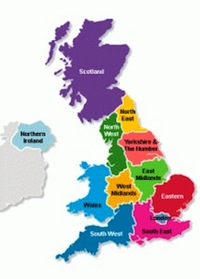
For administrative purposes, England is currently divided into nine regions. These are the populations, The South East 8.6 million. Greater London 8.1 million. North West 7 million. East of England 5.8. West Midlands 5.6 million. Yorkshire and Humberside 5.3 million. South West 5.3 million. East Midlands 4.5 million. North East 2.5 million. But how far do people operate within and identify with these regions? Perhaps an examination of traffic links could be used to give these potential federal units adjusted boundaries. Then there are other indicators of interconnections,  as shown in the above map of phone calls (also see here). It might be possible to roughly amalgamate some of those linked areas.
 UK federalism image

 A pattern of major amalgamation of the above regions could give us, say, three federal units for the UK.  There could be a Northern federal unit, run from say Manchester. The populations of the North West, North East, Yorkshire and Humberside coming to 14.9 million. Then there could be a Midland's federal unit run from say Birmingham. The populations of the East Midlands, West Midlands and the East of England coming to 15.9 million. The largest city in the remaining Southern federal unit (of 22 million) is London; although it might be worth looking for an alternative centre for its federal unit. For Lands End is almost as far away from London as Newcastle is. Again traffic flows/phone-links (etc) might lead to adjustments of the boundaries of such three federal units.

So it looks as if we are looking for between three and nine federal units within England, which have to make sense to their populations whilst advancing democratic participation and economic and social justice. Then what is proposed for the internal powers of each federal unit? How far can we find a fairly common pattern that will be acceptable to people of Scotland, Wales, Northern Ireland and the English Regions? How far will the federal powers need to be identical within each federal unit? Will these powers need to be guaranteed within a new written constitution? 

None of this can begin to be sorted out on the back of fag packet. We need (a) to pass greater powers to the Scottish Parliament as a consequence of referendum promises, (b) retain Scottish MPs powers at Westminster for the time being and (c) engage in a Constitutional Convention to help us establish a federal or federal-style solution. This will be no bad thing if it eventually comes to involve something of the degree of political participation which we have recently witnessed in Scotland - as long as it does not go over the top in the streets of Belfast.

1st October - Update : Another area to employ in seeking to establish regional identity in England, is regional television coverage. A map showing the areas used by the BBC can be found by scrawling down from this link. 

2nd October - Comment : This item has also appeared on the Web-site of Independent Labour Publications (ILP) who are the successors to the Independent Labour Party. See here. Barry Winter their former Secretary submitted them this following comment,which appears here at his suggestion. Thanks Barry.

 Harry’s thoughtful contribution clearly sets out the challenges facing any attempt to reform the UK on a more democratic, equitable and balanced basis. It will not be easy and, as yet, Labour is running scared of dealing with these issues. That’s partly understandable given the difficulties it faces but the issue is likely to become more pressing. It cannot be dodged indefinitely. Already new parties are being formed advocating the decentralisation of power.

Calling for devolution to city regions, as Labour has done, lacks one key element – the need for real democracy. Such deals between city leaders and business people fail to tackle the growing political crisis. Nor is much, as yet, being offered to those areas outside the city regions.

The party could help by starting a conversation both internally and externally about how to proceed. To be fair, it is taking some steps in that direction. But it needs to be a Big Conversation, reaching out into the wider society. It should involve more than submitting ideas to the centre. Party leaders should be coming to listen to party members. I recently attended my constituency party meeting where devolution was on the agenda. Half an hour was allocated to the discussion and the MP spoke for 20 minutes!

One leading question is how we can begin to deal with the mass hostility/disinterest in contemporary politics. As Colin Crouch wrote some time ago, we are living in what he calls a post-democracy. Democracy has been hijacked and increasingly centralised. Large corporate and financial interests, together with leading civil servants and Westminster politicians, shape politics. No wonder people feel cynical and that mood is not going to be easy to overcome. What can be said is that in Scotland, when people were given a tough political choice about their future, politics came alive.

                                                                              Barry Winter


Monday, August 11, 2014

50th Anniversary - Dronfield Contact Club


In 1962, the local Labour Party at Dronfield in Derbyshire commenced the publication of a printed magazine which was called "contact" (in small case). With a red cover, it came out roughly on a monthly basis and was printed in Derby. Amongst the copies I hold is the second edition, which was published in January 1963. It is a neat document. Its 20 pages were just 8 inches by 5. As  it was delivered door to door to the towns 3,000 homes, it attracted plenty of advertising. Almost half its pages were taken up with no less than 25 adverts. All but three of these were for local Dronfield services, such as Dunham's hairdressers on Dronfield's main Chesterfield Road.

Bill Gilbert wrote articles on Dronfield's past, but the magazine otherwise tended to concentrate on the prominent activities of the local Labour Party, the Dronfield Trades and Labour Council, the Dronfield Young Socialists and also on local government matters effecting the Derbyshire County Council and the Dronfield Urban District Council.  Whilst the later had operated since 1894, Labour had only first obtained a majority on the Council in 1958 and its initial breakthrough only lasted for a period of 18 months. Then Labour reclaimed control in 1962 - with the Contact Magazine emerging later in that year. By the 1964-5 session, Labour controlled the Council by 10 seats to the Conservatives 3.

The editorial board of the Contact Magazine was made up of five people - Brian Morgan, Arthur Smith, Norman Rutherford, Eric Chetwynd and Fred Machin. The majority of these served periods as local Labour Urban District Councillors.  In addition to their standard editorial work they were connected with (a) liason with the printers, (b) attracting and maintaining advertisers, (c) fund raising exercises, (d) seeing that the magazine was delivered to every home in Dronfield.

In addition to all these efforts helping to aid Labour's cause in Dronfield, there was a further spin off when Labour was at its peak in Dronfield.  This was the establishment in the town of what became a large and viable social club, appropriately named the "Contact Club".  The idea for the Club was first put forward by Bill Gilbert. At the time there was an Old Comrades Club in the High Street in Dronfield which had existed since the 1920s, but it was on its last legs. So in 1964, a deal was struck to take over its debts of £25 and establish a "new" Contact Club. The finances for the full transformation were provided by a loan of £100 from the North East Derbyshire Constituency Labour Party and the support of Wm. Stone's Brewery, who installed a bar and furnishings for the main room. Money was also collected and kept in a dried milk tin.

A prominent figure in these developments was Lou Howson. He was a local Labour District Councillor, who later became Secretary of the North East Derbyshire Constituency Labour Party and a Derbyshire County Councillor. In a letter written some ten years ago well after his return to Scotland, he wrote that initially a small group, including Bill Gilbert, Fred Broadhead and himself "set about patching the whole place up and installing central heating. We decorated throughout. We applied for a licence which came through about August 1964. We appointed a Committee and Eric Chetwyn was Membership Secretary and Entertainment Secretary. We recruited our first 40 odd members and opened for business on a Saturday night..(on what seems to have been 15 August)... Eric had booked a group for our first Sunday night. The sound reverberated around the town and we had to turn people away. Within a short time we had the maximum membership and began to search for new premises". Lou and Tom Staveley were the Club's original trustees. A position which, Graham Baxter, the leader of the North East Derbyshire Council now holds.


Within three years the Contact Club had moved to its present imposing site on Snape Hill Lane. It was a substantial venture. What achieved this massive transformation is explained in an article which appeared in "The New Contact" in Autumn 1972.  It states - "What had the Contact Club got at this stage to,plan a £30,000 venture? Money? Little or none. Expertise? A committee with two year's experience of running a small club on a shoestring. Not the most heartening of assets, so what decided them? Only an urge of a body of people to create a social centre using the most important asset of all; an abundance of energy and a social conscience".

As shown on a plaque in the entrance to the Contact Club, Manny Shinwell undertook the formal opening of the present site on 12 August, 1967. I was away teaching a Summer School at Coleg Harlech at the time and I missed that fine occasion. I was doubly sorry because I had known Manny well, as I originated from the area in County Durham which he represented in parliament. But although I was living in Sheffield at the time, I had had the good sense to join the Contact Club as it moved into its site on Snape Hill Lane. I regularly attended the Club's discussion meetings on a Sunday Morning which were held in the Lounge.

Within a couple of years Ann, Stephen (aged one) and myself had moved to Dronfield. The Contact Club was a major attraction. Over the years it served as a centre for May Day activities, public meetings, electoral organisation, plus Labour Party meetings and discussions. I currently organise the continuance of the later in the Committee Room, carrying on the tradition I first experienced on Sunday mornings 47 years ago. No one owes a greater debt than I do to the Contact Club for the considerable support it gave to me in my 18 years as its local MP.  So I fully wish the Club all the very best for its next 50 years.

Too many peoples names are missing from this tribute to the Contact Club, for it has always involved a collective activity. But at one time the Club was synonymous with the name of its long serving secretary, Harold Garbutt. His tradition is carried on today by Pete Honeybone.

The final word needs to go to Lou Howson. Ten years ago he wrote "At a meeting in Ayr a few years ago regarding the setting up of a Labour Club, a man stood up and advised that we go and visit the 'best Labour Club in Britain' in a place called Dronfield. I got an ego boost when I showed my life membership card".