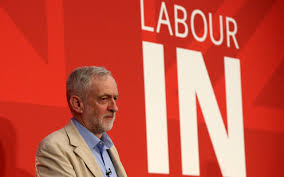
"The people of this country face a historic choice on 23
rd
June whether to remain part of the European Union, or to leave. I
welcome the fact that that decision is now in the hands of the British
people. Indeed, I voted to support a referendum in the last Parliament.
The move to hold this referendum may have been more about managing
divisions in the Conservative party. But it is now a crucial democratic
opportunity for people to have their say on our country’s future, and
the future of our continent as a whole.
The Labour Party is overwhelmingly for staying in because we believe
the European Union has brought: investment, jobs and protection for
workers, consumers and the environment, and offers the best chance of
meeting the challenges we face in the 21
st century. Labour is convinced that a vote to remain is in the best interests of the people of this country.
In the coming century, we face huge challenges, as a people, as a
continent and as a global community. How to deal with climate change.
How to address the overweening power of global corporations and ensure
they pay fair taxes. How to tackle cyber-crime and terrorism. How to
ensure we trade fairly and protect jobs and pay in an era of
globalisation. How to address the causes of the huge refugee movements
across the world, and how we adapt to a world where people everywhere
move more frequently to live, work and retire.
All these issues are serious and pressing, and self-evidently require
international co-operation. Collective international action through the
European Union is clearly going to be vital to meeting these
challenges. Britain will be stronger if we co-operate with our
neighbours in facing them together.
As Portugal’s new Socialist Prime Minister, Antonio Costa, has said:
‘in the face of all these crises around us. We must not divide Europe –
we must strengthen it.’
When the last referendum was held in 1975, Europe was divided by the
Cold War, and what later became the EU was a much smaller, purely
market-driven arrangement. Over the years I have been critical of many
decisions taken by the EU, and I remain critical of its shortcomings;
from its lack of democratic accountability to the institutional pressure
to deregulate or privatise public services.
So Europe needs to change. But that change can only come from working
with our allies in the EU. It’s perfectly possible to be critical and
still be convinced we need to remain a member.
I’ve even had a few differences with the direction the Labour Party’s
taken over the past few years but I have been sure that it was right to
stay a member some might say I’ve even managed to do something about
changing that direction.
In contrast to four decades ago, the EU of today brings together most
of the countries of Europe and has developed important employment,
environmental and consumer protections.
I have listened closely to the views of trade unions, environmental
groups, human rights organisations and of course to Labour Party members
and supporters, and fellow MPs. They are overwhelmingly convinced that
we can best make a positive difference by remaining in Europe.
Britain needs to stay in the EU as the best framework for trade, manufacturing and cooperation in 21
st
century Europe. Tens of billion pounds-worth of investment and millions
of jobs are linked to our relationship with the EU, the biggest market
in the world.
EU membership has guaranteed working people vital employment rights,
including four weeks’ paid holiday, maternity and paternity leave,
protections for agency workers and health and safety in the workplace.
Being in the EU has raised Britain’s environmental standards, from
beaches to air quality, and protected consumers from rip-off charges.
But we also need to make the case for reform in Europe – the reform
David Cameron’s Government has no interest in, but plenty of others
across Europe do.
That means democratic reform to make the EU more accountable to its
people. Economic reform to end to self-defeating austerity and put jobs
and sustainable growth at the centre of European policy, labour market
reform to strengthen and extend workers’ rights in a real social Europe.
And new rights for governments and elected authorities to support
public enterprise and halt the pressure to privatise services.
So the case I’m making is for ‘Remain – and Reform’ in Europe. Today is the Global Day of Action for Fast Food Rights. In the US
workers are demanding $15 an hour, in the UK £10 now. Labour is an
internationalist party and socialists have understood from the earliest
days of the labour movement that workers need to make common cause
across national borders.
Working together in Europe has led to significant gains for workers
here in Britain and Labour is determined to deliver further progressive
reform in 2020 the democratic Europe of social justice and workers’
rights that people throughout our continent want to see.
But real reform will mean making progressive alliances across the EU – something that the Conservatives will never do.
Take the crisis in the steel industry. It’s a global problem and a
challenge to many European governments. So why is it only the British
Government that has failed so comprehensively to act to save steel
production at home?
The European Commission proposed new tariffs on Chinese steel, but it
was the UK Government that blocked these co-ordinated efforts to stop
Chinese steel dumping.
Those proposals are still on the table. So today I ask David Cameron
and George Osborne to to start sticking up for British steel and work
with our willing European partners to secure its future. There are certainly problems about EU state aid rules, which need
reform. But if as the Leave side argues, it is the EU that is the main
problem, how is that Germany, Italy, France and Spain have all done so
much better at protecting their steel industries?
It is because those countries have acted within EU state aid rules to
support their industries; whether through taking a public stake,
investing in research and development, providing loan guarantees or
compensating for energy costs.
It is not the EU that is the problem, but a Conservative Government
here in Britain that doesn’t recognise the strategic importance of
steel, for our economy and for the jobs and skills in those communities.
The Conservative Government has blocked action on Chinese steel
dumping. It has cut investment in infrastructure that would have created
demand for more steel and had no procurement strategy to support
British steel.
A Labour government would have worked with our partners across Europe to stand up for steel production in Britain.
The European Union – 28 countries and 520 million people – could have
made us stronger, by defending our steel industries together. The
actions of the Conservative Government weakened us.
The jobs being created under this Government are too often low skill,
low pay and insecure jobs. If we harnessed Europe’s potential we could
be doing far more to defend high skill jobs in the steel industry.
And that goes for other employers of high skilled staff too – from
Airbus to Nissan – they have made it clear that their choice to invest
in Britain is strengthened by our membership of the European Union.
Of course the Conservatives are loyally committed to protecting one British industry in Europe – the tax avoidance industry.
The most telling revelation about our Prime Minister has not been
about his own tax affair, but that in 2013 he personally intervened with
the European Commission President to undermine an EU drive to reveal
the beneficiaries of offshore trusts, and even now, in the wake of the
Panama Papers, he still won’t act.
And on six different occasions since the beginning of last year
Conservative MEPs have voted down attempts to take action against tax
dodging.
Labour has allies across Europe prepared to take on this global
network of the corrupt and we will work with them to clamp down on those
determined to suck wealth out of our economies and the pockets of our
people.
On Tuesday, the EU announced a step forward on country-by-country
reporting. We believe we can go further. But even this modest measure
was opposed by Conservative MEPs last December.
Left to themselves, it is clear what the main Vote Leave vision is
for Britain to be the safe haven of choice for the ill-gotten gains of
every dodgy oligarch, dictator or rogue corporation. They believe this tiny global elite is what matters, not the rest of us, who they dismiss as “low achievers”.
Some argue that we need to leave the EU because the single market’s
rules are driving deregulation and privatisation. They certainly need
reform. But it was not the EU that privatised our railways. It was the
Conservative Government of John Major and many of our rail routes are
now run by other European nations’ publicly owned rail companies. They
haven’t made the mistake of asset stripping their own countries.
Labour is committed to bringing rail back into public ownership in
2020. And that is why Labour MEPs are opposing any element of the fourth
rail package, currently before the European Parliament, that might make
that more difficult.
The Transatlantic Trade and Investment Partnership is also a huge
cause for concern, but we defeated a similar proposal before in Europe,
together when it was called the Multilateral Agreement on Investment,
back in 1998.
Labour MEPs are rightly opposing the Investor-State Dispute Mechanism
opposing any attempt to enforce privatisation on our public services,
to reduce consumer rights, workplace protections or environmental
standards.
The free market enthusiasts in the Leave campaign would put all those
protections at risk. Labour is building alliances to safeguard them.
We must also put human rights at the centre of our trade agreements,
not as an optional add-on. We already have allies across Europe to do
that. And the EU is vital for promoting human rights at home. As a
result of EU directives and regulations, disabled people are protected
from discrimination. Lifts, cars and buses need to be accessible, as
does sea and air travel.
And it was the Labour Government that signed the Human Rights Act
into UK law that transferred power from government – not to Brussels –
but to individual citizens.
Climate change is the greatest threat that humanity faces this
century. And Britain cannot tackle it alone. We could have the best
policies possible but unless we act together internationally, it is
worthless. Labour brought in the Climate Change Act, John Prescott
played a key role in getting the Kyoto Protocols agreed. Labour has led
the debate within Europe.
But despite David Cameron pledging to lead the greenest Government
ever, Britain still lags far behind most of Europe in terms of renewable
energy production. We have much to learn from what Germany has done in
particular.
The Conservative Government has cut subsidies for solar power while
increasing subsidies for diesel. It has cut regulatory burdens on
fracking yet increased regulations on onshore wind. They say one thing,
but do another.
Again, it has been regulations agreed in Europe that have improved
Britain’s beaches and waterways and that are forcing us to tackle the
scandal of air pollution which will kill 500,000 people in Britain by
2025, unless we act.
Working together in the European Union is vital for tackling climate change and vital in protecting the environment we share.
No doubt debate about EU membership in the next couple of months will
focus strongly on jobs and migration. We live in an increasingly
globalised world. Many of us will study, work or even retire abroad at
some point in our lives.
Free movement has created opportunities for British people. There are
nearly three-quarters of a million British people living in Spain and
over two million living in the EU as a whole.
Learning abroad and working abroad, increases the opportunities and
skills of British people and migration brings benefits as well as
challenges at home.
But it’s only if there is government action to train enough skilled
workers to stop the exploitation of migrant labour to undercut wages and
invest in local services and housing in areas of rapid population
growth that they will be felt across the country.
And this Government has done nothing of the sort. Instead, its
failure to train enough skilled workers means we have become reliant on
migration to keep our economy functioning.
This is especially true of our NHS which depends on migrant nurses
and doctors to fill vacancies. This Government has failed to invest in
training, and its abolition of nurses’ bursaries, and its decision to
pick a fight with junior doctors is likely to make those shortages
worse.
As a former representative of NHS workers, I value our NHS and admire
the dedication of all its staff. It is Labour’s proudest creation. But
right now, it would be in even greater crisis if many on the Leave side
had their way. Some of whom have argued against the NHS and free
healthcare on demand in principle.
And of course it is EU regulations that that underpin many rights at
work, like holiday entitlement, maternity leave, rights to take breaks
and limits to how many hours we can work, and that have helped to
improve protection for agency workers.
The Tories and UKIP are on record as saying they would like to cut back EU-guaranteed workplace rights if they could.
A Labour government would instead strengthen rights at work making
common cause with our allies to raise employment standards throughout
Europe, to stop the undercutting of wages and conditions by unscrupulous
employers, to strengthen the protection of every worker in Europe.
Just imagine what the Tories would do to workers’ rights here in
Britain if we voted to leave the EU in June. They’d dump rights on equal
pay, working time, annual leave, for agency workers, and on maternity
pay as fast as they could get away with it. It would be a bonfire of
rights that Labour governments secured within the EU.
Not only that, it wouldn’t be a Labour government negotiating a
better settlement for working people with the EU. It would be a Tory
government, quite possibly led by Boris Johnson and backed by Nigel
Farage, that would negotiate the worst of all worlds: a free market
free-for-all shorn of rights and protections.
It is sometimes easier to blame the EU, or worse to blame foreigners,
than to face up to our own problems. At the head of which right now is a
Conservative Government that is failing the people of Britain.
There is nothing remotely patriotic about selling off our country and
our national assets to the highest bidder. Or in handing control of our
economy to City hedge-funds and tax-dodging corporations based in
offshore tax havens.
There is a strong socialist case for staying in the European Union.
Just as there is also a powerful socialist case for reform and
progressive change in Europe.
That is why we need a Labour government, to stand up – at the
European level – for industries and communities in Britain, to back
public ownership and public services, to protect and extend workers’
rights and to work with our allies to make both Britain and Europe work
better for working people.
Many people are still weighing up how they will vote in this
referendum. And I appeal to everyone, especially young people – who will
live longest with the consequences – to make sure you are registered
to vote. And vote to keep Britain in Europe this June. This is about
your future.
By working together across our continent, we can develop our
economies protect social and human rights, tackle climate change and
clamp down on tax dodgers.
You cannot build a better world unless you engage with the world,
build allies and deliver change. The EU, warts and all, has proved
itself to be a crucial international framework to do that. That is why I will be am backing Britain to remain in Europe and I hope you will too."







 The
Independent Working Class Education Network are holding their first
meeting on ‘The history and future of the Labour Party’ at Northern
College in Barnsley on Saturday 23 January.
The
Independent Working Class Education Network are holding their first
meeting on ‘The history and future of the Labour Party’ at Northern
College in Barnsley on Saturday 23 January.